

AP Syllabus focus: 'Static friction has a maximum value equal to the coefficient of static friction times the normal force. For the same surfaces, static friction is usually greater than kinetic friction.'
Static friction is often misunderstood because it does not automatically equal one fixed formula. For AP Physics C, the essential idea is that it adjusts as needed, but only up to a definite maximum.
The core relationship
The coefficient of static friction connects the interacting surfaces to the largest static friction force they can support before slipping begins.
Coefficient of static friction: A dimensionless constant, denoted , that gives the largest possible ratio of static friction to normal force for a particular pair of surfaces.
This coefficient depends on the nature and condition of the two surfaces in contact. It is not a force, and it has no units. A larger value of means the surfaces can sustain a larger friction force before motion starts.
The key AP result is the expression for the maximum static friction. This is the limiting value reached only when the object is on the verge of slipping.
= maximum static friction force, in newtons
= coefficient of static friction, unitless
= normal force, in newtons
A very important distinction follows from this equation: the actual static friction force is not always equal to .
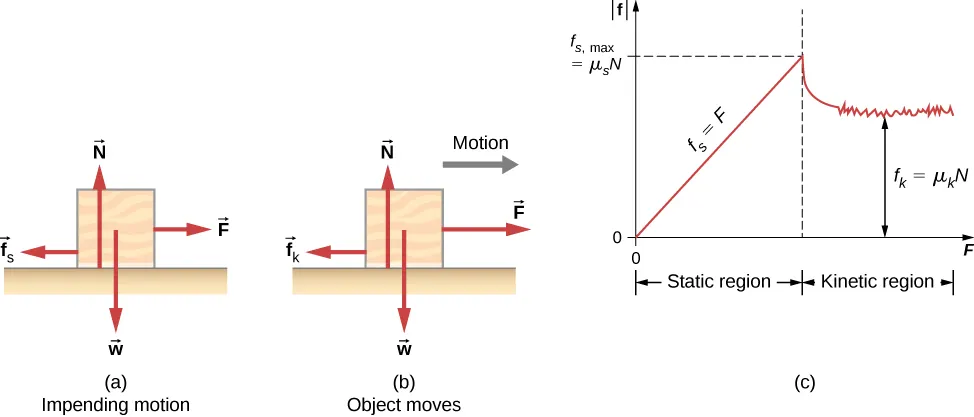
Static friction increases to match the applied force until it reaches the limiting value , after which slipping begins and the friction transitions to the lower kinetic level . The accompanying free-body diagrams reinforce that friction acts parallel to the surface and opposite the impending (or actual) motion. Source
Instead, static friction can take any value from zero up to that maximum, so . The formula above gives the ceiling, not the automatic value.
What “maximum” means physically
Static friction exists to prevent relative slipping between surfaces in contact. If some other force tries to make one surface slide across the other, static friction responds in the opposite direction and increases as needed.
That response continues only until the required friction reaches the largest possible value, . At that threshold:
the surfaces are just about to slip
static friction has reached its limiting magnitude
any further increase in the required friction will cause slipping to begin
This is why the phrase maximum static friction matters. It marks the boundary between two situations:
no slipping, where static friction can still adjust
impending slipping, where static friction has run out of available range
Students often make the mistake of substituting immediately whenever static friction appears in a problem. That is only valid at the instant just before motion begins, or when the problem clearly states the object is at the threshold of slipping.
If the object remains at rest and the applied force is smaller than the maximum possible static friction, then the static friction force simply matches whatever value is needed for equilibrium. In that case, the magnitude is less than .
Why the normal force matters
The equation shows that the maximum possible static friction increases in direct proportion to the normal force. If the normal force becomes larger, the limiting static friction becomes larger as well.
This dependence matters because the same surfaces can produce different maximum static friction forces in different physical situations. The coefficient may stay the same, while changes.
For that reason, when analyzing a problem, it is not enough to know the surfaces alone. You must also identify the normal force correctly. A common AP-level reasoning step is:
determine the normal force from the force situation
use that value in
compare the required friction to the maximum available friction
Only then can you decide whether static friction is sufficient to prevent slipping.
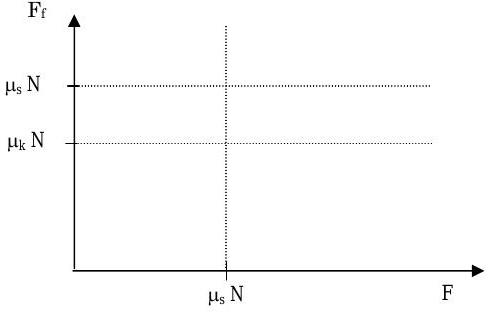
Schematic friction model showing the key reference levels (maximum available static friction) and (kinetic friction level once sliding occurs). Used alongside a force analysis, it highlights the decision step: compare the required friction to the threshold to determine whether slipping begins. Source
Comparing static and kinetic coefficients
For the same pair of surfaces, static friction is usually greater than kinetic friction, so AP problems typically use the comparison .
This comparison means that it usually takes more force to start motion than to maintain motion once sliding has begun. Physically, the surfaces can resist the onset of slipping more strongly than they resist motion after the contact points are already sliding past each other.
The word usually is important. These coefficients are determined experimentally, so the comparison is an empirical trend, not a mathematical necessity derived from first principles. In introductory AP Physics C contexts, however, you should generally expect the static coefficient to be larger for the same surfaces unless stated otherwise.
Do not compare coefficients for different surface pairs. A value of or only has meaning for the specific materials and surface conditions involved.
Common reasoning mistakes
Several errors appear repeatedly in friction problems involving this subtopic:
Assuming in every case.
The correct idea is that is the maximum possible static friction.Forgetting that static friction is self-adjusting.
Before the threshold of motion, its magnitude depends on what is required for equilibrium.Using before slipping starts.
The kinetic coefficient applies only after the surfaces are sliding relative to each other.Ignoring the phrase “for the same surfaces.”
The comparison is meant for one given pair of surfaces, not unrelated materials.Treating coefficients as forces or giving them units.
Both and are pure numbers.
FAQ
Because $\mu_s$ depends on the actual condition of the surfaces, not just the material names.
Small changes can matter:
dust or oil on the surface
oxidation or wear
surface roughness at the microscopic level
humidity and temperature
how long the surfaces have been in contact
In a real experiment, those factors can change from trial to trial, so the measured value is often an approximation rather than a perfectly fixed constant.
A common method is to raise the incline slowly until the object is just about to slide.
At that critical angle $\theta_c$:
the downhill component of weight is at the threshold of overcoming static friction
the coefficient can be found from $ \mu_s=\tan\theta_c $
This method is useful because it identifies the instant of impending motion directly, which is exactly when the maximum static friction relation applies.
In the standard model, the microscopic contact points change as the load changes.
If the apparent area is larger, the pressure is often lower. If the apparent area is smaller, the pressure is often higher. Those effects can offset one another, so the friction model is written in terms of $N$ rather than visible area.
That said, the model is an approximation. For soft materials, highly textured surfaces, or unusual conditions, the simple proportional rule may become less accurate.
Yes. In practice, that usually means you no longer have the “same surfaces” in the physical sense relevant to friction.
Surface condition can alter:
adhesion between contact points
how easily microscopic irregularities interlock
how the load is distributed across the contact region
So even if the bulk materials are still, for example, rubber and wood, the effective coefficient of static friction may differ noticeably after contamination, polishing, or moisture.
Before sliding begins, microscopic contact points can settle, interlock, and form stronger junctions while the surfaces remain still.
Once sliding starts:
many of those junctions are broken
the contact points do not remain aligned long enough to strengthen as much
the resisting force is typically lower
That is why the threshold for motion is often higher than the force needed during motion, leading to the usual result that $\mu_s$ exceeds $\mu_k$ for the same pair of surfaces.
Practice Questions
A block rests on a horizontal surface. The coefficient of static friction between the block and the surface is .
If the block has mass , determine the maximum static friction force. Then state whether a horizontal applied force of will make the block move.
1 mark for stating
1 mark for stating the block does not move because
A block is on a horizontal floor. The coefficients of friction are and .
(a) Calculate the maximum static friction force on the block.
(b) A horizontal force of is applied. Determine the friction force and state whether the block moves.
(c) Find the minimum horizontal force required to start the block moving.
(d) Once the block is sliding, determine the kinetic friction force. Briefly explain why this value differs from the answer to part (c).
Take .
(a)
1 mark for using
1 mark for
(b)
1 mark for stating friction force is opposite the applied force
1 mark for stating the block does not move because
(c)
1 mark for stating the minimum force to start motion is
(d)
1 mark for and for explaining that for the same surfaces, so less force is needed to keep the block sliding than to start it moving
