

AP Syllaibus focus: 'Static friction can act when surfaces are not moving relative to each other. It takes whatever value and direction are needed to prevent slipping or sliding.'
Static friction is subtle because it does not have one fixed value. Instead, it responds to a situation by preventing surfaces in contact from beginning to slide past one another.
Core idea
What static friction actually means
Static friction arises when two surfaces touch and there is a tendency for one to slip across the other, but no slipping actually occurs.
Static friction: A contact force parallel to the surfaces in contact that acts when those surfaces are not moving relative to each other and resists the tendency to slip.
The key idea is that static friction is preventive. It does not appear only after motion starts. It acts specifically to keep relative sliding from starting in the first place.
This makes static friction different from the common oversimplified picture that “friction just opposes motion.” For static friction, the more precise statement is that it opposes impending relative motion between the surfaces.
Relative motion is the important test
When deciding whether static friction is present, the important question is not simply “Is the object moving?” The correct question is “Are the two surfaces in contact moving relative to each other?”
Relative motion: Motion of one object or surface measured with respect to another object or surface.
An object can be moving and still experience static friction, as long as the contact surfaces are not sliding past each other. Likewise, an object can be at rest and still have static friction acting on it if slipping would occur without that force.
So the word static refers to the contact condition, not necessarily to the object's overall motion in a larger reference frame.
Direction of static friction
Opposite the slipping tendency
The direction of static friction is not fixed in advance. It depends on which way the surfaces would slip if static friction were absent.
If a block on a floor is pushed to the right but does not move, static friction on the block points to the left.
If a block rests on an incline and would otherwise slide down, static friction points up the incline.
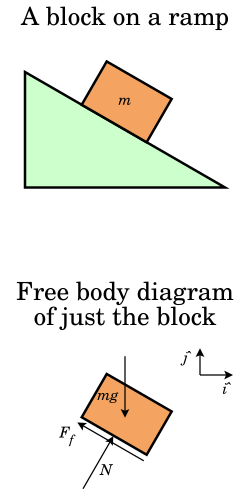
Free-body diagram of a block on an inclined plane showing , the normal force , and the friction force along the surface. This is a canonical setup for deciding the static-friction direction by imagining the slip that would occur if friction were absent. Source
If a surface beneath an object accelerates and carries the object along without slipping, static friction can point in the same direction as the object's motion.
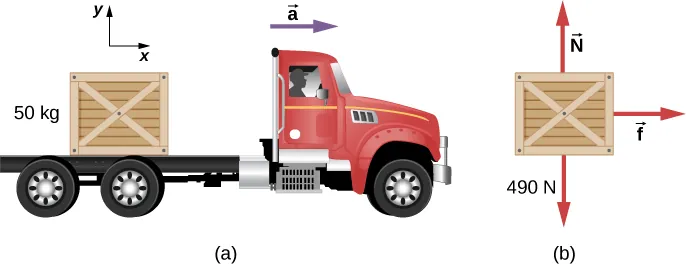
Diagram of a crate on an accelerating truck with the corresponding free-body diagram showing static friction acting forward. This concretely illustrates how static friction enforces the no-slip condition by providing the horizontal force needed for the crate’s acceleration. Source
This is why it is incorrect to say that static friction always points opposite the object's velocity. Static friction points opposite the relative slipping that is trying to happen at the contact.
A reliable way to choose the direction
A useful reasoning process is:
identify the two surfaces in contact
imagine what would happen if there were no static friction
determine which way one surface would move relative to the other
draw static friction opposite that relative slipping tendency
This method is more reliable than memorizing a direction rule, because the direction can change from one situation to another.
Magnitude of static friction
It adjusts to the situation
A central feature of static friction is that its magnitude is not preset. Instead, it takes whatever value is required to prevent slipping, as long as slipping has not yet begun.
That means static friction is a self-adjusting force. If only a small force is trying to cause slipping, then only a small static friction force is needed. If a larger force is trying to cause slipping, static friction becomes larger.
This also means static friction is sometimes zero. If nothing is trying to make the surfaces slide relative to each other, no static friction is required.
For example, a box resting on a horizontal floor with no horizontal push does not need static friction. The floor can provide it if needed, but in that situation there is no slipping tendency to resist.
Why students often make mistakes
A common mistake is to assume that whenever surfaces touch, a nonzero static friction force must be present. That is false. Static friction appears only when it is needed to prevent relative motion.
Another mistake is to assign a fixed friction value before analyzing the situation. For static friction, the correct approach is to determine what value is necessary to maintain no slipping.
Motion without slipping
Static friction can act even when an object moves
Static friction often appears in situations where the object is moving. What matters is that the contact surfaces move together at the point of contact.
Examples include:
a crate moving with a truck bed without sliding
a shoe gripping the ground during part of a step
a wheel rolling without skidding
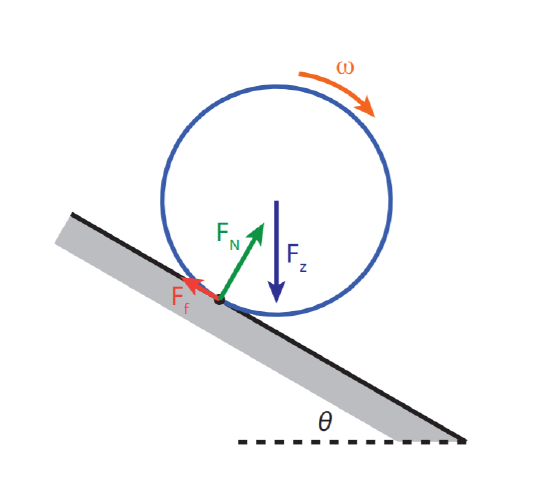
Free-body diagram of a cylinder rolling down an incline without slipping, with weight, normal force, and static friction labeled. It visually supports the idea that the friction direction is chosen to prevent relative sliding at the contact while providing the torque needed for rolling. Source
In all of these cases, static friction allows the surfaces to remain matched at the contact rather than sliding across each other.
This is an important conceptual point for AP Physics C: no slipping does not mean no motion. It means the surfaces in contact share the same motion at the contact.
Using static friction in analysis
Free-body diagrams and physical interpretation
In a free-body diagram, static friction is drawn parallel to the contact surface. Its direction should come from the slipping tendency, not from a memorized rule about whether the object is moving or at rest.
When analyzing a problem:
do not assume the direction blindly
think about the likely slipping tendency
let the conditions of no slipping determine the needed friction force
If you choose a direction and later find that your result would require the opposite direction, that does not mean the method failed. It means your original direction assumption should be reversed.
Common misconceptions
“If an object is at rest, static friction must be acting.”
Not always. Static friction acts only if needed to prevent slipping.
“Static friction always opposes motion.”
More accurately, it opposes the tendency for relative slipping between surfaces.
“Static friction has one standard value in a problem.”
No. It adjusts to whatever value is needed to keep the surfaces from sliding.
“No slipping means no horizontal force.”
False. A nonzero static friction force may be exactly what prevents the slipping.
Practice Questions
A block rests on a rough incline. If friction were absent, the block would slide down the incline. State the direction of the static friction force on the block and briefly explain why.
1 mark: States that static friction acts up the incline.
1 mark: Explains that static friction opposes the tendency to slip or the impending relative motion between the block and the incline.
A block of mass rests on the horizontal floor of a truck. The truck accelerates to the right with acceleration , and the block does not slip relative to the truck.
(a) State the direction of the static friction force on the block.
(b) Determine the magnitude of the static friction force on the block.
(c) Explain why static friction is needed in this situation even though the block and truck remain in contact without slipping.
(d) If the truck later moves at constant velocity on a level road and the block still does not slip, what is the static friction force on the block?
(a) 1 mark: States that static friction on the block acts to the right.
(a) 1 mark: Explains that without friction the block would lag behind relative to the truck bed, so friction must prevent that slipping.
(b) 1 mark: Recognizes that the only horizontal force on the block is static friction.
(b) 1 mark: Applies Newton’s second law in the horizontal direction.
(b) 1 mark: Correctly concludes that .
(c) or (d) 1 mark: Explains that static friction provides the horizontal force needed to make the block share the truck’s acceleration, and states that at constant velocity on a level road the static friction force is .
FAQ
Static friction comes from electromagnetic interactions between the atoms and molecules at the surfaces in contact.
Real surfaces are not perfectly smooth. Their tiny high points deform and interlock, and the electron clouds in the materials resist being forced past one another.
Because of this, static friction is not a separate “substance-like” force. It is the macroscopic result of many small contact interactions spread across the contact region.
Yes, depending on the situation and the reference frame.
For a rolling wheel on a stationary road, static friction often does no work on the wheel because the point of contact is instantaneously at rest relative to the road.
In other cases, such as an object being accelerated by a moving belt, static friction can transfer energy and do work on the object without any slipping occurring.
So the statement “static friction never does work” is too simplistic.
Traction depends on the tyre gripping the road without sliding across it.
When a car accelerates, brakes, or turns, the tyre must push on the road while the road pushes back on the tyre through static friction. That is what allows controlled motion.
If the tyre begins to slide, the contact is no longer governed by static friction alone, and control is usually reduced. Good traction therefore means maintaining contact without slipping.
In real systems, static friction acts across a contact area, not at a single mathematical point.
Different parts of that area can experience slightly different local forces depending on deformation, pressure, and material properties.
In many AP Physics C problems, this distributed interaction is simplified into one effective friction force in the free-body diagram. That model is very useful, but the actual physical interaction is spread over the contact patch.
Static friction can prevent slipping only while the surfaces can still maintain grip.
If the required tangential force becomes too large, or if the surfaces are disturbed by vibration, contamination, wear, or deformation, the contact can no longer sustain the no-slip condition.
At that point, slipping begins. The transition can be abrupt, which is why objects sometimes seem to “stick” and then suddenly move. This stick-slip behaviour is common in real mechanical systems.
