

AP Syllabus focus: 'The normal force is the perpendicular force exerted by a surface on an object in contact with it, directed away from the surface.'
In friction questions, the hardest step is often not the friction law itself but identifying the contact geometry correctly, because the normal force depends on the surface and on all forces perpendicular to it.
Understanding the normal force
The normal force is the contact force a surface exerts on an object touching it. Its direction is set by the surface itself, not by gravity or by the page orientation.
Normal force: The contact force exerted by a surface on an object, perpendicular to the surface and directed away from it.
A floor pushes upward, a wall pushes horizontally, and an incline pushes at right angles to the plane. This means the normal force is not always vertical and is not always equal to the object's weight. Its direction changes whenever the surface orientation changes.
The normal force exists only while the object remains in contact with the surface. If contact is lost, the normal force immediately becomes zero. In friction problems, that idea matters because friction also requires contact. No contact means no surface force and therefore no friction force from that surface.
Why it matters in friction problems
In many mechanics problems, friction cannot be determined until the normal force is known. The normal force measures how strongly the surfaces are pressing against each other, so it is often the first quantity that must be found from the force balance.
A common mistake is to assume that the normal force is a simple geometric fact of the situation. It is not. The surface provides whatever perpendicular force is required by the motion constraints. If extra forces press the object harder into the surface, the normal force increases. If other forces partly lift the object away from the surface, the normal force decreases.
Because of this, the same block can have different normal forces on the same surface depending on how it is pushed, pulled, or accelerated.
Finding the normal force with Newton's laws
The most reliable method is to start with a free-body diagram and choose axes that match the contact surface:
one axis perpendicular to the surface
one axis parallel to the surface
This separates the contact question from the motion along the surface. The normal force is found from Newton's second law in the perpendicular direction.
= net force perpendicular to the contact surface, N
= mass of the object, kg
= acceleration perpendicular to the contact surface,
If the object does not accelerate into or away from the surface, then . In that case, the perpendicular forces must balance, and the normal force is obtained by solving that balance. This is the central step in most friction problems involving surfaces.
Horizontal surfaces
For an object on a horizontal surface, the normal force equals the weight only in a limited situation: the object has no vertical acceleration and no other vertical forces act. Under those conditions, the surface pushes up just enough to balance gravity.
That result changes as soon as an additional vertical component appears. A downward push increases the normal force because the surface must support both the weight and the extra downward effect. An upward pull reduces the normal force because the surface no longer needs to provide as much support.
So, the statement is sometimes true, but it is never a rule that applies automatically.
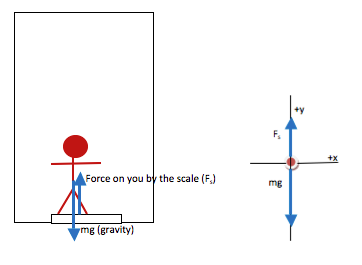
Free-body diagram for a person standing on a scale, showing the upward normal/contact force from the scale () and the downward weight (). Because Newton’s second law applies to the vertical forces, the diagram supports cases where when the person/elevator has nonzero vertical acceleration. Source
Inclined surfaces
On an incline, the best coordinate choice is almost always one axis perpendicular to the plane and one axis along the plane.
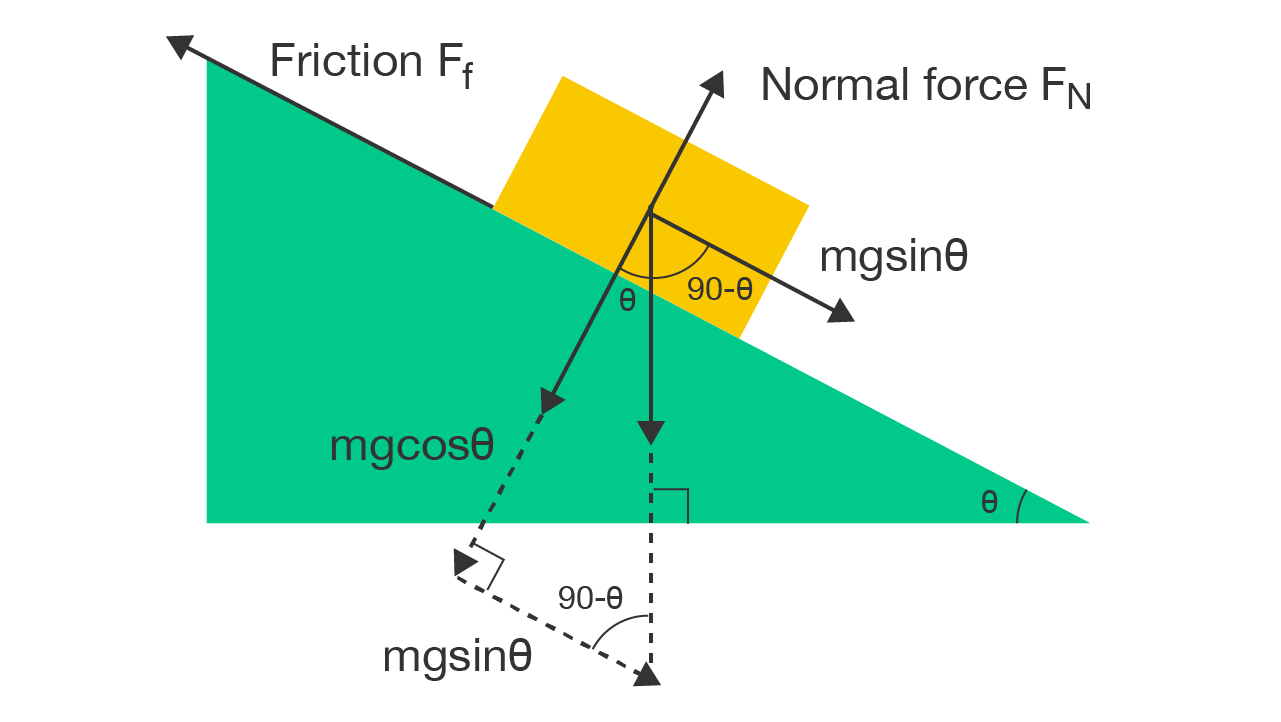
Free-body diagram for a block on an incline showing the normal force perpendicular to the plane and the weight resolved into (into the plane) and (down the plane). This visualization makes it clear why the perpendicular equation typically gives when there is no acceleration into/away from the surface. Source
Weight is then resolved into components relative to the surface. The component perpendicular to the plane is , where is the incline angle.
If there are no other forces with perpendicular components and the object remains in contact with the plane, the normal force balances that perpendicular component. In that common situation, the normal force is smaller than the full weight.
Additional applied forces can change the result. A force directed partly into the plane increases the normal force. A force directed partly away from the plane decreases it. The normal force responds only to the perpendicular components of forces, not to their full magnitudes.
Subtle points and common errors
Several ideas help prevent mistakes in friction problems:
Do not assume the normal force is always equal to weight. That fails on inclines and whenever extra forces act.
Do not draw the normal force vertically unless the surface is horizontal. The correct direction is perpendicular to the surface.
Do not use parallel force components when solving for the normal force. Only perpendicular components belong in the perpendicular force equation.
Do not forget that losing contact makes the normal force zero. If the surface no longer touches the object, it cannot exert a normal force.
Do not combine different contacts into one force automatically. If an object touches more than one surface, each surface can exert its own normal force.
Another useful check is physical reasoning: if a situation presses surfaces together more strongly, the normal force should increase; if it tends to separate them, the normal force should decrease.
FAQ
The normal force is actually distributed across the contact area, not concentrated at a single mathematical point.
In a particle model, it is often drawn as a single force for simplicity. In a more realistic rigid-body model, the resultant normal force acts through the centre of pressure, which can be away from the centre of mass.
On a curved surface, the normal force is always perpendicular to the surface at the specific point of contact.
That means its direction changes from point to point as the object moves. On a track or loop, you must use the local surface direction, not a single fixed direction for the whole motion.
Usually, on a fixed rigid surface, the normal force does no work because the object's displacement is tangent to the surface, making the angle between force and displacement $90^\circ$.
However, it can do work if the surface itself moves or if the object has displacement in the normal direction. So the statement “the normal force never does work” is too absolute.
Pressure describes how contact force is spread over an area. The normal force is the net result of many microscopic contact forces across that area.
In a continuous model, the total normal force can be written as $N=\int p\ dA$, where $p$ is the pressure distribution. If the pressure is uneven, the resultant normal force may not act through the geometric centre of the contact area.
If only part of an object touches the surface, the total normal force comes only from that smaller contact region.
The magnitude may still be large, but the pressure is usually greater because the same support may be provided over less area. In tipping situations, the line of action of the normal force can shift significantly even before contact is completely lost.
Practice Questions
A block of mass rests on a rough incline of angle . The block remains in contact with the incline. Determine the magnitude of the normal force from the incline on the block. [2 marks]
1 mark: Resolves the weight into a component perpendicular to the surface, .
1 mark: States the normal force magnitude is .
A box of mass is pulled across a rough horizontal floor by a force of magnitude applied at an angle above the horizontal. The box does not accelerate vertically. (a) Derive an expression for the normal force. (b) The coefficient of kinetic friction is . Write an expression for the kinetic friction force. (c) Explain how increasing while keeping constant changes the normal force and the kinetic friction force. [5 marks]
1 mark: Identifies the vertical forces as , , and .
1 mark: Applies vertical force balance, .
1 mark: Solves for .
1 mark: Writes .
1 mark: States that increasing increases , so decreases and the kinetic friction force decreases.
