

AP Syllabus focus: 'Hooke's law gives the spring force, which is directed toward the equilibrium position of the object-spring system.'
Springs are modeled in AP Physics C as sources of restoring force. The key idea is not just the size of the force, but also that it points back toward a special reference position.
Hooke's Law
For an ideal spring, the force it exerts changes in direct proportion to how far the attached object is displaced from a reference position. This proportional relationship is called Hooke's law. In AP Physics C, this law is used to connect an object's displacement to the force the spring exerts on it. A larger displacement produces a larger spring force, and a larger spring constant means the spring is stiffer, so the same displacement produces a stronger force.
The most important reference position is the equilibrium position.
Equilibrium position: The position of the object-spring system at which the object can remain at rest; if the object is displaced, the spring force points back toward that position.
In one dimension, Hooke's law is written with a sign convention that combines magnitude and direction in a single equation.
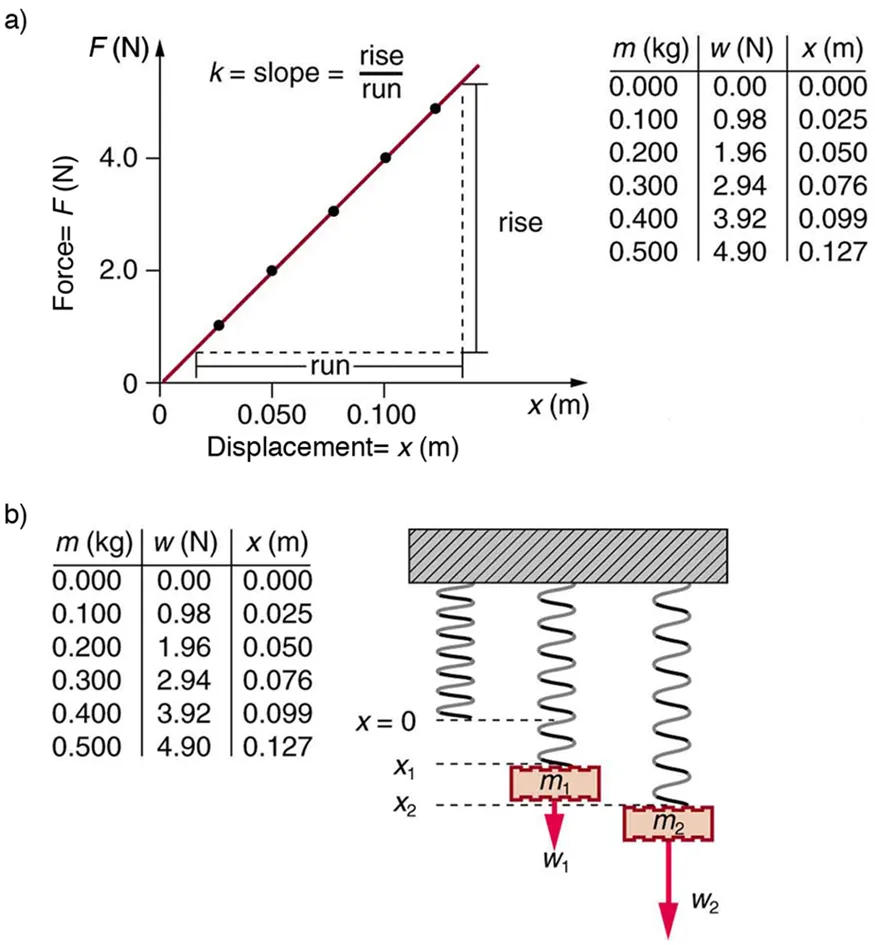
A force–displacement graph for a Hooke’s-law spring showing a straight-line relationship between restoring force magnitude and displacement; the slope corresponds to the spring constant . The paired measurement diagram (weights producing different displacements) connects the abstract graph to an experimental setup for determining . Source
= spring force exerted by the spring, in newtons
= spring constant, in newtons per meter
= displacement from equilibrium, in meters
This equation is compact, but it carries two ideas at once. First, the magnitude of the spring force is proportional to the distance from equilibrium, so . Second, the minus sign tells you that the spring force points opposite the displacement chosen as positive. The equation therefore describes a restoring force: whenever the object moves away from equilibrium, the spring force acts to bring it back.
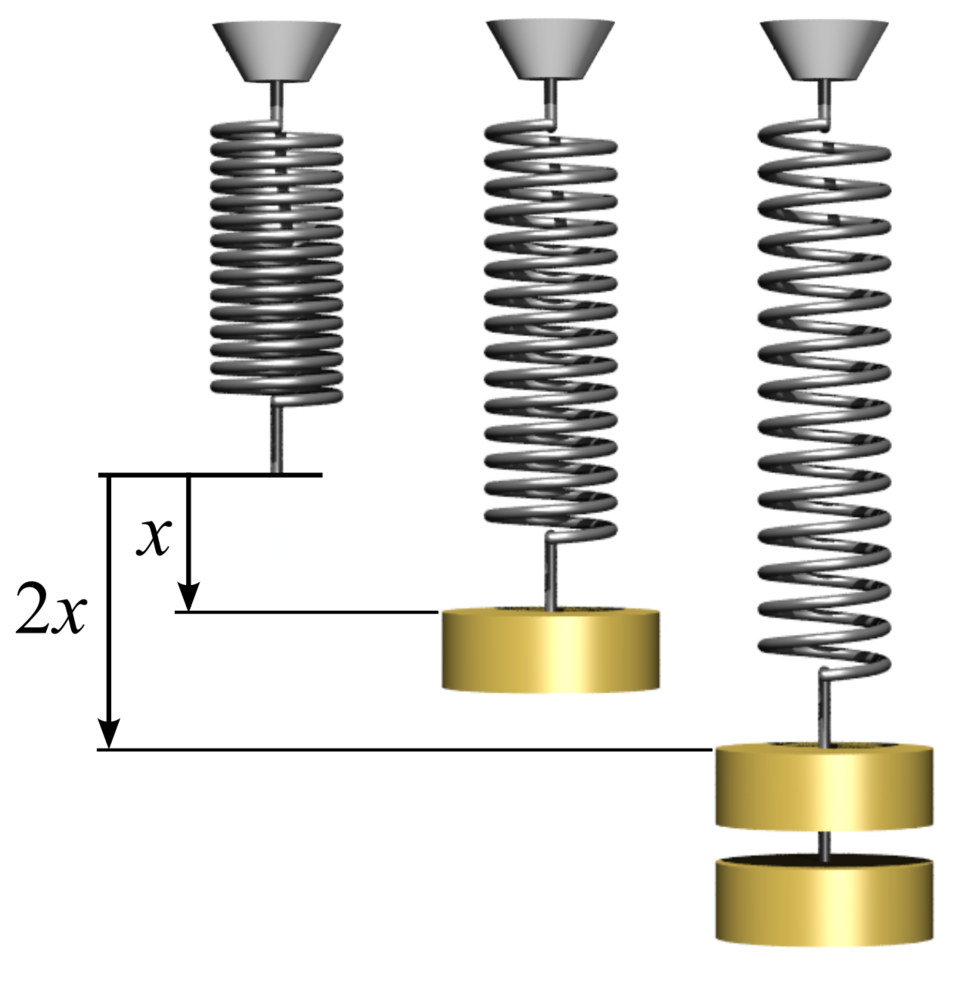
A labeled spring–mass diagram illustrating Hooke’s law in a physically intuitive way: stretching vs. compression correspond to opposite signs of displacement, and the spring force reverses direction to point back toward equilibrium. This directly supports the interpretation of as a restoring force, with the minus sign encoding direction. Source
Direction of the Spring Force
A spring force acts along the length of the spring. It does not point in the direction the object is moving unless that happens to be along the spring and toward equilibrium. This is important because students sometimes confuse spring force with drag or friction. A spring force is not determined by velocity. Instead, it is determined by displacement from equilibrium.
If the object is attached to a horizontal spring and the positive -direction is to the right, the force direction follows directly from the sign of .
Reading the Minus Sign
If the object is pulled to the right, then . Hooke's law gives , so the spring force points to the left, back toward equilibrium.
If the object is pushed to the left, then . Hooke's law gives , so the spring force points to the right, again back toward equilibrium.
If the object is exactly at equilibrium, then and the spring force is zero in this coordinate choice.
The sign of the force is not a separate extra detail added after the calculation. It is part of the physics. A positive force points in the positive coordinate direction; a negative force points in the negative coordinate direction. As long as the coordinate axis is chosen consistently, Hooke's law automatically gives the correct direction.
What "Toward Equilibrium" Means
The phrase toward equilibrium is the central physical meaning of Hooke's law. If the object is displaced on one side of equilibrium, the spring pulls or pushes it back. If the object is displaced on the other side, the spring reverses direction and still points back. This is why spring forces are called restoring forces: they oppose the displacement, not necessarily the motion.
That distinction matters. An object can be moving to the right while the spring force also points to the right, provided the object is left of equilibrium and moving toward it. Likewise, an object can be moving to the left while the spring force points left if the object is right of equilibrium and moving toward it. The spring force depends on position, not on whether the speed is increasing or decreasing at that moment.
A spring can therefore do either of two macroscopic things:
pull an object when the spring is stretched
push an object when the spring is compressed
In both cases, the direction is still toward equilibrium. This makes spring problems highly structured: identify the equilibrium position, define a coordinate axis, assign the sign of the displacement, and then apply Hooke's law.
Common AP Physics C Mistakes
One common mistake is using the spring force magnitude without treating as a signed quantity. If the sign is ignored, the direction must be restored separately, and students often reverse it.
Another mistake is saying the spring force is always opposite the object's motion. That is false. The spring force is opposite the displacement from equilibrium.
A third mistake is forgetting that the coordinate choice matters. If positive is chosen to the left instead of the right, the signs of both and change consistently, but the physical direction of the force does not.
Finally, students sometimes treat equilibrium as just a place where the object momentarily stops. That is not the correct idea. Equilibrium position is defined by the force relationship of the system, and Hooke's law describes how the spring force behaves when the object is displaced away from that position.
FAQ
For a real spring, the force-displacement graph is only nearly linear over part of its range.
For small deformations, the spring’s internal structure responds elastically, so force is roughly proportional to displacement.
For large deformations, coils may touch, the material may begin to yield, or the restoring behaviour may become nonlinear.
Once that happens, a single constant $k$ no longer describes the spring accurately.
$k$ depends on both material and geometry.
Stiffer materials usually increase $k$.
Thicker wire usually increases $k$.
Larger coil diameter usually decreases $k$.
More active turns usually decrease $k$.
So two springs made of the same metal can have very different $k$ values if their shapes differ.
One common method is static.
Apply several known forces.
Measure the corresponding extensions or compressions.
Plot force against displacement.
If the graph is straight, the gradient gives $k$.
A second method is dynamic, using oscillations, but the static method shows Hooke's law most directly because it compares force and displacement without needing time measurements.
Motion is not required. A spring force comes from deformation.
When a spring is stretched or compressed, its atoms are displaced slightly from their preferred spacing. Electromagnetic interactions inside the material then create an internal restoring force. That macroscopic force can act continuously even in a completely static situation.
So a spring can pull or push while every visible part of the system is momentarily at rest.
No.
The relaxed length is the length of the spring when it is neither stretched nor compressed. The equilibrium position depends on the whole object-spring arrangement and on any other forces acting.
For a horizontal spring with no other horizontal forces, the two often coincide.
For other arrangements, they can differ, so it is important to identify which reference point the problem is using.
Practice Questions
A block on a frictionless horizontal surface is attached to a spring. The spring constant is N/m, and the block is displaced m to the right of equilibrium. Taking right as positive, determine the spring force on the block.
1 mark: Uses Hooke's law,
1 mark: N, or states the force is N to the left
A block attached to a spring moves on a frictionless horizontal track. The spring constant is N/m. The coordinate is measured from equilibrium, with positive to the right.
(a) Write an expression for the spring force as a function of .
(b) Determine the spring force when m. State magnitude and direction.
(c) Determine the spring force when m. State magnitude and direction.
(a) 1 mark: Writes or
(b) 1 mark: Correct substitution into Hooke's law
(b) 1 mark: N, or N to the left
(c) 1 mark: Correct substitution into Hooke's law
(c) 1 mark: N, or N to the right
