

AP Syllabus focus: 'An ideal spring has negligible mass and exerts a force proportional to its displacement from relaxed length. A nonideal spring has mass or does not follow this proportional relationship.'
Springs are often represented by simplified models in mechanics. For AP Physics C, you must recognize when the ideal spring approximation is justified and when a real spring must be treated as nonideal.
Understanding the spring model
A spring in mechanics is any deformable object that changes length when a force is applied and then exerts a force in response. The reference length for that behavior is its relaxed length.
Relaxed length: The length of a spring when it is neither stretched nor compressed.
Displacement is measured from the relaxed length. If a spring is stretched or compressed by an amount , that is the quantity compared with the force the spring exerts. For this subtopic, the key question is whether the force magnitude changes in direct proportion to and whether the spring's own mass can be ignored.
Ideal spring
The standard AP model is the ideal spring.
Ideal spring: A spring model with negligible mass whose force magnitude is proportional to its displacement from relaxed length.
This definition contains two separate assumptions. First, the spring has negligible mass, meaning its mass is small enough to ignore in the mechanics model. Second, the force-displacement relationship is linear. That means equal increases in displacement produce equal increases in force magnitude. If the displacement doubles, the force magnitude doubles as well.
The linear spring model can be written as follows.
= magnitude of spring force,
= spring constant,
= displacement from relaxed length,
In this model, the spring constant measures stiffness. A larger means a larger force magnitude is associated with the same displacement. For an ideal spring, a graph of versus is a straight line through the origin, and the slope is constant.
The same constant describes the spring throughout the range where the ideal model applies.
Why negligible mass matters
Ignoring spring mass is not just a convenience; it changes how the system is analyzed. If the spring is treated as massless, the model does not need separate equations for different parts of the spring. The spring is described only by its displacement from relaxed length and its spring constant.
This assumption is often reasonable when the spring is much lighter than the objects attached to it. In that situation, the spring's inertia contributes very little to the motion of the system. The model then captures the most important physics with minimal complexity, which is why ideal springs appear so frequently in introductory mechanics and AP problems.
If the spring's mass is not negligible, different parts of the spring can have different motions during stretching or compression.
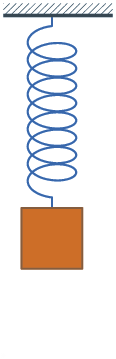
Diagram of a vertical spring–mass system used when the spring’s own mass is not negligible. In a massive spring, different segments can have different speeds, motivating the idea of an effective spring mass when modeling the system’s dynamics. Source
Then the spring is no longer fully represented by a single constant and a single displacement measurement.
Nonideal springs
A real spring may fail one or both assumptions of the ideal model. Such a spring is a nonideal spring.
Nonideal spring: A spring that has significant mass, does not maintain a force proportional to displacement, or both.
Many real springs are only approximately ideal. They may behave linearly for small deformations but not for large ones. In that case, the ideal model is useful only over a limited range. Outside that range, no single constant slope describes the entire force-displacement graph.
Common signs of nonideal behavior include:
the force-displacement graph curves instead of forming a straight line
the slope of the graph changes as displacement changes
the spring's mass is large enough to affect the system's motion
stretching or compression changes the spring so that later measurements no longer follow the same proportional pattern
A nonideal spring can still be analyzed, but it requires a more detailed model. Sometimes the force must be given by a different mathematical function of displacement. In other cases, the spring's mass must be included as part of the system's inertia. The main point is that the simple ideal-spring approximation is no longer exact.
Recognizing the correct model in AP Physics C
When a problem involves a spring, first decide whether the spring should be treated as ideal. In AP Physics C, that decision usually depends on the wording of the problem and the physical evidence provided.
Look for these cues:
Ideal spring or light spring usually means the spring's mass is negligible and the linear model should be used.
A straight-line force-displacement relationship supports the ideal approximation.
Information about substantial spring mass or a curved force-displacement graph indicates a nonideal spring.
In free-response and multiple-choice settings, model choice determines what equations are valid. If the spring is ideal, the force can be related directly to displacement with one constant . If the spring is nonideal, additional information about the spring's mass or a different force law is needed before the mechanics can be modeled correctly.
FAQ
For small changes in length, the internal forces in the material are often approximately linear. That makes the force roughly proportional to displacement, which matches the ideal-spring model.
For larger deformations, the material response becomes more complicated. The spring may stiffen, soften, or even deform permanently, so the straight-line relationship no longer holds.
No. The material matters, but the spring’s geometry matters as well.
Important factors include:
wire thickness
coil diameter
number of turns
overall shape
how the spring is manufactured
Two springs made from the same material can therefore have very different values of $k$.
Temperature can change the material’s elastic properties, so the spring constant may shift slightly as the spring gets hotter or colder.
In careful measurements, temperature can also affect the relaxed length and increase unwanted effects such as internal damping. That means a spring that looks nearly ideal in one environment may be less reliable in another.
Hysteresis means the spring follows a different force-displacement path when unloading than when loading.
This matters because:
the behaviour is not perfectly reversible
some energy is dissipated internally
one simple proportional rule may not describe the motion well
An ideal spring would not show hysteresis.
In compression, a coiled spring can reach coil bind, where adjacent coils touch. Once that happens, the effective stiffness can change sharply.
A long, slender spring can also buckle sideways instead of compressing neatly along one line. In either case, the spring no longer follows the simple ideal model, even if it behaved linearly at smaller deformations.
Practice Questions
State the two defining features of an ideal spring in AP Physics C Mechanics.
1 mark: States that the spring has negligible mass.
1 mark: States that the force magnitude is proportional to displacement from relaxed length.
A spring is tested by measuring the magnitude of the force it exerts for different displacements from relaxed length. The data are:
The spring has mass and is attached to a block of mass .
(a) Determine whether the spring behaves ideally over the first three measurements.
(b) Determine the spring constant over that range.
(c) State two reasons the spring should not be treated as ideal for the entire situation.
Mark scheme:
1 mark: Correctly states that the first three measurements are consistent with ideal behaviour because is constant.
1 mark: Uses .
1 mark: Calculates .
1 mark: States that the fourth data point does not follow the same proportional relationship, so the spring is not linear over the full range.
1 mark: States that the spring mass is not negligible compared with the block, so the spring is nonideal.
