

AP Syllabus focus: 'For springs in series, the reciprocal of the equivalent spring constant equals the sum of the reciprocals of the individual spring constants. The equivalent constant is smaller than the smallest spring constant.'
A series combination of springs behaves more flexibly than any individual spring. The key idea is that each spring shares the same force, while their extensions add to produce a larger total stretch.
What a series arrangement means
When springs are connected end-to-end and the same pull or push is transmitted through the chain, they are in series.
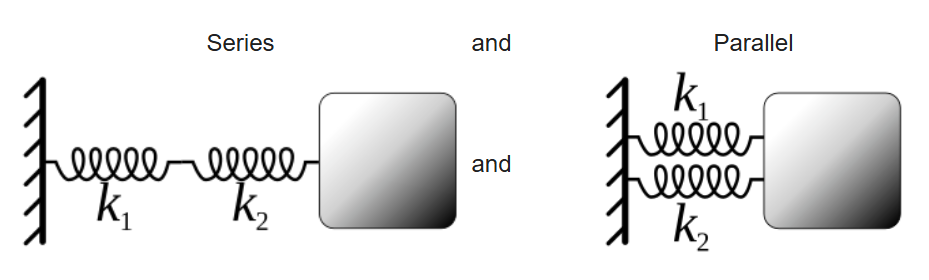
Two springs in series transmit the same tension through the chain, so each spring experiences the same force magnitude. The total elongation is the sum of the individual elongations, , which is why the series combination is more compliant than either spring alone. Source
The full arrangement can often be replaced by one imaginary spring that gives the same overall extension for the same applied force.
Springs in series: A spring arrangement in which springs are connected one after another so that the same force acts through each spring and the total extension is the sum of the individual extensions.
This model is useful because it lets you describe several springs with one equivalent spring constant .
Why the force is the same in each spring
Suppose several springs are attached in one straight chain and an external force is applied at the ends. Each spring must transmit that interaction to the next spring. Because the springs are connected one after another, the force carried through the chain is the same in every spring.
This does not mean each spring stretches by the same amount. A less stiff spring extends more under the same force, while a stiffer spring extends less. In a series arrangement, equal force and unequal extension are often linked ideas.
The total extension of the combination is found by adding all the individual extensions. That additive stretching is why a series combination is always less stiff than any single spring by itself.
Deriving the equivalent spring constant
Let the applied force be , and let the total extension of the full combination be . If the individual extensions are , , and so on, then two facts define the series arrangement:
the same force acts in each spring
the total extension is
For linear springs, each extension is inversely related to the spring constant, so , , and similarly for the rest.
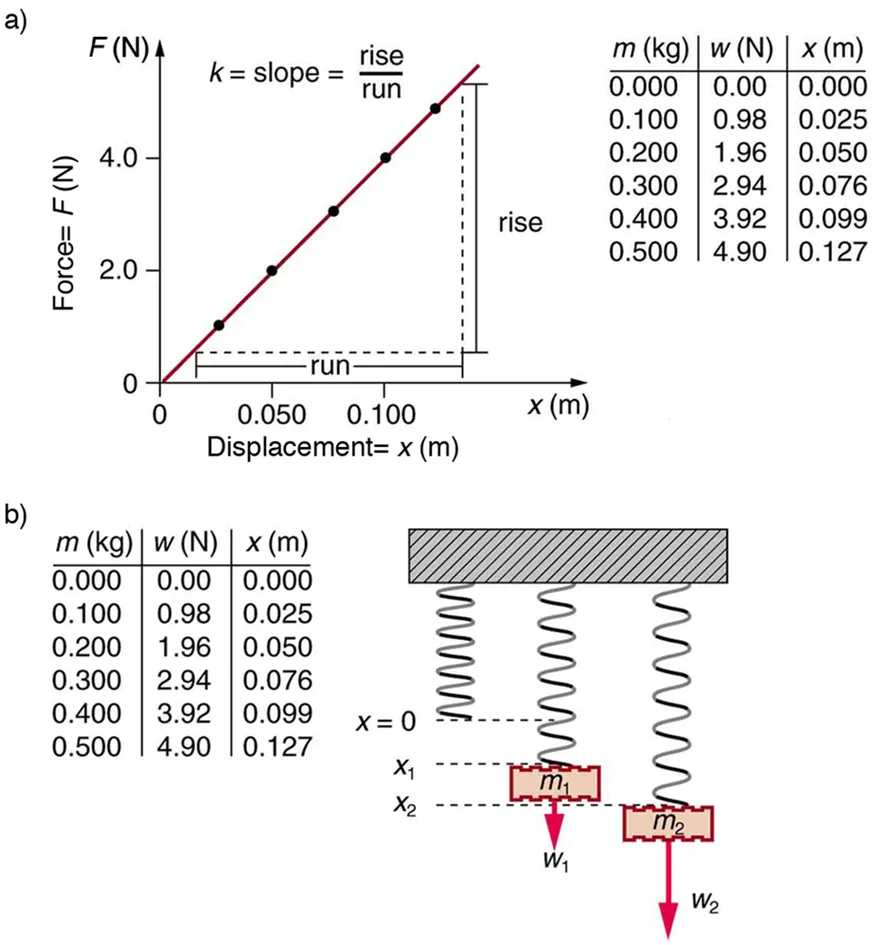
A Hooke’s-law plot of restoring force magnitude versus displacement is linear, so the slope of the straight line corresponds to the spring constant . Reading as a slope makes the inverse relationship visually intuitive: a smaller slope (smaller ) produces a larger displacement for the same applied force. Source
If one equivalent spring replaces the whole chain, then its extension under the same force is .
Substituting the individual extensions into the total extension gives the standard series result.
= equivalent spring constant of the full series combination, in
= individual spring constants, each in
= number of springs in series
This is the key equation for the topic. In series, the reciprocals add, not the spring constants themselves.
For two springs, the reciprocal form can be rewritten into a compact expression that is often quicker to use.
= equivalent spring constant of two springs in series, in
= spring constants of the individual springs, in
This algebraic form is convenient, but the reciprocal form makes the physical pattern clearer and works immediately for any number of springs.
Why the equivalent constant is smaller
The syllabus specifically states that the equivalent constant for springs in series is smaller than the smallest individual spring constant. That is a physical consequence of how the system deforms.
Under one applied force, every spring in the chain stretches. Since the total extension is the sum of all those individual extensions, the full arrangement extends more than any one spring alone would extend under that same force. A larger extension for the same force means a smaller effective stiffness.
Several useful consequences follow:
Adding another spring in series always decreases .
The combination is easier to stretch than any single spring in it.
If one spring is much softer than the others, it strongly affects .
The equivalent constant is pulled downward by the smallest spring constant.
If all springs are identical, each with spring constant , the result simplifies further.
= spring constant of each identical spring, in
= number of identical springs in series
So two identical springs in series behave like one spring with half the stiffness, and three identical springs behave like one spring with one-third the stiffness.
Using the idea correctly
Several common mistakes appear in series-spring questions:
Do not add spring constants directly. That does not describe a series arrangement.
Do not assume equal extensions unless the springs are identical.
Keep force and extension separate. In series, the force is the same in each spring, but the extensions add.
Check the size of your answer. If your final is not smaller than the smallest individual , the result is inconsistent with the physics.
Use consistent units before substituting values.
The series model is most appropriate when the springs act along the same line and each spring is well described by a constant stiffness over the displacement considered. In AP Physics C Mechanics, the goal is to recognize the arrangement, apply the reciprocal rule correctly, and connect the algebra to the physical meaning of a less stiff combined system.
FAQ
For the static equivalent spring constant, no. The expression for $k_{eq}$ depends only on the reciprocal sum, so swapping the positions of the springs does not change the result.
However, the order can matter in practice if you care about:
where the largest extension occurs
whether one spring reaches its safe limit first
how the system behaves dynamically when masses are attached
So the stiffness of the full series combination is unchanged, but some practical details can still depend on placement.
Yes. Different natural lengths do not stop the springs from being in series.
The natural lengths affect the total unloaded length of the full arrangement, but they do not by themselves change the series formula for $k_{eq}$. What matters for the stiffness calculation is the spring constant of each spring in the range where it behaves linearly.
If one spring is already stretched or compressed before the main motion begins, you must define carefully what you mean by the displacement from equilibrium.
For ideal linear springs, no. Pre-stretching changes the equilibrium position, not the spring constant.
So if each spring still obeys a linear force-extension relationship over the motion considered, the same series formula for $k_{eq}$ applies.
It can change in real systems if:
the spring is pushed into a non-linear region
the material begins to deform permanently
the geometry changes enough to alter the effective response
In short, preload alone does not change $k_{eq}$ for a truly linear spring model.
In a simple static model, the standard series result is often still a very good approximation if the connector is small and its weight is negligible.
In more detailed models, a massive connector can matter because:
it can introduce extra forces if the system accelerates
it can make the tension differ slightly at different points during motion
it can create additional oscillation behaviour
For many AP-level static or near-static questions, the connector is treated as negligible unless the problem states otherwise.
Small discrepancies are common in laboratory work.
Possible reasons include:
the springs are not perfectly linear
internal friction causes hysteresis
the springs have noticeable mass
the springs are not perfectly aligned
the extension is measured with uncertainty
the connectors slip or bend slightly
A theoretical result assumes an ideal model. A measured result reflects the actual apparatus, so a small difference does not necessarily mean the series formula is wrong.
Practice Questions
A student connects two springs with spring constants and in series.
(a) Write an expression for the equivalent spring constant .
(b) State how compares with and .
1 mark for or equivalently
1 mark for stating that is smaller than the smaller of and , so it is smaller than both individual spring constants
Three springs with spring constants , , and are connected in series and pulled by an applied force .
(a) State the force in each spring.
(b) Write an expression for the total extension of the three-spring system.
(c) Derive an expression for the equivalent spring constant .
(a) 1 mark for stating that the force in each spring is
(b) 1 mark for writing
(b) 1 mark for writing
(c) 1 mark for using
(c) 1 mark for obtaining
