

AP Syllabus focus: 'A combination of springs can act like a single spring with an equivalent spring constant that depends on how the springs are arranged.'
When several springs are connected together, their combined response can often be simplified. The main goal is to replace the full arrangement with one spring that produces the same measurable force-displacement behavior.
Seeing a Spring Combination as One System
A spring combination can often be treated as a single effective spring. This is useful because many mechanics problems depend on how the entire arrangement responds to an external pull or push, not on the detailed behavior of each individual spring.
The key quantity is the equivalent spring constant.
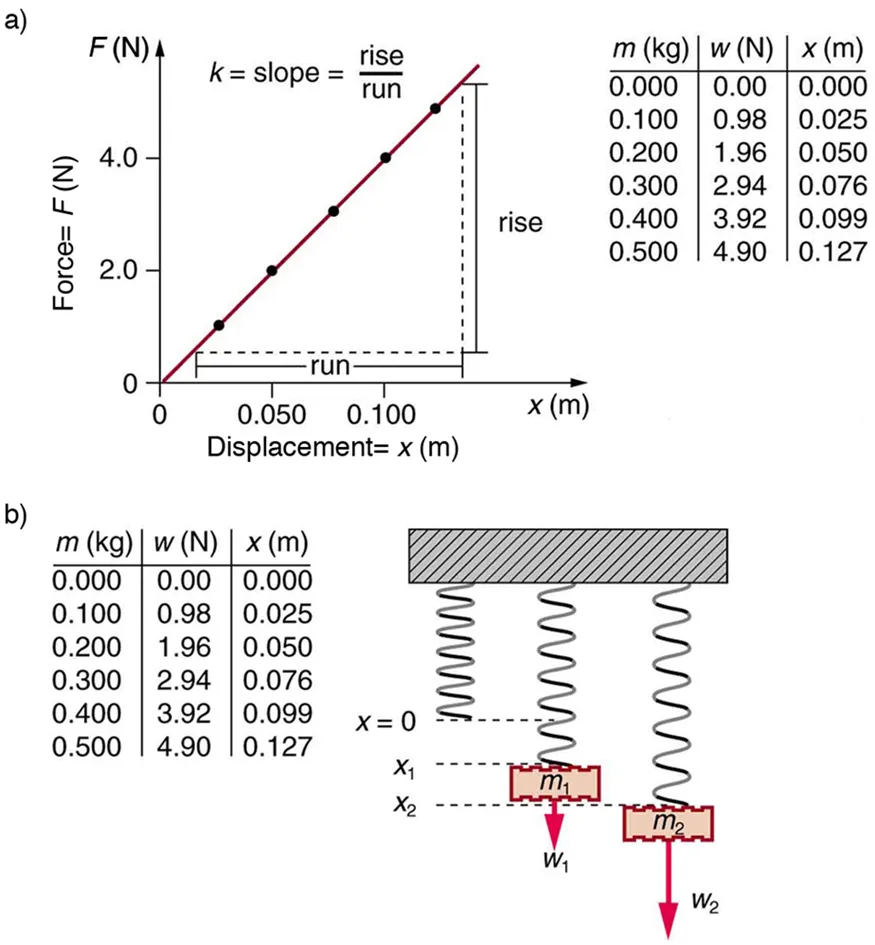
A Hooke’s-law force–displacement graph for a spring, showing that the linear relationship can be represented by a straight line whose slope is the spring constant. In an equivalent-spring model, is the slope of the external vs. overall graph for the entire combination. Source
Equivalent spring constant: The spring constant of a single spring that would produce the same external force-displacement relationship as a given combination of springs.
This idea is about modeling. The actual springs are still there, but if the combination responds like one spring from the outside, then the whole arrangement may be replaced by one simpler object in the analysis.
For AP Physics C, the important question is: if a force is applied to the spring system, how much does the system stretch or compress as a whole? If one spring can match that response, then that spring has the system’s equivalent spring constant.
= Applied force magnitude along the deformation direction, in newtons
= Equivalent spring constant of the combination, in newtons per meter
= Overall displacement of the end of the spring system, in meters
This equation expresses the behavior of the replacement spring. A larger value of means the combination is harder to stretch or compress. A smaller value means the combination is easier to deform.
Why Arrangement Matters
The specification emphasizes that the equivalent spring constant depends on how the springs are arranged.
This is the central idea of the topic.
A spring system is not determined only by:
how many springs are present
the spring constants of the individual springs
whether the springs are identical or different
It is also determined by the pattern of connection between those springs.
Two combinations may contain exactly the same individual springs but still have different equivalent spring constants. That happens because the arrangement changes how the applied force is transmitted through the system and how the total displacement is shared within the system.
In other words, the equivalent spring constant is a property of the whole arrangement, not just a list of the spring constants inside it.
External Behavior Is What Must Match
To say that a combination “acts like” a single spring does not mean every part of the system behaves the same way as that single spring. Internal forces, internal extensions, and internal compressions may be very different from one arrangement to another.
What must match is the external response:
the force applied to the combination
the resulting displacement of the point where that force is applied
If the external relationship is the same, then the same can represent the combination.
This is why equivalent spring constant is a powerful simplification. It lets you ignore internal detail when only the overall force-displacement behavior matters.
Interpreting the Value of
The equivalent spring constant tells you the overall stiffness of the full spring system.
A combination with a greater :
resists deformation more strongly
needs more force for the same displacement
stretches or compresses less under a given force
A combination with a smaller :
deforms more easily
needs less force for the same displacement
stretches or compresses more under a given force
This makes a direct way to compare different spring arrangements. Even before calculating anything, you should think qualitatively about whether a particular connection makes the system behave more stiffly or more flexibly.
How to Use the Concept Correctly
To model a spring combination with an equivalent spring constant, focus on the system’s input-output behavior.
A careful process is:
identify the endpoints of the spring combination
identify the direction in which the system is being stretched or compressed
determine the overall displacement between those endpoints
relate that displacement to the externally applied force
replace the full arrangement with a single spring only if it produces the same external response
This means the equivalent spring constant is tied to a specific setup. If the way the system is attached or loaded changes, the equivalent spring constant for the model may also change.
Common Mistakes
One common mistake is assuming that more springs always means a larger equivalent spring constant. That is not necessarily true. The arrangement determines whether the combination behaves as a stiffer system or as a more easily deformed one.
Another mistake is treating the equivalent spring constant as if it belonged to one particular spring inside the system. It does not. It belongs to the entire combination viewed as a single object.
Students also sometimes confuse the total displacement of the combination with the displacement of an individual spring. Those are not automatically the same. The equivalent spring constant must connect the external force to the overall system displacement.
Finally, do not assume that two visually different spring systems must have different equivalent spring constants. Different arrangements can sometimes produce the same overall stiffness, even when their internal behaviors are different.
FAQ
Yes.
Different-looking arrangements can produce the same overall stiffness when measured between the same two endpoints. What matters is the external relationship between applied force and overall displacement, not whether the internal layout looks the same.
So two networks may have:
different internal extensions
different internal forces
the same $k_{eq}$
That is one reason the idea is called an equivalent spring constant rather than an identical physical structure.
For a linear spring system, $k_{eq}$ is the gradient of the graph of force against extension.
A steeper graph means a larger equivalent spring constant, because more force is needed for each additional unit of extension.
A shallower graph means a smaller equivalent spring constant.
This graph interpretation is especially useful when the spring arrangement is tested experimentally rather than analysed from its geometry.
Yes, it can.
If you attach the system differently, or measure displacement between a different pair of points, you may be describing a different effective mechanical connection. That can change the overall force-displacement relationship.
So $k_{eq}$ is not just a property of the materials alone. It is a property of the arrangement as viewed between specific terminals.
It depends on the model.
For ideal linear springs, preloading changes the force already present in the system, but it does not change the slope of the force-extension relation. In that case, $k_{eq}$ stays the same.
For real springs, large preloads can sometimes move the system away from linear behaviour. Then the effective stiffness may change.
In AP Physics C, the usual assumption is the ideal linear case unless told otherwise.
Because many mechanics questions only need the overall response of the system.
If you only care about how far the end moves, how much force is needed, or how the attached object behaves, replacing the network with one spring saves time and reduces algebra.
However, if a problem asks about force in a particular spring or the extension of one part of the network, the internal structure matters again, and the single-spring model is no longer enough.
Practice Questions
A combination of ideal springs is replaced by a single spring with spring constant .
State what it means for the single spring to be equivalent to the original combination.
1 mark: States that the combination can be modeled as one spring.
1 mark: States that the single spring gives the same external force-displacement relationship as the original combination.
Two different spring combinations, A and B, are attached between a wall and a block. When the same horizontal force is applied to each combination, combination A stretches by and combination B stretches by , where .
(a) Which combination has the larger equivalent spring constant? Explain. (2 marks)
(b) A student says, “Both combinations contain three identical springs, so they must have the same equivalent spring constant.” Explain why this statement is incorrect. (2 marks)
(c) State one condition that must be satisfied before either combination can be replaced by a single spring in an analysis. (1 mark)
(a)
1 mark: Identifies combination B as having the larger equivalent spring constant.
1 mark: Explains that for the same applied force, the smaller displacement corresponds to the larger .
(b)
1 mark: States that equivalent spring constant depends on arrangement, not just on the number of springs.
1 mark: Explains that different arrangements can transmit force and distribute deformation differently, changing the overall stiffness.
(c)
1 mark: States that the single spring must produce the same external force-displacement behavior as the original combination.
