

AP Syllabus focus: 'For springs in parallel, the equivalent spring constant is the sum of the individual spring constants. AP Physics C only expects series or parallel arrangements, not mixed systems.'
When springs act side by side on the same object, the system resists displacement more strongly than any single spring. The key to analyzing parallel springs is recognizing what quantity stays the same.
Understanding a Parallel Spring Arrangement
A set of springs is in parallel when each spring is attached between the same support and the same moving object, so the springs act side by side. In typical AP Physics C diagrams, a block or rigid bar is connected to several springs that all stretch or compress together.
Springs in parallel: A spring arrangement in which each spring connects the same moving object to the same support, so all springs undergo the same displacement.
The most important feature of a parallel arrangement is that every spring has the same displacement.
If the object moves a distance , then each spring changes length by that same amount. In symbols, .
Because the displacement is shared, the forces from the springs can be combined directly. This is why parallel spring problems are usually simpler than they first appear.
Why the Forces Add
Each spring exerts its own restoring force on the object. Since all the springs act on the same object and along the same line of motion, the total spring force is the vector sum of the individual spring forces. For one-dimensional motion, that means the magnitudes add while the common restoring direction is kept.
= net spring force from all springs, in
= individual spring constants, each in
= common displacement of the springs from equilibrium, in
This total-force expression has the same form as Hooke’s law for a single spring. That lets us replace the entire combination with one effective spring described by an equivalent spring constant.
Equivalent spring constant: The single spring constant that would produce the same force-displacement relationship as the entire spring combination.
For a parallel arrangement, that equivalent constant is the sum of the individual constants.
= equivalent spring constant of the parallel combination, in
= individual spring constants, each in
So the full set of parallel springs can be modeled as one spring with stiffness . This replacement works because the combined system produces the same restoring force for every displacement in the motion being studied.
Physical Meaning of a Larger
A larger spring constant means a stiffer spring system. Since spring constants in parallel add, a parallel combination is always stiffer than any one of its individual springs alone. If all spring constants are positive, then is greater than each separate .
That has an important consequence: for the same applied force, the displacement is smaller. In static equilibrium, the relation is , so increasing decreases for a given external force.
If there are identical springs, each with spring constant , then the parallel result becomes . This is a common shortcut when the springs are identical and clearly arranged in parallel.
The units also make sense physically. Since each is measured in , adding them still gives a result in . The equivalent spring constant is therefore a true spring constant, not a different kind of quantity.
Conditions for Using the Parallel Formula
The formula only applies when the geometry really creates a parallel arrangement. You should check the model carefully before using it.
Signs that the arrangement is truly parallel
Same moving endpoint: all springs are attached to the same object or rigid connector.
Same fixed endpoint behavior: the other ends are attached to supports that do not change the shared displacement condition.
Same displacement: every spring stretches or compresses by the same amount.
Same line of action in the model: the spring forces combine along the direction being analyzed.
If those conditions are not met, you cannot automatically add the spring constants.
For AP Physics C Mechanics, you are expected to analyze pure parallel arrangements. Mixed spring networks are outside the scope of this subsubtopic.
Useful Interpretations and Common Errors
On a force-versus-displacement graph, the slope for a spring system is its spring constant.
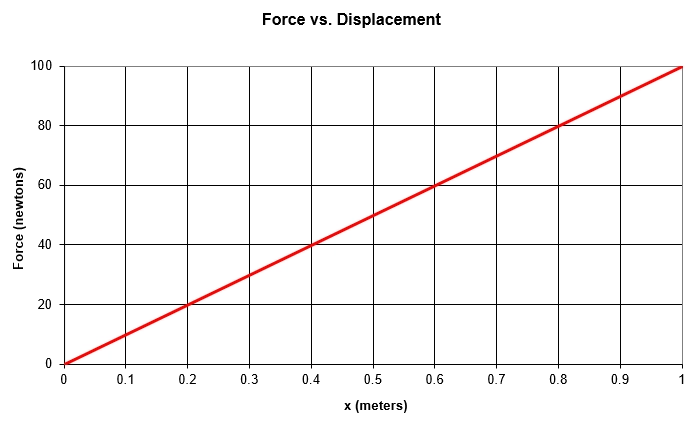
Force–displacement graph for a linear spring, showing a straight-line relationship consistent with Hooke’s law. The constant slope of the line corresponds to the spring constant (units ), which is the key graphical interpretation used when comparing single vs. equivalent spring systems. Source
For parallel springs, the slope of the combined graph is the sum of the individual slopes. That graphical view matches the algebra exactly.
Common mistakes include:
Assuming the forces in each spring are the same. In parallel, the displacements are the same. If the spring constants differ, the individual spring forces usually differ too.
Adding displacements instead of spring constants. Parallel springs share one displacement; they do not contribute separate displacements that must be summed.
Forgetting the restoring direction. The spring force points opposite the displacement from equilibrium, so the sign in matters.
Using the formula without checking the geometry. Springs must truly act side by side on the same moving point for the parallel rule to apply.
Treating a nonrigid connector as rigid without justification. If the connector bends or shifts, different springs may not have the same displacement, and the simple parallel model can fail.
FAQ
Then the simple parallel model may only apply over part of the motion.
If one spring reaches its relaxed length before the others, it may stop exerting force, while the others continue to act. In that case, the effective spring constant changes with position.
So, instead of one constant $k_{eq}$ for all displacements, you may have:
one value in one range of motion
a different value in another range
This is usually beyond the simplest AP treatment, but it is important in real systems.
Yes. That creates a preload.
A preloaded spring already exerts force even when the object is at the chosen reference position. The system can still behave like parallel springs, but the total force is shifted by a constant amount.
That means:
the stiffness from the springs may still add
the equilibrium position may move
the force-displacement graph may no longer pass through the origin
So the combined stiffness can stay the same while the zero-force position changes.
Only if the motion you care about gives each spring the same relevant component of displacement.
In a more realistic model, angled springs do not always contribute fully along the direction of motion. You may need to resolve each spring force into components first.
So the springs are not automatically treated with $k_{eq}=k_1+k_2+\cdots$ unless:
the geometry is symmetric, or
the problem explicitly reduces to one shared line of motion
Otherwise, the effective stiffness depends on direction.
Even though all springs have the same displacement, they do not generally store the same energy.
For each spring, $U_i=\dfrac{1}{2}k_i x^2$
So a larger $k_i$ means that spring stores more energy at the same displacement.
The total stored energy is the sum:
each spring stores its own elastic energy
the system energy is the total of all of them
This is consistent with a single equivalent spring, whose energy would be based on $k_{eq}$.
Using several springs in parallel can be practical for design and manufacturing.
Advantages can include:
easier replacement of individual springs
better load sharing
flexibility in adjusting stiffness by adding or removing springs
reduced stress on any single spring
improved packaging in a device
It can also make fine tuning easier. Rather than manufacturing one exact spring constant, designers can combine standard springs to reach a desired overall stiffness.
So parallel springs are not just a physics model; they are a common engineering choice.
Practice Questions
A block is attached to two ideal springs in parallel with spring constants and . What is the equivalent spring constant of the combination?
1 mark for using
1 mark for
A cart is attached to three ideal springs in parallel on a horizontal surface. The spring constants are , , and .
(a) Derive an expression for the net restoring force on the cart when it is displaced a distance from equilibrium.
(b) If , , and , find the magnitude of the external force required to hold the cart at rest at a displacement of .
(c) Explain why adding another spring in parallel would change the displacement produced by the same applied force.
(a) 1 mark for stating that each spring has the same displacement
(a) 1 mark for summing forces:
(b) 1 mark for finding
(b) 1 mark for using
(b) 1 mark for
(c) 1 mark for explaining that adding a parallel spring increases
(c) 1 mark for concluding that for the same force, becomes smaller
