

AP Syllabus focus: 'Applying Newton's second law to motion with resistive force produces a differential equation for velocity that can be solved using separation of variables.'
When a force depends on velocity, Newton’s second law no longer gives a simple algebraic relation. Instead, it leads to a differential equation that connects force, acceleration, and changing velocity over time.
Turning Newton’s Second Law into a Differential Equation
A resistive force depends on the object’s motion and acts opposite the velocity. In AP Physics C Mechanics, the most common model for this process is linear drag, written in one dimension as a force proportional to velocity.
The key step is to remember that acceleration is not treated as a constant number here. Instead, acceleration must be written as the derivative of velocity with respect to time.
Differential equation: An equation that contains an unknown function and one or more of its derivatives.
If an object moves along a straight line under a constant external force and a linear drag force, Newton’s second law becomes a first-order differential equation in and .
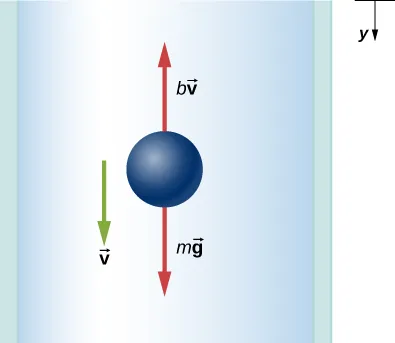
Free-body diagram for 1D motion with linear drag: the drag force is modeled as (opposite the velocity), while the constant body force (here ) acts downward. This diagram is the bookkeeping step that makes the sign convention in unambiguous. Source
= mass of the object, kg
= velocity along the chosen axis, m/s
= time, s
= constant external force in the positive direction, N
= positive drag constant, N s/m
This equation shows why drag problems are different from constant-force problems. The drag term changes as the velocity changes, so the acceleration also changes continuously.
A correct sign convention matters. The expression already includes the idea that drag opposes motion, because the sign of determines the sign of the force. If is positive, is negative. If is negative, is positive.
Why Separation of Variables Works
The equation above is called separable because all factors involving velocity can be collected on one side, while all factors involving time can be collected on the other.
Separation of variables: A method for solving a differential equation by rearranging it so that one variable and its differential appear on one side, and the other variable and its differential appear on the other side.
Starting from Newton’s second law, divide by and multiply by to isolate the variables.
= infinitesimal change in velocity
= infinitesimal change in time
= net force expression in one dimension, N
At this point, the equation is ready for integration. This is the central mathematical move in the subtopic: Newton’s second law gives a differential equation, and separation of variables turns it into an integrable form.
A common AP approach is to include the initial condition directly in the integral limits. If the object has velocity at time , then integrating both sides gives a relation between and .
= initial velocity at , m/s
= natural logarithm
= dimensionless combination produced by the integration
This logarithmic form is already a valid solution, but AP Physics C students are usually expected to solve explicitly for velocity as a function of time.
Solving for Velocity
Rearranging the integrated result gives the velocity function.
The final answer contains an exponential because integrating a separated linear-drag equation produces a logarithm, and solving a logarithmic equation requires exponentiation.
= velocity at time , m/s
= initial velocity, m/s
= exponential factor that decreases with time
= constant velocity scale set by force and drag, m/s
This result shows that the velocity does not usually change linearly in time when drag is present. Instead, the exponential factor causes the motion to adjust rapidly at first and then more gradually.
The initial condition is essential. Without it, the integration produces a family of possible velocity functions. The initial condition selects the one that matches the physical situation.
Sign Conventions and Common Pitfalls
Students often lose accuracy on drag problems because of sign errors rather than calculus errors.
Choose a positive direction before writing Newton’s second law.
Write each force with its correct sign in that coordinate system.
Use velocity, not speed, in the linear drag term if you write the force as .
Replace acceleration with immediately.
Separate variables only after the force equation is correct.
Apply the initial condition carefully after integrating, or build it into the integration limits from the start.
Another frequent mistake is assuming the acceleration is constant just because the external force is constant. With drag, the net force changes as changes, so must be treated as variable.
AP Exam Approach
For this subsubtopic, a strong exam method is:
identify the forces acting along the line of motion
write Newton’s second law with signs
substitute
rearrange into separable form
integrate both sides
use the given initial condition
solve for if required
On AP Physics C, the emphasis is usually on the reasoning chain: force model differential equation separation of variables velocity function.
FAQ
Using definite integrals lets you include the initial condition immediately, which avoids solving for an extra constant later.
It also keeps the logarithm in a cleaner form, often as a ratio such as $\ln\left(\dfrac{F_0-bv_0}{F_0-bv}\right)$, which is mathematically tidier than taking the logarithm of a dimensional quantity.
From $F_d=bv$, the units must satisfy $N=(b)(m/s)$.
So,
$b$ has units of $N s/m$
equivalently, $b$ has units of $kg/s$
This is a useful check. If your units for $b$ do not reduce to $kg/s$, the model or algebra is inconsistent.
Linear drag works best when speeds are relatively low and the surrounding fluid flow is gentle enough that the resistive force is approximately proportional to $v$.
At higher speeds, many systems are better modelled by a force proportional to $v^2$. That produces a different differential equation, so the algebra and final velocity function change.
If you write drag as $-bv$, the sign updates automatically because $v$ changes sign.
However, you must still think physically. If the motion crosses through $v=0$, the force model may need to be checked over separate time intervals, especially if other forces also change or if the chosen expression was based on an assumed direction of motion.
Sometimes, but not always.
If the equation can still be rearranged into a form with all $v$ terms on one side and all $t$ terms on the other, separation works. For example, some specially structured equations remain separable.
If the force has a more complicated time dependence, the equation may no longer be separable, and another differential-equation method is needed.
Practice Questions
A block of mass moves to the right under a constant applied force . A resistive force of magnitude opposes the motion. Write the differential equation for the block’s velocity .
1 mark for identifying that the drag force is opposite the velocity and contributes
1 mark for writing or equivalent
A cart of mass moves along a horizontal track. It is pulled in the positive direction by a constant force and experiences a resistive force . At , the cart has velocity .
(a) Write Newton’s second law for the cart in differential-equation form.
(b) Use separation of variables to obtain an equation relating and after integration.
(c) Solve for .
(a) 1 mark for
(b) 1 mark for correctly separating variables, such as
(b) 1 mark for integrating correctly
(b) 1 mark for using the initial condition
(c) 1 mark for
