

AP Syllabus focus: 'A resistive force is a velocity-dependent force that points opposite an object's velocity, such as a force proportional to negative velocity.'
Resistive forces are often the first realistic correction to ideal motion. In AP Physics C, the key goal is to recognize their direction, dependence on speed, and the meaning of a simple mathematical model.
Core idea
In mechanics, a resistive force represents the effect of a surrounding medium such as air, water, or oil on a moving object. The defining feature is that the force depends on velocity. That makes it different from a constant-force model, because the force changes as the motion changes.
A good model of resistance captures two linked ideas:
the magnitude depends on how fast the object is moving
the direction is opposite the object's velocity
If an object moves faster, the resistive force usually becomes larger. If the object reverses direction, the resistive force also reverses direction.
Direction matters
The phrase opposite the velocity is more precise than saying “opposite the motion” in a vague way. Resistive force does not automatically point downward, upward, left, or right. Its direction is set by the instantaneous velocity vector.
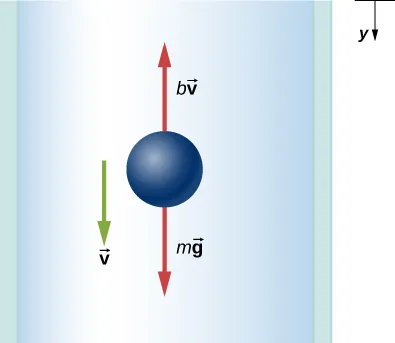
Free-body diagram for an object moving downward through a resistive medium: the velocity vector points downward while the linear drag force points upward, opposing the motion. This visually encodes the model by showing the drag force antiparallel to . Source
If points to the right, the resistive force points left.
If points downward, the resistive force points up.
If an object follows a curved path, the resistive force points opposite the tangent direction of the motion at that instant.
This is a vector relationship. In one-dimensional motion, the sign of the velocity tells you the direction of the resistive force. In two- or three-dimensional motion, the force must oppose the full velocity vector, not just one component.
It is also important not to confuse velocity with acceleration. An object can have velocity in one direction while its acceleration points in another, but the resistive force still opposes the velocity.
A common AP Physics C model
A standard simplified model is a linear resistive force, where the force is proportional to velocity. This is the model named directly in the syllabus and is common because it is simple, physically meaningful, and mathematically useful.
= resistive force, in newtons
= positive proportionality constant, in
= object's velocity relative to the medium, in
The constant is taken to be positive. The negative sign is what makes the force point opposite the velocity. Without that sign, the model would predict a force in the same direction as the motion, so it would not be resistive.
Speed versus velocity
Many problems say that the magnitude of the resistive force is proportional to speed. In symbols, that means , together with the rule that the force points opposite . The compact vector equation above combines both statements into one line.
This distinction matters because speed gives only size, while velocity gives both size and direction. A correct model needs both.
Interpreting the sign in one dimension
Along the -axis, the model becomes .
If , then , so the force points in the negative -direction.
If , then , so the force points in the positive -direction.
This is why the signed form is powerful: one equation automatically handles both directions of motion. You should not add an extra manual sign if you are already using signed velocity.
What the model is really saying
A resistive-force model does not say the medium applies the same force at all times. Instead, it says the interaction with the medium adjusts continuously as the object's velocity changes. In the linear model, faster motion relative to the medium means stronger resistance.
The phrase relative to the medium is important. If the air or water is moving, the relevant velocity is the object's velocity compared with that fluid, not necessarily compared with the ground. At an instant when relative to the medium, the linear model gives zero resistive force.
When this model is useful
The linear model is an approximation. In AP Physics C, it is mainly used to build an accurate mathematical description of a velocity-dependent force and to predict how its direction changes.
It is especially useful when:
the problem explicitly states that the resistive force is proportional to velocity
the motion occurs in a situation where a linear approximation is reasonable
the main goal is to include resistance without introducing a more complicated drag model
You should not assume linear drag unless the problem gives it or clearly indicates it.
Common modeling mistakes
Several errors appear often in resistive-force problems.
Using speed when the equation needs signed velocity. If you write , then must represent signed velocity in one dimension.
Making the force always negative. Negative depends on the chosen axis and on the direction of motion.
Forgetting that the force reverses when velocity reverses.
Treating resistive force as constant. In this model, it changes whenever the velocity changes.
Ignoring the medium. The force depends on motion through a medium, not just motion through space in general.
A useful physical check is simple: the resistive force should always act in a way that tends to reduce the object's speed relative to the medium.
Limits of the simple model
Real drag can be more complicated than . The proportionality constant may depend on fluid properties, shape, or orientation, and some situations are better modeled with a force whose magnitude is proportional to . For this subsubtopic, however, the essential idea is the modeling principle itself: a resistive force depends on velocity and points opposite the velocity.
Practice Questions
An object moves along the -axis through a medium. The resistive force is proportional to the object's velocity with constant .
(a) Write an expression for the resistive force in terms of and .
(b) If , state the direction of the resistive force.
(a) Writes or an equivalent correct expression. (1)
(b) States that the resistive force points in the direction. (1)
A small sphere moves vertically through a liquid. Take upward as positive. The liquid exerts a resistive force proportional to the sphere's velocity with constant .
(a) When the sphere moves upward with velocity , write the expression for the resistive force. (1)
(b) When the sphere moves downward with velocity , state whether the resistive force points upward or downward. (1)
(c) Write one signed expression for the resistive force that is valid for both upward and downward motion. (1)
(d) Explain why the model in part (c) must include a negative sign rather than being written as . (2)
(a) or an equivalent statement that the force is downward for . (1)
(b) Upward. (1)
(c) . (1)
(d) Explains that the negative sign makes the force oppose the velocity. (1)
(d) Explains that when the velocity reverses, the force reverses automatically; would point with the motion, so it would not be resistive. (1)
FAQ
In very viscous fluids and at low speeds, the flow around the object is often smooth rather than turbulent. In that regime, the resistive force tends to scale directly with speed.
That is why oils, glycerine, and similar fluids often fit a linear drag model better than fast motion through air.
For a small sphere moving slowly through a viscous fluid, Stokes' law gives the magnitude of the drag force as $F=6\pi \eta r v$.
This matches the AP form $F_r=-bv$ if $b=6\pi \eta r$, where $\eta$ is the fluid viscosity and $r$ is the sphere's radius. The AP model is therefore a simplified general form of a more specific physical law.
Yes. The simple AP model often treats $b$ as constant, but in real situations it can vary.
It may change if:
the object changes orientation
the fluid temperature changes
the object's shape changes
the object moves into a different medium
If the problem does not say otherwise, AP questions usually intend $b$ to remain constant.
Use the object's velocity relative to the air, not relative to the ground.
If the wind velocity is $\vec{v}{air}$ and the object's ground velocity is $\vec{v}{obj}$, then the relevant velocity is $\vec{v}{obj}-\vec{v}{air}$. A headwind increases the relative speed and usually increases the drag; a tailwind does the opposite.
At higher speeds, especially in air, inertial effects in the fluid become more important than simple viscous effects. The disturbed fluid carries more momentum, and the resistive force often grows roughly with the square of speed.
That is why models of the form $F_r\propto v^2$ are frequently used for cars, cyclists, and skydivers moving quickly through air.
