

AP Syllabus focus: 'Terminal velocity is the maximum speed reached when a constant force and an opposing resistive force act on an object and the net force becomes zero.'
Terminal velocity matters whenever resistive forces grow as an object speeds up, because motion then approaches a limiting speed instead of continuing to accelerate under a constant driving force.
What terminal velocity means
Terminal velocity describes a situation in which an object is still moving, but its speed is no longer changing because the forces on it have become balanced.
Terminal velocity: The constant maximum speed reached when a constant force and an opposing resistive force become equal in magnitude, so the net force is zero.
A common setting is an object moving through a fluid such as air or water. The constant force might be the object's weight, while the resistive force is drag acting opposite the motion. At first, the object may speed up, but as the resistive force grows, the net force becomes smaller. Eventually the resistive force matches the constant force, and the speed stops increasing.
The word maximum is important. In this model, once the balancing condition is reached, the object cannot continue to gain speed unless one of the forces changes.
How terminal velocity is reached
Early motion
When the object first begins moving, the resistive force is often small because the speed is small. That means the constant force is larger than the resistive force, so there is a nonzero net force in the direction of motion. As a result, the object accelerates.
As the speed increases, the resistive force increases. Because that resistive force points opposite the motion, it reduces the net force. The object is still speeding up, but it does so more slowly than before because its acceleration is decreasing.
Approaching terminal velocity
Terminal velocity is not usually reached suddenly. Instead, the object approaches it as the resistive force gets closer and closer to the constant force. The closer the force balance becomes, the smaller the acceleration becomes.
This means an object can be moving fast while still not yet being at terminal velocity. What matters is not whether the speed is large, but whether the net force is zero.
Force balance and acceleration
If the positive direction is chosen to be the direction of motion, the force relationship can be written as follows.
= net force on the object, N
= constant force driving the motion, N
= resistive force opposing the motion, N
= mass of the object, kg
= acceleration of the object, m/s^2
This equation shows why the speed does not jump instantly to its limiting value. As long as is greater than , the acceleration is positive in the chosen direction, so the object keeps gaining speed.
At terminal velocity, the acceleration becomes zero because the net force becomes zero.
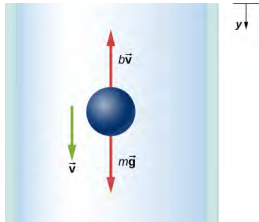
Free‑body diagram for an object moving downward through a resistive medium with linear drag. The diagram makes the force balance explicit: weight acts downward while the drag force acts upward, and terminal behavior occurs when these two become equal in magnitude so and even though . Source
= net force on the object, N
= constant force in the direction of motion, N
= resistive force opposite the motion, N
A key AP Physics point is that zero net force does not mean zero velocity. It means constant velocity. An object at terminal velocity is not in translational motionlessness; it is in translational equilibrium while moving.
What the motion looks like on graphs
A speed-versus-time graph for motion toward terminal velocity starts with a positive slope. That slope gradually becomes smaller, and the graph levels off. The horizontal part represents constant speed, which is the terminal velocity.
An acceleration-versus-time graph starts at some nonzero value in the direction of motion, then approaches zero as the resistive force increases. Once terminal velocity is reached, the acceleration remains zero as long as the forces stay balanced.
A net-force-versus-time graph behaves similarly to the acceleration graph, since force and acceleration are directly related for a fixed mass.
What affects the terminal velocity
Terminal velocity depends on the balance between the constant force and the resistive force model for the situation.
Important factors include:
the magnitude of the constant force
how strongly the medium resists motion
the object's shape and orientation
properties of the fluid, such as how effectively it produces drag
In a falling-object situation, a larger downward force generally requires a larger opposing resistive force before balance occurs, so the terminal speed is often larger.
Common misconceptions to avoid
Terminal velocity is not the moment drag first appears. Drag acts before terminal velocity is reached.
Terminal velocity does not mean the forces disappear. It means they balance.
Terminal velocity does not require the object to stop. The object continues moving with constant velocity.
Terminal velocity can change if the constant force changes or if the resistive conditions change, such as a change in shape, orientation, or surrounding fluid.
Practice Questions
An object falls downward through air. Its weight is constant downward, and the air resistance is upward. State the condition for terminal velocity and give the object's acceleration at terminal velocity.
1 mark: States that the upward resistive force equals the downward constant force, or that the net force is zero.
1 mark: States that the acceleration is .
A small sphere is released from rest and falls vertically through a fluid. The sphere experiences a constant downward force and an upward resistive force that increases as the sphere's speed increases.
Explain how the sphere's motion changes from the moment it is released until it reaches terminal velocity. Your answer should refer to force, acceleration, and the shape of the speed-time graph.
1 mark: States that initially the resistive force is zero or small, so the net force is downward.
1 mark: States that the sphere accelerates downward at first.
1 mark: States that as speed increases, the resistive force increases.
1 mark: States that the increasing resistive force reduces the net force, so the acceleration decreases toward zero.
1 mark: States that at terminal velocity the resistive force equals the constant downward force, the net force is zero, and the speed-time graph becomes horizontal.
FAQ
Yes. If an object is launched downward or if conditions change suddenly, it can briefly move faster than the terminal velocity for the new situation.
When that happens:
the resistive force becomes larger than the constant driving force
the net force points opposite the motion
the object slows down until it returns to terminal velocity
So terminal velocity is a stable speed for a given set of conditions, not an absolute speed limit in every circumstance.
Yes, because both the driving force and the surrounding medium matter.
For falling objects:
stronger gravity usually increases the constant downward force
a denser atmosphere usually increases resistive force at a given speed
That means the same object could have very different terminal velocities on Earth, Mars, or Venus.
On the Moon, ordinary atmospheric terminal velocity is not relevant because there is essentially no atmosphere to provide significant drag.
As a raindrop speeds up, the air pushes back more strongly. That increased drag reduces the net downward force until the drop reaches terminal velocity.
Also, very large raindrops are unstable:
they can flatten
they can wobble
they can break into smaller drops
These effects increase drag and prevent unlimited speed growth. So real raindrops are naturally constrained by both air resistance and their changing shape.
Yes. A skydiver can have different terminal velocities at different stages.
Examples include:
falling spread-eagle
diving head-first
opening a parachute
Each configuration changes the drag conditions. When the posture or equipment changes, the resistive force at a given speed changes too, so the force balance occurs at a different speed.
That is why a parachutist can first speed up to one terminal velocity and later slow to a much smaller one after the parachute opens.
It is usually found by measuring how speed changes with time and identifying when the speed stops increasing appreciably.
Common methods include:
video analysis
motion sensors
tracking position over equal time intervals
If the measured speed values level off, that plateau gives the terminal velocity.
In careful experiments, researchers also check that the motion is steady over a time interval, not just briefly constant because of measurement uncertainty.
