AP Syllabus focus:
‘Introduction to the normal distribution as a model for some population distributions, with a focus on its mound-shaped and symmetric properties. Explanation of parameters µ (mean) and σ (standard deviation) as key characteristics of a normal distribution. Discussion of the empirical rule, stating that approximately 68% of observations fall within 1 standard deviation of the mean, about 95% within 2 standard deviations, and about 99.7% within 3 standard deviations. Skill 2.D: Developing competency in comparing data distributions to the normal distribution model, understanding its parameters and the significance of the empirical rule.’
The normal distribution is central in AP Statistics because it models numerous real-world phenomena and provides a foundation for interpreting standardized scores and probability-based conclusions.
The Nature of the Normal Distribution
The normal distribution is a theoretical model describing how some quantitative variables are distributed. It is characterized by its smooth, continuous curve and its distinctive mound-like appearance. This distribution is most useful for variables influenced by many small, independent factors—such as height, measurement errors, or physiological traits. Because of its widespread applicability, recognizing its structural features is essential for statistical reasoning.
A distribution in statistics describes the frequency of values for a variable. When that distribution follows a particular pattern—specifically, a bell shape—it is considered normal. The bell shape signals that most observations cluster around a central value, with fewer observations appearing as values move toward the extremes.
Shape: Mound-Shaped and Symmetric
One hallmark of the normal distribution is its symmetry. Symmetry means that the left and right sides of the distribution mirror one another around the center point. This symmetry implies that low values and high values occur with balanced frequency, and that the central region contains the greatest density of observations.
When discussing shape in AP Statistics, students focus on the concept of a mound-shaped curve, where frequencies rise to a single peak in the center and taper evenly on both sides. In a perfectly normal distribution, this symmetry is exact, making it easier to interpret standardized scores and make probabilistic statements.
Parameters of a Normal Distribution
A normal distribution is defined by two numerical characteristics, or parameters: the mean and the standard deviation.
Parameter: A numerical value that describes a characteristic of a population distribution, such as its mean or standard deviation.
The parameter μ (mu) represents the mean, or center, of the distribution, while σ (sigma) represents the standard deviation, a measure of spread.
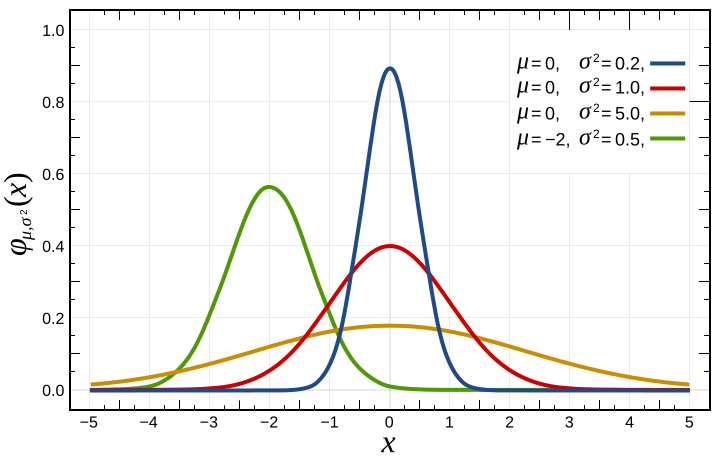
A set of normal curves with different means and standard deviations, showing how μ shifts the curve horizontally and σ stretches or compresses its spread. Source.
EQUATION
Because a normal distribution is fully described by μ and σ, understanding these parameters helps students interpret patterns, compare distributions, and assess deviations from typical values.
A normal sentence follows here to maintain required spacing before another formal block.
Empirical Rule: Understanding Spread in a Normal Model
A defining feature of normally distributed data is its predictable spread. The empirical rule (or 68–95–99.7 rule) describes how data fall relative to the mean when the distribution is approximately normal. This rule is essential for estimating probabilities and making informal judgments about extremity.
This approximate pattern is summarized by the empirical rule (68–95–99.7 rule).
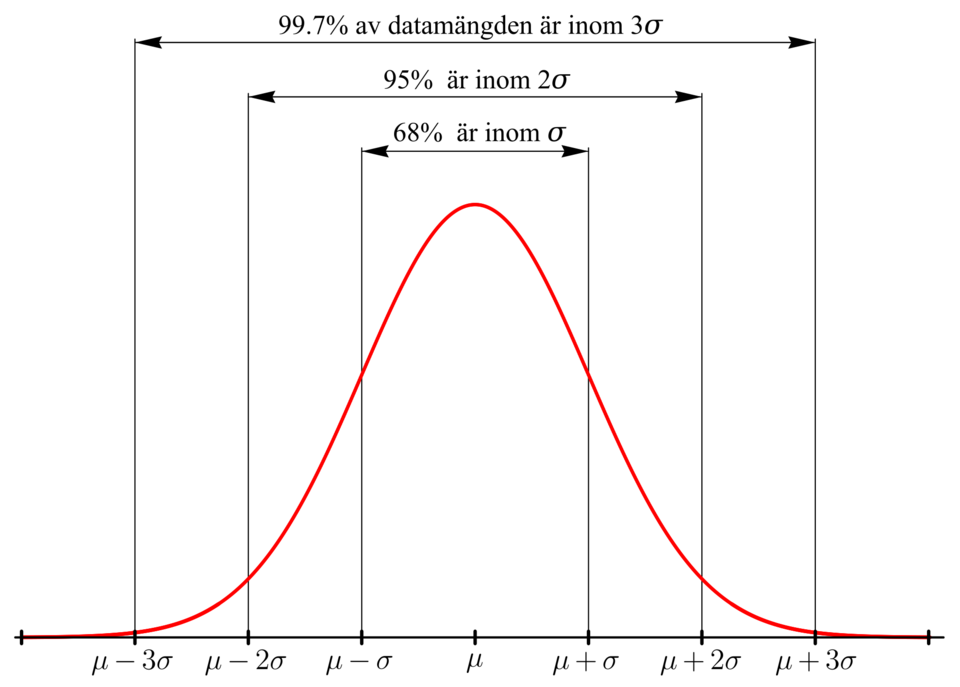
A labeled standard normal curve showing the proportions of data within 1, 2, and 3 standard deviations of the mean, illustrating the empirical rule. Source.
Key features include:
About 68% of observations fall within 1 standard deviation of the mean (between μ − σ and μ + σ).
About 95% fall within 2 standard deviations of the mean.
About 99.7% fall within 3 standard deviations of the mean.
These predictable proportions allow students to identify unusual values, estimate ranges for typical observations, and compare different datasets using standardized units.
Interpreting Values in a Normal Distribution
Understanding the normal distribution helps students judge how extreme or typical a value is. Because the distribution is symmetric and centered at its mean, values far from the center become increasingly rare. A score that is several standard deviations away from the mean indicates an unusual observation. Recognizing these characteristics supports skill development in comparing datasets and evaluating the relative standing of observations.
When comparing two quantitative variables that each roughly follow a normal distribution, the parameters μ and σ allow for meaningful interpretation. For example, a distribution with a larger standard deviation will have values more widely dispersed, influencing the interpretation of what counts as typical or unexpected.
Using the Normal Model Appropriately
Students must remember that not all data follow a normal distribution. The normal model is appropriate only when the observed distribution is roughly symmetric, unimodal, and mound-shaped. Before applying concepts such as the empirical rule, students should visually assess the distribution using graphs like histograms or dotplots. A distribution that is skewed, multimodal, or contains strong outliers does not meet the assumptions of normality and will not follow predictable proportions around the mean.
Importance of the Normal Distribution in Statistical Reasoning
The normal distribution is foundational in statistical inference and probability. Its predictable structure allows for comparing distributions, interpreting standardized values, and assessing the likelihood of specific outcomes. Mastery of its characteristics supports deeper understanding of later topics, including z-scores, percentiles, and the use of technology to compute areas under normal curves.
FAQ
The easiest first step is to examine a histogram or dot plot to see whether the data appear roughly symmetric and mound-shaped.
A more refined approach is to use a normal probability plot. If the points lie close to a straight line, the normal model is usually appropriate.
You should also ensure that there are no extreme outliers or strong skewness, as these features break the assumptions of normality.
Real-world data rarely follow the normal curve exactly. “Approximately normal” means the data resemble the overall shape: a central peak, symmetric tails, and gradual decline away from the mean.
Small deviations do not invalidate the normal model.
It becomes unsuitable when there is major skewness, heavy tails, or multiple peaks.
Many variables are influenced by a combination of numerous small, independent factors. When these effects accumulate, they tend to produce values that cluster around a central point.
This phenomenon is linked to the central limit principle, which explains why many measurement-based variables (such as biological traits or errors) display normal-like patterns.
A larger standard deviation spreads the distribution out, increasing the likelihood of values far from the mean.
A smaller standard deviation makes the curve narrower and taller, reducing the probability of observing extreme scores.
This influences how unusual a particular value appears in context.
The percentages 68%, 95%, and 99.7% are rounded values representing the actual proportions under the normal curve.
The precise values are 68.27%, 95.45%, and 99.73%.
These small differences are negligible for most statistical reasoning, which is why the rounded figures are standard practice in introductory statistics.
Practice Questions
Question 1 (1–3 marks)
A researcher claims that the distribution of reaction times for a certain cognitive test is approximately normal with a mean of 520 milliseconds and a standard deviation of 40 milliseconds.
Using the characteristics of the normal distribution, estimate the interval that should contain about 95% of all reaction times.
Question 1 (3 marks total)
• 1 mark for identifying that 95% of observations lie within 2 standard deviations of the mean.
• 1 mark for calculating the lower bound: 520 − 80 = 440 ms.
• 1 mark for calculating the upper bound: 520 + 80 = 600 ms.
Accept any equivalent interval clearly based on 2 standard deviations.
Question 2 (4–6 marks)
A large population’s scores on a reasoning assessment are known to be normally distributed with mean 70 and standard deviation 12.
(a) Explain what it means for this distribution to be symmetric and mound-shaped.
(b) Using the empirical rule, determine whether a score of 94 should be considered unusual. Show your reasoning.
(c) A student scores 58. Comment on how this value compares with the mean in terms of standard deviations, and interpret the position of this score within the distribution.
Question 2 (6 marks total)
(a) (2 marks)
• 1 mark for stating that symmetry means values are evenly distributed around the mean.
• 1 mark for noting that mound-shaped indicates most observations cluster around the centre, tapering off equally on both sides.
(b) (2 marks)
• 1 mark for using the empirical rule to determine that 95% of scores lie within 2 standard deviations (mean ± 24).
• 1 mark for concluding that 94 is within 2 standard deviations of the mean (70 + 24 = 94), so it is not unusual.
(c) (2 marks)
• 1 mark for identifying that 58 is 1 standard deviation below the mean (70 − 12).
• 1 mark for interpreting this as a score that falls within the typical range and is not considered extreme within a normal distribution.