AP Syllabus focus: 'Regression coefficients are the estimated slope and y-intercept. The slope is the predicted change in y for each one-unit increase in x.'
When you read a regression equation, the coefficients carry the interpretation. AP Statistics expects you to explain each coefficient clearly in context, using the variables, units, and precise language of prediction.
What regression coefficients represent
In a linear regression equation, the two regression coefficients are the numbers that describe the fitted line and how it makes predictions about the response variable.
Regression coefficients: The numerical values in a regression equation that estimate the slope and y-intercept of the line used to predict the response variable.
A common simple linear regression equation is written in the form below.
= predicted value of the response variable
= y-intercept, in units of the response variable
= slope, predicted change in the response variable for each one-unit increase in
= explanatory variable value and its unit
These coefficients are estimated from sample data, so they describe the prediction line rather than an exact rule for every individual observation. That is why good interpretations use words such as predicted or estimated.
Interpreting the slope coefficient
The slope is the coefficient attached to . It tells how much the predicted response changes when the explanatory variable increases by one unit.
A correct slope interpretation has three essential parts:
it describes a change in the response variable
it refers to a one-unit increase in the explanatory variable
it uses the language of prediction
In context, the slope should be interpreted as: for each one-unit increase in the explanatory variable, the predicted value of the response variable changes by the slope amount.
The sign of the slope matters:

Three line graphs illustrate how the slope coefficient controls the direction of a fitted line. When the predicted response increases as increases; when the predicted response stays constant; and when the predicted response decreases as increases. This connects the algebraic sign of the slope to a clear visual trend. Source
A positive slope means larger values of are associated with larger predicted values of .
A negative slope means larger values of are associated with smaller predicted values of .
Units are also essential. The slope’s units are “units of the response per unit of the explanatory variable.” If the response is measured in dollars and the explanatory variable is measured in hours, then the slope is measured in dollars per hour. If you leave out units, the interpretation is incomplete.
Careful wording matters on AP questions. The slope is not simply “how much changes.” Real data points do not all lie exactly on the line. Instead, the slope is the predicted change in for each one-unit increase in . That distinction is important because regression describes a model, not a perfect relationship.
Interpreting the y-intercept
The y-intercept is the constant term in the regression equation.
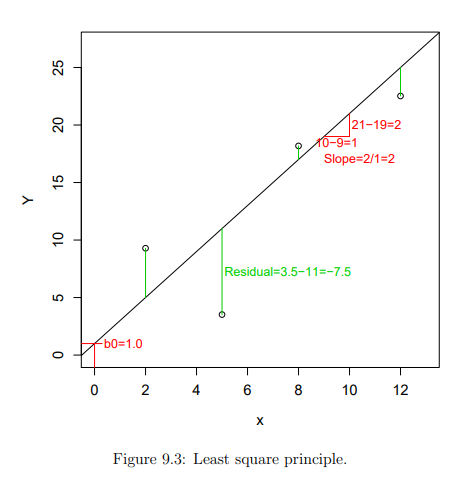
A scatterplot with a fitted line labels the intercept at and uses a right triangle to visualize slope as rise over run. The diagram also marks a residual as a vertical difference between an observed point and the predicted value on the line. Together, these labels reinforce that regression coefficients describe a prediction line rather than a perfect fit to every data point. Source
It gives the predicted value of the response variable when the explanatory variable equals 0.
A correct intercept interpretation begins with that condition: when . Then it states the predicted value of the response variable, including the proper units.
The y-intercept is different from the slope in a basic way:
the slope describes a rate of change
the y-intercept describes a predicted starting value at
Because of this, students sometimes mix them up. If your interpretation includes “for each one-unit increase,” you are describing the slope, not the intercept. If your interpretation begins with “when ,” you are describing the intercept.
The intercept may or may not be useful in context. It is meaningful when a value of 0 for the explanatory variable is possible and sensible. It may be less meaningful when:
a value of 0 is impossible in the setting
a value of 0 is unrealistic
the variable values in the data are nowhere near 0
Even in those cases, the mathematical meaning stays the same: the y-intercept is still the model’s predicted response when .
Writing coefficient interpretations in context
On AP Statistics questions, a coefficient interpretation must be tied to the actual variables in the problem. A response such as “the slope is 1.8” is not enough.
A strong interpretation usually does all of the following:
names the response variable
names the explanatory variable
includes the units
states whether the coefficient describes a predicted change or a predicted value
It also helps to match the wording to the coefficient:
For a slope, write about how the predicted response changes when the explanatory variable increases by one unit.
For an intercept, write about the predicted response when the explanatory variable is 0.
Common mistakes include:
interpreting the slope as a starting value
interpreting the intercept as a rate of change
forgetting the word predicted
omitting units
switching the explanatory and response variables
A useful self-check is to ask:
Does my slope interpretation describe a change in the response?
Does my intercept interpretation describe the predicted response at ?
If the answer to both questions is yes, your interpretation is likely aligned with AP Statistics expectations.
Practice Questions
A regression equation predicting quiz score from minutes studied is , where is minutes studied and is predicted quiz score in points.
Interpret the slope in context. [2 marks]
1 mark for stating that the interpretation is about a one-minute increase in study time.
1 mark for stating that the predicted quiz score increases by 0.35 point for each additional minute studied.
A researcher uses the regression equation to predict resting heart rate, in beats per minute, from weekly exercise time, in hours.
(a) Interpret the slope in context. [2 marks]
(b) Interpret the y-intercept in context. [2 marks]
(c) Adults in the study had exercise times between 3 and 10 hours per week. Explain whether the y-intercept is likely to be practically meaningful. [1 mark]
Part (a)
1 mark for identifying that the explanatory variable increases by 1 hour per week.
1 mark for stating that the predicted resting heart rate decreases by 0.8 beat per minute for each additional hour of weekly exercise.
Part (b)
1 mark for stating that the interpretation must be at hours of weekly exercise.
1 mark for stating that the model predicts a resting heart rate of 12.6 beats per minute when weekly exercise time is 0 hours.
Part (c)
1 mark for explaining that the intercept is not very practically meaningful because 0 hours is outside the observed range of 3 to 10 hours, so the prediction is less useful in context.
FAQ
Changing units changes the numerical values of the coefficients.
If you change the unit of $x$, the slope changes because it is measured in units of $y$ per unit of $x$.
If you change the unit of $y$, both the slope and intercept change because both are measured in units of the response.
For example, measuring time in minutes instead of hours makes the slope smaller numerically, even though the relationship is the same.
The interpretation must always match the units actually used in the regression equation.
Centering means replacing $x$ with $x-c$ for some constant $c$.
This changes the point where the line crosses the vertical axis, so the intercept becomes the predicted response when the original $x$ equals $c$, not 0.
The slope still describes how much the predicted response changes for a one-unit increase in the explanatory variable, so its basic interpretation as a rate of change stays the same.
Centering is often useful because it can make the intercept easier to interpret in context.
Only when the study design supports causation.
A regression slope by itself describes a predicted change in the response as the explanatory variable increases. That is an association-based interpretation.
Causal wording is appropriate only if the data come from a well-designed randomized experiment or from another setting where cause-and-effect conclusions are justified.
If that evidence is missing, safer wording is:
“is associated with”
“predicts”
“corresponds to”
The slope and intercept describe different features of a line.
The slope controls how steep the line is.
The intercept controls where the line starts when $x=0$.
So two lines can rise or fall at the same rate but begin at different predicted values. Graphically, they are parallel lines.
In context, that means the predicted change per one-unit increase in $x$ is the same in both models, but the predicted response at $x=0$ is different.
Use enough precision to match the context, but do not overstate accuracy.
A good rule is:
use the coefficients as given in the problem, or
round to a reasonable number of decimal places that keeps the meaning clear
If the slope is very small, over-rounding can distort the interpretation. If the intercept has many decimals, slight rounding is usually fine if it does not change the practical meaning.
In written interpretations, the words and units matter more than repeating every decimal exactly.