AP Syllabus focus:
‘Madison argued a large republic helps control the “mischiefs of faction” by delegating authority to elected representatives and dispersing power between states and the national government.’
Federalist No. 10 explains why conflict among groups is inevitable in a free society and argues the Constitution’s design can reduce the harm factions cause. Madison’s key solution is a large, representative republic.
Core Idea: Factions Are Unavoidable, So Control Their Effects
Madison’s argument begins with a realistic view of politics: people disagree because they have different interests, wealth, religions, and values. Eliminating conflict by suppressing liberty would destroy republican government.
Faction: A group of citizens (majority or minority) united by a shared passion or interest that can act against the rights of others or the long-term public good.
Madison distinguishes between removing the causes of faction and controlling the effects of faction:
Removing causes would require either destroying liberty or giving everyone the same opinions and interests
Because both are impossible or unacceptable, government must be designed to limit factional harm
“Mischiefs of Faction”
The “mischiefs” Madison worries about are most dangerous when a majority faction gains power and uses government to:
Violate minority rights
Pass unstable, unfair, or self-serving laws
Undermine long-term public interest for short-term advantage
The Large Republic as the Main Safeguard
Madison argues a large republic is better than a small one at reducing the likelihood that any single faction can dominate.
Representation Filters Public Opinion
A large republic relies on delegating authority to elected representatives. Madison claims representation can refine and enlarge public views by selecting leaders who (ideally) deliberate beyond immediate passions.
Key implications:
Citizens do not directly make national policy; they choose representatives to do so
Elections create an incentive (though not a guarantee) for representatives to consider broader interests
Larger districts and a wider electorate make it harder for a narrow faction to capture office everywhere at once
Scale Makes Majority Tyranny Harder
In a large republic:
There are more factions and interests, so political coalitions are more complex
Factions must bargain and compromise to form majorities
Coordinating an unjust majority is harder because interests are diverse and geographically spread
This does not eliminate factions; it reduces the chance that a single majority faction can act quickly and oppressively.
Dispersing Power Across Levels of Government
Madison also argues the Constitution disperses power between states and the national government, adding structural friction against factional abuses.
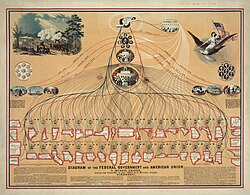
N. Mendal Shafer’s (1862) “Diagram of the Federal Government and American Union” visually maps how authority is distributed across national branches and connected to the states. As a diagram, it reinforces Madison’s point that constitutional structure can slow or block faction-driven action by forcing policy to move through multiple institutions and levels of government. Source
How Dispersion Limits Factional Control
When authority is divided across levels:
A faction strong in one state may be checked by national institutions or other states’ preferences
Policy change requires navigating multiple arenas, slowing sudden swings driven by passion
Competing centers of power create additional opportunities to block unjust measures
This dispersal supports the broader goal of controlling the effects of faction without suppressing liberty.
Why Federalist No. 10 Matters for Understanding the Constitution
Federalist No. 10 is a defense of a constitutional design that assumes:
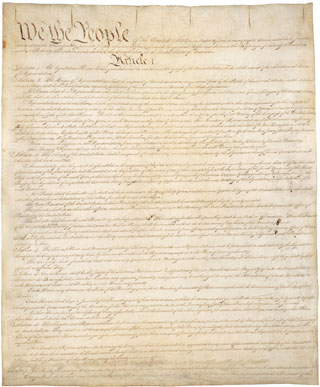
High-resolution scanned pages of the signed U.S. Constitution (National Archives) provide a direct visual reference for the institutional design Madison defends in Federalist No. 10. Using the original document underscores that his argument is about how constitutional structure—representation and layered decision-making—can control factional “mischiefs” without eliminating liberty. Source
Conflict is normal in democracy
Institutions should channel conflict into representation, negotiation, and coalition-building
Liberty is protected not by eliminating disagreement, but by preventing any one faction from easily dominating the entire system
High-Utility Takeaways for AP Government
Madison’s solution is institutional: large republic + representation + dispersed power
The threat is not faction itself, but the ability of faction (especially a majority) to capture government and harm rights and the public good
The Constitution’s design aims to make oppressive majorities less likely and less effective
Practice Questions
(2 marks) In Federalist No. 10, explain one reason Madison argues factions cannot be eliminated in a free society.
1 mark: Identifies that faction is rooted in liberty and/or diverse interests (e.g., property, opinions, passions).
1 mark: Explains why removing causes would require destroying liberty or making everyone think alike (unacceptable/impossible).
(6 marks) Using Federalist No. 10, analyse how Madison argues a large republic reduces the “mischiefs of faction”. In your answer, refer to representation and the distribution of power across levels of government.
1 mark: Defines or accurately describes “mischiefs of faction” as threats to rights/public good, especially by a majority faction.
2 marks: Explains representation as a mechanism that filters/refines public views and makes it harder for a narrow faction to control government.
2 marks: Explains how a large republic increases the number/diversity of factions, making majority formation require coalition and compromise.
1 mark: Explains dispersal of power between state and national levels as an additional barrier to factional dominance.
FAQ
He saw factions as inevitable and sometimes useful for representing interests.
The danger arises when a faction—especially a majority—can convert its preferences into unjust law.
Madison links faction to unequal property and differing economic interests.
He treats these differences as permanent features of society that government must manage, not erase.
Critics argue large size can distance representatives from voters.
They also claim national factions can still coordinate through parties, media, and fundraising networks.
It assumes elections can select capable leaders, but not perfectly.
Madison’s design reduces risk by making capture harder, even if representatives are imperfect.
It provided a major theoretical defence for an extended republic.
It also shaped how Americans justified competing interests and coalition politics as compatible with liberty.