AP Syllabus focus:
‘Anti-Federalists opposed ratification, warning that a large, centralized government threatened personal liberty; they preferred a small, decentralized republic with greater state power.’
Anti-Federalists were influential critics of the proposed Constitution who prioritised safeguarding liberty over building national capacity. Their arguments highlight enduring tensions between effective central authority and protections for individual freedom and local self-government.
Who Were the Anti-Federalists?
Anti-Federalists were a coalition rather than a single party: small farmers, debtors, and local leaders who mistrusted concentrated political power and valued responsive, community-based governance.
Anti-Federalists: Opponents of ratification who argued the proposed Constitution created an overly powerful national government that would endanger personal liberty and weaken the states.
Core Assumption: Power Tends to Expand
A central Anti-Federalist claim was that political power naturally seeks to grow, especially when housed in distant institutions. They believed that once the national government gained broad authority, it would be difficult to restrain.
Distance reduces accountability: faraway officials are harder for ordinary citizens to monitor.
Consolidation invites abuse: concentrated authority increases the risk of tyranny or arbitrary rule.
Elites benefit first: national institutions could be captured by wealthy, well-connected interests.
Liberty Concerns: Why a Large, Centralised Government Felt Dangerous
Anti-Federalists argued that the Constitution’s structure could threaten personal liberty by enabling national officials to intrude into daily life.
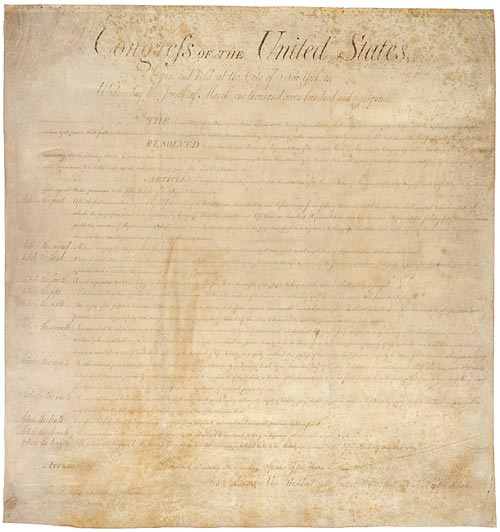
This National Archives image shows the engrossed Bill of Rights (the amendments proposed by the First Congress in 1789 and ratified in 1791). It provides a direct visual link between Anti-Federalist critiques—especially fears of federal overreach—and the addition of explicit constitutional protections for individual rights. Source
Their worry was not only what the Constitution explicitly allowed, but what it might allow over time through broad interpretations.
Fear of National “Consolidation”
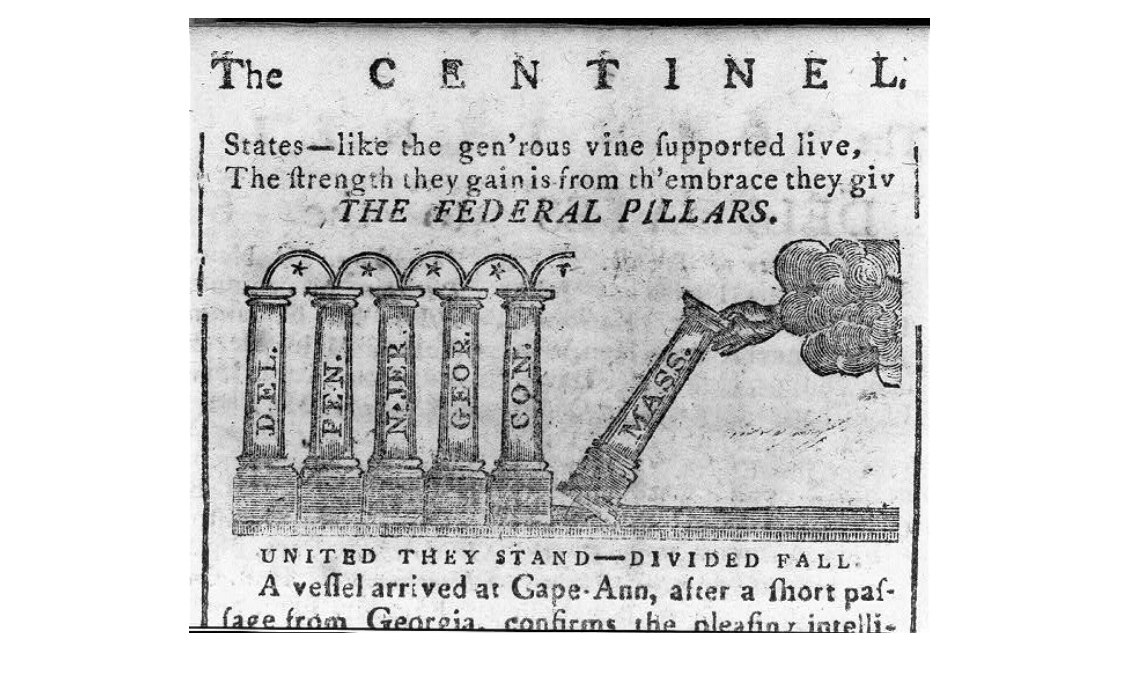
This Library of Congress ratification cartoon (“The Federal Pillars,” 1788) depicts the Constitution as a structure supported by state “pillars,” making ratification a visible, state-centered process. The image underscores how contemporaries framed the debate in terms of whether the union would hold together—and how the refusal of particular states could threaten the new system’s legitimacy. Source
They warned that the new system would shift the United States from a federation of states into a single, dominant national regime.
National supremacy in practice: even if states remained formally important, federal authority could become the default.
Uniform rules, local costs: one-size-fits-all policy could ignore local needs and traditions.
Reduced local control: citizens would have fewer meaningful opportunities to influence government close to home.
Anxiety About Representative Government at Scale
Anti-Federalists did not reject representation, but they argued that a very large republic makes representation less protective of liberty.
Fewer shared interests: larger districts can dilute community values and make officials less responsive.
Harder to know candidates: voters may rely on reputation and wealth, favouring prominent elites.
Longer chain of influence: citizens must pass concerns through multiple layers, weakening real consent.
Preference for State Power: Small, Decentralised Republic
The specification emphasises that Anti-Federalists “preferred a small, decentralised republic with greater state power.” For them, liberty was better protected when governance remained closer to the people.
Why States Were Seen as Better Guardians of Rights
Anti-Federalists viewed state governments as more trustworthy because they were:
Closer to citizens: easier access to legislators and courts.
More familiar: built around shared local economies, religions, and customs.
More easily corrected: harmful state policies could be changed through local political pressure faster than national policies.
Decentralisation as a Structural Rights Protection
Anti-Federalists believed liberty is safest when power is fragmented and local.
Multiple centres of authority: states can resist or slow national overreach.
Policy diversity: states can choose different solutions rather than being forced into national uniformity.
Local political participation: smaller communities make civic engagement and oversight more realistic.
What Anti-Federalists Wanted from Government (In Practice)
Even when arguing against ratification, Anti-Federalists still accepted the need for government; they wanted it designed to minimise threats to liberty.
Governance Priorities
Limited national responsibilities: a restrained federal role, with most governing left to states.
Tighter control of national officials: shorter terms and stronger links to local voters were seen as liberty-enhancing.
Clear boundaries: powers should be specified so citizens can recognise when government exceeds legitimate authority.
Central Theme for AP Gov
Anti-Federalist thinking connects a consistent chain of reasoning:
Liberty is fragile
Central power is risky
State power is protective
Therefore, the Constitution should not be adopted if it enables national consolidation and weakened local self-rule
Practice Questions
(2 marks) Identify one reason Anti-Federalists opposed ratification of the Constitution.
1 mark: Identifies a valid reason (e.g., fear of a large, centralised government).
1 mark: Links it to liberty or state power (e.g., threatens personal liberty or weakens states).
(6 marks) Explain two ways Anti-Federalists argued that a large, centralised republic could undermine liberty.
1 mark each (2): Names two distinct ways (e.g., reduced accountability due to distance; elite domination; weakened state authority).
2 marks each (4): Explains each way with clear causal reasoning tied to liberty (how the mechanism reduces protections or increases abuse risk).
FAQ
Support tended to be stronger in rural areas and places wary of commercial centres.
Factors included local economic interests, distrust of coastal elites, and preference for familiar state institutions.
They relied on pamphlets, pseudonymous essays, local meetings, and newspaper networks.
Influence spread through personal ties among community leaders and state-level political circles.
Most accepted some national authority (e.g., diplomacy), but wanted it narrowly defined.
They mainly resisted open-ended powers that could be interpreted expansively over time.
Some prioritised debtor relief and local economic autonomy; others focused on constitutional design.
This diversity made them effective critics but less unified on a single alternative blueprint.
Their scepticism helped normalise a tradition of vigilance against central overreach.
It also encouraged continuing debate over how much autonomy states should retain within the federal system.