AP Syllabus focus:
‘Federalists supported ratification and a stronger central government; they argued that national authority and representation would promote stability and effective governance.’
Federalists were the leading advocates for adopting the U.S. Constitution.
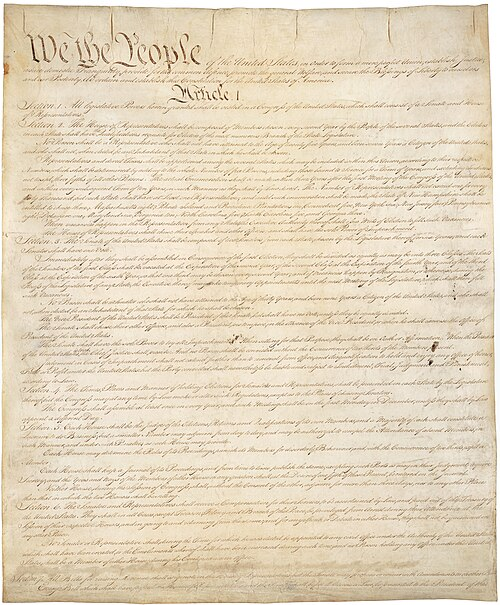
Page 1 of the U.S. Constitution (beginning with the Preamble, “We the People”) in high-resolution. This primary-source document helps connect the Federalist ratification campaign to the specific constitutional text they urged Americans to adopt, clarifying what “a stronger national framework” actually meant in practice. Source
Their case connected practical governing problems to constitutional design, arguing that a stronger national framework and representative institutions were necessary for stability and effective governance.
Who the Federalists Were
The Federalists were a coalition of influential political leaders, merchants, creditors, and professionals who promoted the proposed Constitution during the ratification debate of 1787–1788. Their arguments emphasised national solutions to national problems.
Federalists: Supporters of ratifying the U.S. Constitution who argued for a stronger national government to improve stability and effective governance.
Federalist leadership and messaging often relied on coordinated public persuasion, including essays, speeches, and state-level organising to secure approval.
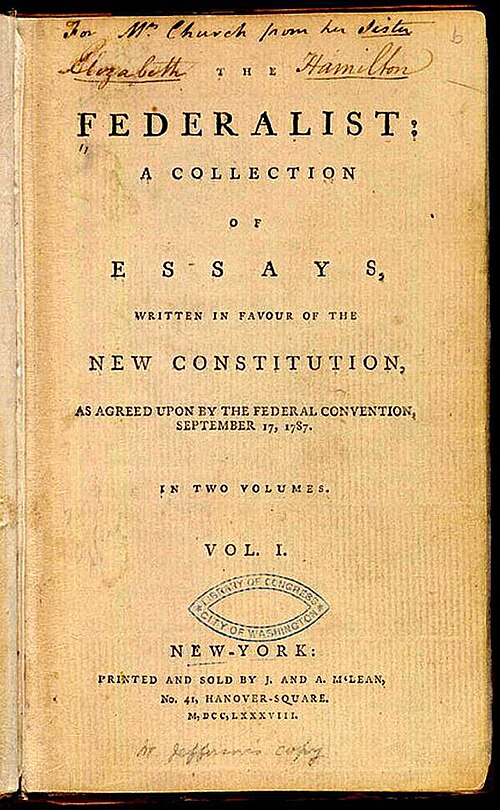
Title page of the 1788 first edition of The Federalist, the essay collection published under the pseudonym “Publius.” As a primary-source artifact, it supports study notes about Federalist persuasion by showing how arguments for ratification circulated in print and were packaged for public consumption. Source
Core Goal: Ratification of the Constitution
Federalists prioritised ratification—formal state approval required for the Constitution to take effect—because they believed the existing system could not reliably govern a growing republic.
Ratification: The formal approval process by which states accepted the Constitution through state ratifying conventions.
Federalists framed ratification as a choice between a workable national structure and continued governmental weakness, stressing urgency and long-term national survival.
Federalist Case for a Stronger National Government
Federalists supported a stronger central government because they believed national authority was essential for both order and liberty. Their reasoning focused on capacity: a government must be strong enough to function, but structured to prevent abuse.
Stability as a Primary Value
Federalists argued that national authority would promote stability by enabling consistent policy, predictable enforcement, and coherent leadership across the country. They viewed stability as necessary for:
Maintaining internal order and public safety
Encouraging economic confidence through reliable rules
Strengthening the nation’s standing and credibility
Effective Governance Through Capacity
Federalists linked constitutional ratification to effective governance, meaning a government able to act decisively within its constitutional powers. They argued a stronger national government could:
Address problems that crossed state boundaries
Reduce policy confusion created by inconsistent state actions
Provide durable institutions capable of long-term planning
Federalists presented the Constitution as a practical blueprint for governing at scale, not merely an abstract statement of ideals.
Representation as the Key to Legitimate National Power
A major Federalist claim was that representation would make stronger national power legitimate and safer. Federalists argued that elected representatives could refine public views into policy, producing decisions that were more deliberative and consistent.
How Representation Supported Federalist Arguments
Federalists emphasised that representation:
Creates a structured link between the people and government decision-makers
Encourages debate and compromise across diverse interests
Helps prevent sudden, unstable policy swings
By tying authority to elections and representative institutions, Federalists claimed the national government would remain responsive while still capable of governing effectively.
Persuasion Strategy: Building Support for Ratification
Federalists did not rely on one argument; they built a broad case tailored to different audiences and state contexts. Their strategy often combined principle with pragmatism.
Common Lines of Federalist Persuasion
Problem–solution framing: identifying governance failures and presenting the Constitution as the remedy
Credibility and expertise: using respected leaders and published arguments to reassure doubtful voters
Appeals to unity: arguing that national cohesion required a stronger central framework
Federalists also stressed that adopting a stronger national government was compatible with liberty when power was channelled through constitutional structures and representative accountability.
What to Remember for AP Analysis
When describing the Federalist position, keep the causal chain clear: ratification was necessary to create stronger national authority, which would enable stability and effective governance, and representation was the mechanism that made that authority legitimate.
Key phrases to use accurately:
supported ratification
stronger central government
national authority
representation
stability
effective governance
Practice Questions
(1–3 marks) Identify one reason Federalists supported ratification of the U.S. Constitution.
1 mark: Identifies a correct reason (e.g., to create a stronger national/central government).
1 mark: Explains it in terms of stability or effective governance (e.g., national authority would improve stability and make governing more effective).
(4–6 marks) Explain how Federalists connected national authority and representation to their argument for ratification.
1 mark: Describes Federalist support for ratification.
1 mark: Links ratification to creating stronger national authority.
1–2 marks: Explains why national authority would promote stability and/or effective governance.
1–2 marks: Explains how representation makes stronger authority legitimate (e.g., elected representatives connect people to policy and enable deliberation).
FAQ
Support was often stronger in commercially connected areas and port cities.
Reasons commonly included economic reliance on predictable rules, desire for coordinated policy, and concern about instability affecting trade and credit.
They used coordinated messaging across multiple states.
This included planned publication efforts, aligned local advocates, and targeted outreach to key delegates in state ratifying conventions.
They focused on persuading undecided convention delegates and politically attentive citizens.
These audiences often wanted reassurance that stronger national authority would not undermine representative accountability.
They argued a government must be capable of acting decisively to govern.
At the same time, they framed capacity as consistent with constitutional limits and electoral accountability, avoiding language suggesting unchecked authority.
For elite audiences, arguments often stressed institutional design, durability, and economic predictability.
For broader publics, messaging more frequently highlighted practical benefits: order, stability, and a government able to solve shared problems.