AP Syllabus focus:
‘British conflicts with American Indians over land, resources, and political boundaries led to military confrontations, including Metacom’s War (King Philip’s War) in New England.’
Metacom’s War erupted from intensifying tensions between expanding English settlements and Native peoples in New England, revealing deep conflicts over land, authority, and cultural survival in the 1670s.
Metacom’s War: Background and Causes
Metacom’s War (1675–1676), also known as King Philip’s War, emerged from decades of escalating friction between English colonists and Indigenous nations, particularly the Wampanoag, Narragansett, and Nipmuc peoples.
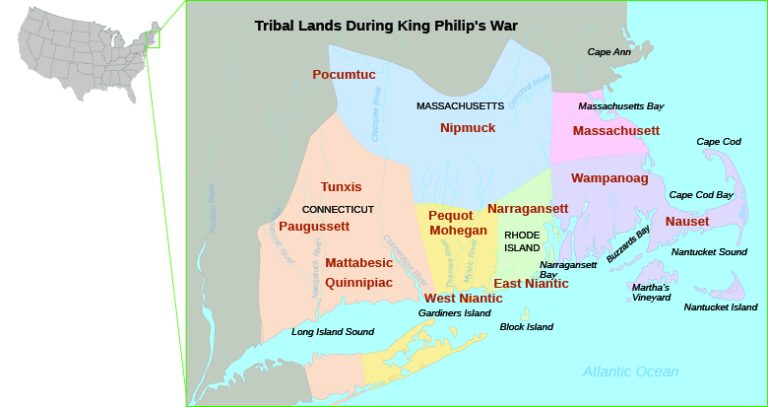
This map shows the approximate homelands of major Native nations in southern New England in 1670, including the Wampanoag, Narragansett, Nipmuc, Pequot, and Mohegan. It visually highlights how English settlements were pressing into a landscape already densely populated and politically organized by Indigenous peoples. The image includes some broader tribal and colonial labels not required by the syllabus, but these only provide geographic orientation. Source.
English Expansion and Land Pressure
By the mid-17th century, English settlers had established numerous towns across New England, frequently using legal mechanisms such as deeds, land sales, and treaties that Native peoples often understood differently than colonists.
Deed: A legal document conveying land ownership under English property law.
English interpretations of these agreements prioritized exclusive ownership, which clashed with Indigenous conceptions of shared use and seasonal rights. As a result, colonists increasingly asserted control over land and imposed English legal jurisdiction on Native communities. This shift helped undermine traditional governance structures within the Wampanoag confederation.
Growing Political Tensions
Metacom (King Philip), the Wampanoag sachem, viewed English oversight as a threat to Indigenous sovereignty. His father, Massasoit, had once maintained an uneasy but functional alliance with the Plymouth colonists. By the 1670s, however, English demands for submission, disarmament, and compliance with colonial courts left Wampanoag leaders with diminishing authority. Tensions peaked following the execution of three Wampanoag men accused of murdering a Christianized Native informant. Many Indigenous groups interpreted the trial as a direct encroachment on their political autonomy.
Outbreak and Course of the War
The conflict began in June 1675, when Wampanoag warriors attacked English settlements in Swansea.
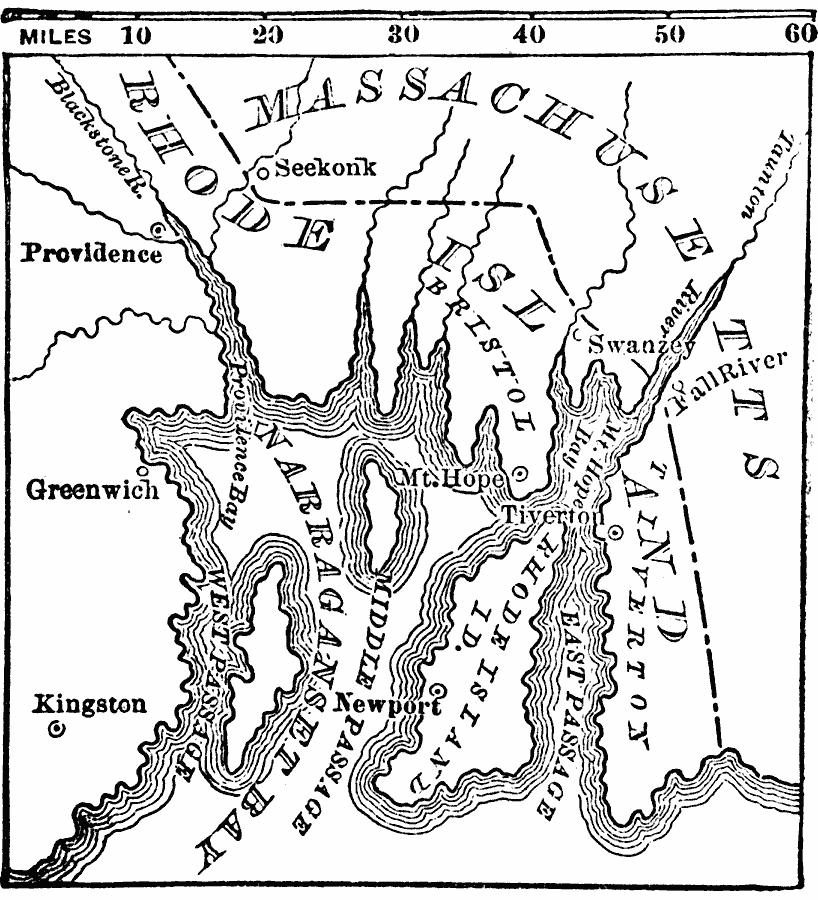
This map depicts the Narragansett Bay region where the earliest clashes of Metacom’s War unfolded, including Swansea, Mt. Hope, Providence, and Newport. It helps students visualize how violence spread along key settlements and waterways in southern Massachusetts and Rhode Island. Some additional geographic labels appear, but they serve only to orient the viewer. Source.
Indigenous Strategies and Goals
Native combatants aimed to push back English territorial advances and reassert local control. They relied on:
Guerrilla warfare, including ambushes and rapid strikes on isolated towns.
Strategic destruction of livestock, crops, and property to weaken colonial survival.
Alliances among Wampanoag, Nipmuc, and Narragansett fighters to expand the scale of resistance.
These tactics initially overwhelmed English settlements, destroying dozens of towns and halting agricultural production.
Colonial Military Response
English forces responded by militarizing their militias and forging alliances with Indigenous groups such as the Mohegan and Pequot, who sought to weaken regional rivals. Colonial authorities also used scorched-earth strategies against Native villages, especially targeting food stores to undermine Indigenous resistance.
Key Turning Points
The Great Swamp Fight (December 1675)
One of the war’s decisive battles occurred when colonial militias launched a devastating attack on a fortified Narragansett settlement.
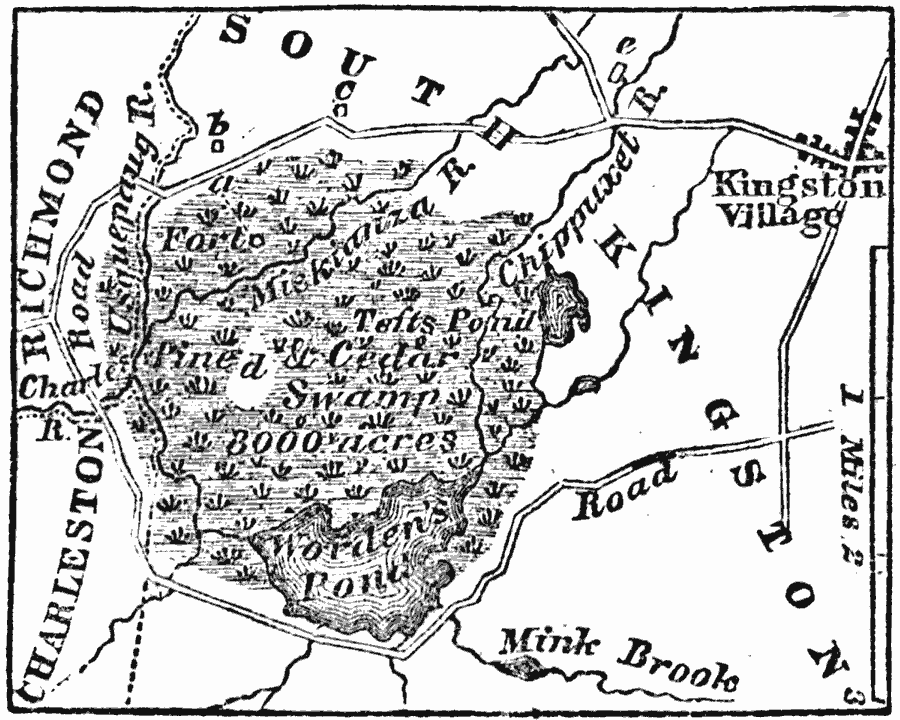
This historical map shows the swampy terrain where the Narragansett fort stood, the focal point of the Great Swamp Fight. It highlights how the marsh landscape shaped the strategies and difficulties of both Native defenders and colonial militias. Some period place names and road references are included, but they primarily help situate the location. Source.
Fragmentation of Indigenous Resistance
By 1676, Indigenous groups faced severe shortages of food, munitions, and safe refuge. Winter conditions and constant colonial pursuit further strained their ability to coordinate. Internal divisions and the death of key leaders accelerated the breakdown of the Native coalition.
Metacom’s Death
Metacom’s death in August 1676 near Mount Hope marked a symbolic end to major hostilities. Surviving Indigenous fighters were killed, sold into slavery in the West Indies, or forced into submission under colonial rule.
Consequences of the Conflict
Metacom’s War had profound consequences for both Indigenous peoples and English colonists, reshaping the balance of power in New England.
Demographic and Material Devastation
The war was among the deadliest conflicts in colonial American history relative to population size.
Many Native communities suffered catastrophic losses through warfare, starvation, disease, and enslavement.
English settlements experienced widespread destruction, with several towns abandoned permanently.
The colonial economy endured severe short-term disruptions due to the loss of crops, livestock, and trade.
Transformation of Indigenous Autonomy
Following the war, English colonists imposed strict controls over surviving Native populations.
Many were confined to praying towns or forced onto limited parcels of land.
Tribal political independence diminished, as colonial courts asserted authority over Indigenous affairs.
Alliances among Native groups in southern New England fractured under the combined pressures of war and colonial governance.
Strengthening of English Colonial Authority
The war also consolidated English political power. Colonial governments expanded militia systems, increased regional coordination, and enacted laws limiting Native movement, access to arms, and land rights. The conflict reinforced the colonists’ view of Indigenous peoples as obstacles to territorial and economic expansion, shaping future policies of displacement.
Long-Term Regional Implications
Metacom’s War marked a turning point in British–Indigenous relations, solidifying English dominance in New England and dramatically curtailing Indigenous resistance. Although small conflicts continued, Native communities could no longer mount unified military opposition to colonial expansion. The war also deepened racialized attitudes toward Native peoples, influencing later colonial and imperial policies across British North America.
FAQ
Missionary activity eroded traditional power structures by encouraging Indigenous conversion and settlement in praying towns, which operated under English supervision.
Many Wampanoag leaders viewed this as undermining their authority, especially when converted Natives served as interpreters, informants, or intermediaries in colonial courts.
The cultural pressure created divisions within Native communities, increasing suspicion and resentment toward English settlers.
Winter conditions in 1675–76 played a crucial role. Freezing temperatures and limited food supplies strained Indigenous mobility and weakened resistance.
Colonial militias, operating from fortified towns with stored provisions, were better positioned to sustain winter campaigning.
The harsh season accelerated the collapse of Native alliances by making it difficult to coordinate movements and protect vulnerable non-combatants.
These groups sought to weaken regional rivals like the Wampanoag and Narragansett, who had traditionally competed with them for territory, trade, and influence.
Aligning with the English offered strategic benefits:
Access to weapons and supplies
Opportunities to reinforce political standing
Greater security against hostile neighbouring nations
This pragmatic alliance demonstrated the complexity of Indigenous diplomacy during the conflict.
Many English colonists saw the conflict as divine punishment or a test of communal morality, reinforcing Puritan notions of collective responsibility.
Leaders also framed the war as evidence that stronger regional coordination was necessary. This contributed to:
Increased militia organisation
Greater cooperation between colonies
More assertive efforts to regulate Native affairs
The war thus influenced emerging regional governance practices.
Thousands of Indigenous people were captured, and their fates varied widely.
Many were sold into slavery in the Caribbean and the Azores, where they faced harsh labour and permanent separation from their communities.
Others, especially women and children, were forcibly indentured in New England households, where they experienced cultural displacement and limited legal rights.
A small number were confined to supervised communities, often under strict surveillance and with limited freedom of movement.
Practice Questions
Question 1 (1–3 marks)
Identify and briefly explain one major cause of Metacom’s War (King Philip’s War) in New England.
Question 1
• 1 mark for identifying a relevant cause, such as English expansion onto Indigenous lands, colonial imposition of English law, or the execution of Wampanoag men.
• 1–2 marks for explaining how this cause contributed to rising tensions and the outbreak of war.
• Full marks require a clear causal link between the factor identified and the start of the conflict.
Question 2 (4–6 marks)
Explain how Metacom’s War changed the balance of power between English colonists and Indigenous peoples in New England. In your answer, refer to both short-term and longer-term consequences.
Question 2
• 1–2 marks for describing short-term consequences, such as the destruction of Native communities, deaths of Indigenous leaders, or the collapse of Indigenous alliances.
• 1–2 marks for describing longer-term consequences, such as the loss of Indigenous autonomy, increased English control over land and governance, or the decline of Indigenous military resistance.
• 1–2 marks for explaining how these changes shifted the overall balance of power decisively in favour of the English colonists.
• Higher-level answers must use accurate historical detail, show clear explanation, and reference both short-term and long-term impacts.