AP Syllabus focus:
‘Growing international migration sparked public debates over assimilation and Americanization as immigrants balanced old traditions with U.S. culture.’
Late nineteenth-century immigration reshaped American society, prompting intense debates over assimilation and Americanization as newcomers negotiated cultural identity amid pressures to conform to evolving national norms.
Assimilation and Americanization in the Gilded Age
Public discussion about immigrant adaptation intensified as immigration surged from southern and eastern Europe and Asia.
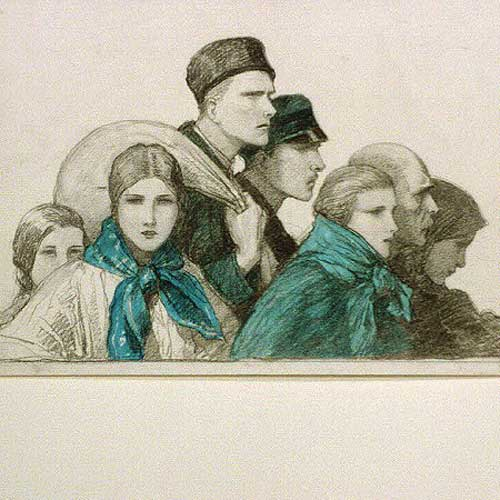
This illustration portrays diverse immigrant arrivals during the late nineteenth century, highlighting the social context that fueled national debates over assimilation. Although not depicting Americanization programs directly, it visualizes the demographic changes that intensified conflict over cultural identity. Source.
Many Americans questioned whether newcomers could—or should—retain cultural traditions while integrating into the expanding industrial nation. Reformers, politicians, employers, and immigrants themselves entered these debates, shaping competing visions of what it meant to belong in the United States. These debates had lasting implications for cultural pluralism, national identity, and federal policy.
Defining Assimilation and Americanization
The influx of immigrants led to widespread use of the term assimilation, introduced in discussions of how newcomers adopted dominant cultural patterns.
Assimilation: The process by which immigrants adopt the language, cultural norms, values, and behaviors of the host society, often under social or institutional pressure.
Debates about assimilation often overlapped with Americanization, which emphasized active transformation rather than gradual cultural adaptation.
A variety of institutions—from schools to settlement houses—claimed authority to direct this transformation. Arguments differed over how much cultural difference should be tolerated, and whether assimilation should occur voluntarily or through coercive policies.
Forces Encouraging Assimilation
Rapid industrialization and urbanization created new environments in which immigrant communities interacted closely with long-settled Americans. Several powerful forces encouraged newcomers to conform culturally.
Industrial workplaces pushed for English-language proficiency and standardized behavior to increase productivity and reduce conflict.
Public school systems, expanding dramatically in this period, promoted patriotic instruction, U.S. history, and English literacy as tools for national unity.
Mass culture, including newspapers, consumer goods, and entertainment venues, drew immigrants into shared cultural experiences.
Political rhetoric stressed loyalty to the nation during debates over labor unrest and fears of radicalism.
These forces helped create a public expectation that immigrants would gradually blend into mainstream American society.
Immigrant Strategies and Cultural Retention
Immigrants did not simply absorb dominant cultural norms; many actively balanced tradition with adaptation. Ethnic neighborhoods offered opportunities for cultural continuity and communal support. Churches, benevolent societies, and mutual-aid organizations preserved language, festivals, religious practice, and customary law while helping newcomers navigate American institutions.
Immigrants frequently adopted practical aspects of assimilation—such as language acquisition—without relinquishing heritage.
Cultural blending produced distinct hybrid identities, enabling immigrant families to participate in American civic life while maintaining ties to ancestral customs.
Resistance to Americanization programs sometimes emerged when these efforts appeared to stigmatize immigrant cultures or demand complete cultural abandonment.
This dynamic demonstrates that assimilation was not a linear process but a negotiation shaped by community autonomy and structural pressures.
Americanization Programs and Reform Movements
The late nineteenth century saw the rise of organized Americanization efforts intended to shape immigrant behavior and cultural orientation.
Schools and Civic Instruction
Public schools pursued a civic mission to cultivate patriotism and shared national values. Teachers emphasized English literacy, lessons on democratic institutions, and respectful workplace conduct. These programs helped standardize educational experiences across diverse communities.
Settlement Houses
Settlement-house leaders worked to help immigrants adjust to urban life by offering classes, childcare, and employment assistance.
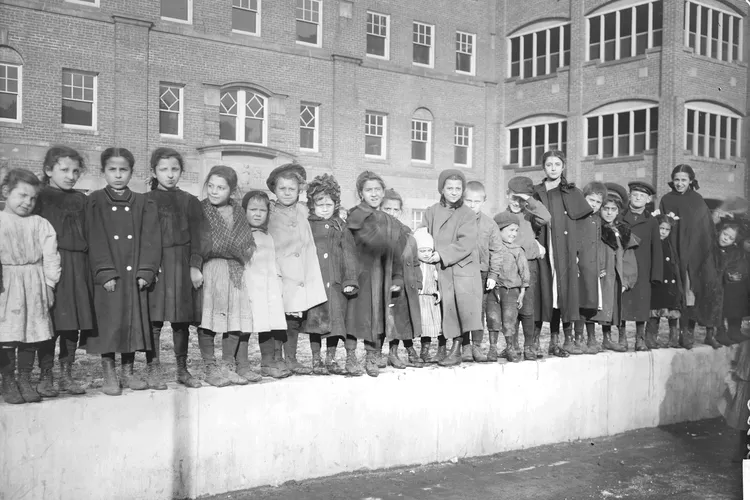
This photograph shows children at Hull House, illustrating how settlement houses provided supportive services to immigrant communities. It reflects the educational and social programs designed to ease adjustment to urban life. Although the image dates to 1908, it accurately represents practices that originated in the late nineteenth century. Source.
Americanization: Reform movement encouraging immigrants to adopt U.S. cultural norms, political values, and language, often through structured programs and patriotic instruction.
Many reformers believed these programs would foster social cohesion in crowded industrial cities.
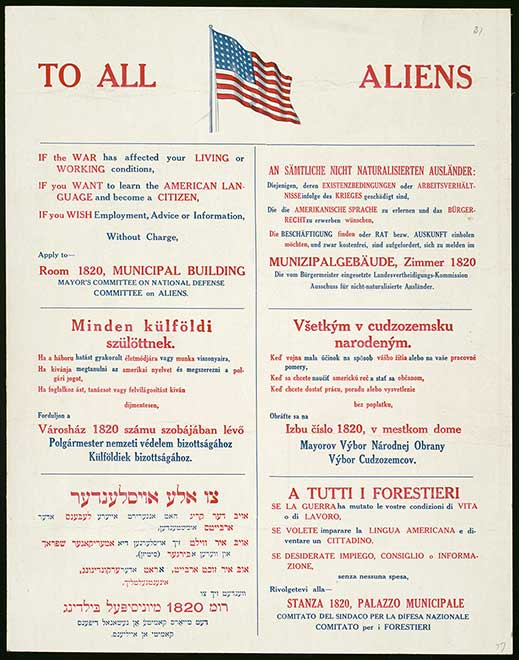
This Americanization poster urges immigrants to learn English and pursue citizenship, demonstrating the structured programs reformers used to promote cultural conformity. Although produced in 1917, it closely echoes the themes and strategies of earlier Americanization efforts that emerged in the Gilded Age. Source.
Nativism and Pressures to Conform
Not all assimilation debates were benevolent or reform-minded. Nativism, rooted in longstanding fears of cultural difference, framed immigrants as threats to national stability. Nativists often argued that certain groups—especially those perceived as racially or religiously different—were incapable of assimilation.
Anti-immigrant groups portrayed southern and eastern Europeans as politically radical and morally suspect.
Chinese immigrants faced particularly intense hostility, culminating in the Chinese Exclusion Act of 1882, which curtailed immigration and reinforced racialized boundaries of belonging.
Newspaper campaigns, political cartoons, and activist organizations normalized stereotypes and pressured immigrants to conform or face exclusion.
These ideas reshaped public discourse by linking assimilation debates to nationalism, racial hierarchy, and federal immigration policy.
Competing Visions of National Identity
Underlying the debates were fundamental disagreements about what constituted American identity. Some believed the United States should function as a “melting pot,” blending diverse cultures into a unified whole. Others preferred a cultural hierarchy privileging Anglo-American norms. Still others viewed immigrant traditions as enriching the national fabric and argued for a more pluralistic society.
These competing visions emerged in workplaces, urban neighborhoods, political rhetoric, and religious institutions. As immigrants navigated pressures to assimilate, they also contributed meaningfully to the cultural diversification of the nation, challenging narrow definitions of American identity and shaping debates that continued into the twentieth century.
Practice Questions
Question 1 (1–3 marks)
Identify and briefly explain one reason why debates over assimilation intensified in the United States during the late nineteenth century.
Mark scheme:
1 mark for identifying a valid reason (e.g., increased immigration from southern and eastern Europe or Asia; fears of cultural fragmentation; concerns about political radicalism).
1 mark for explaining how this factor contributed to debates about assimilation (e.g., newcomers were seen as culturally distinct, prompting calls for Americanisation).
1 additional mark for providing a clear contextual link to industrialisation, urbanisation, or changing labour markets.
Question 2 (4–6 marks)
Explain how Americanisation programmes attempted to shape the experiences of immigrants in the late nineteenth century. In your answer, consider both educational and social approaches.
Mark scheme:
Up to 2 marks for describing the educational dimension (e.g., public schools promoting English language learning, patriotic instruction, civic education).
Up to 2 marks for describing the social or community-based dimension (e.g., settlement houses offering classes, childcare, employment support, and cultural guidance).
Up to 1 mark for explaining the intended purpose of these programmes (e.g., fostering social cohesion, encouraging loyalty, facilitating workplace integration).
Up to 1 mark for linking these practices to broader national debates about identity, nativism, or the perceived need to integrate diverse populations.
FAQ
Assimilation pressures varied depending on perceptions of racial, religious, and cultural difference. Immigrants from northern and western Europe generally faced less scrutiny, as many Americans viewed them as culturally compatible.
By contrast, southern and eastern European immigrants, as well as Asian immigrants, often encountered stronger demands to abandon traditional practices. These groups were more frequently associated with radical politics, unfamiliar religions, or perceived racial difference, intensifying calls for rapid Americanisation.
Employers influenced assimilation by promoting English proficiency and uniform work habits to increase efficiency and reduce conflict.
Some companies offered English classes or encouraged attendance at Americanisation programmes, emphasising punctuality, discipline, and loyalty. Industrial workplaces thus helped frame assimilation as essential for economic advancement while reinforcing managerial control.
Immigrant-run newspapers provided guidance on navigating American institutions while preserving cultural traditions, enabling readers to interpret assimilation on their own terms.
They created shared public spaces for debate, allowing immigrants to challenge hostile stereotypes, defend their customs, and discuss political participation. In doing so, they offered an alternative voice to mainstream press narratives that often pressured newcomers to conform fully.
Religious institutions acted as centres of cultural preservation by offering worship in native languages, transmitting traditions, and providing schooling.
They also encouraged selective assimilation, helping immigrants adapt to new laws and social norms while maintaining moral and communal ties. Clergy often mediated between immigrant groups and broader American society, balancing participation with cultural continuity.
Children typically assimilated more quickly, as they attended school, learned English rapidly, and absorbed mainstream cultural expectations.
This created a generational bridge but also tension. Children often served as interpreters and cultural intermediaries, accelerating family adaptation, yet their faster assimilation sometimes challenged parental authority and traditions.
Their experiences highlight how assimilation unfolded unevenly within immigrant households.