AP Syllabus focus: ‘Judaism and Islam, alongside Christianity, and the core beliefs and practices of these religions continued to shape European society.’
Medieval Europe was predominantly Christian, yet Jewish and Muslim communities remained vital minorities. Their religious practices, legal status, economic roles, and cultural exchanges shaped politics, scholarship, and everyday life from c. 1200 to c. 1450.
Framing Religious Diversity in Europe (c. 1200–1450)
Christian institutions and rulers usually defined public norms, but Europe contained long-standing Jewish diasporic communities and significant Muslim populations (especially in Iberia and parts of the Mediterranean).
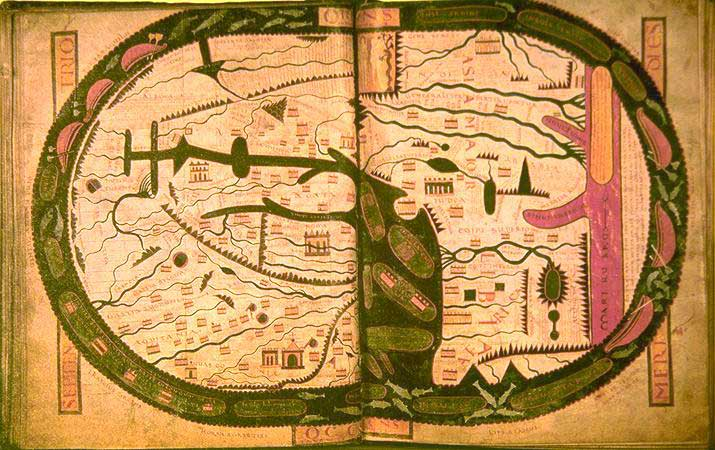
This is a “Beatus map,” a type of medieval Christian mappa mundi produced in Iberian manuscript traditions. It helps students visualize how Latin Christian Europe represented the world and its regions—an intellectual backdrop for later encounters with Islamic geography and Mediterranean exchange. Using it alongside Islamic cartography highlights that “knowledge transfer” occurred across distinct scholarly traditions, not from a single unified mapmaking culture. Source
Diversity was managed through a mix of pragmatic tolerance, segregation, and periodic persecution.
Key idea: “protected minority” status
In many places, rulers regulated minority faiths through special legal categories, taxes, and residence rules rather than immediate forced conversion.
Dhimmi: In Islamic states, a legally protected non-Muslim (often Jews and Christians) allowed to practice their religion in exchange for loyalty and a special tax.
Judaism in Medieval Europe
Jewish life was organized around synagogues, rabbis, and communal institutions that maintained religious law, education, and charity.
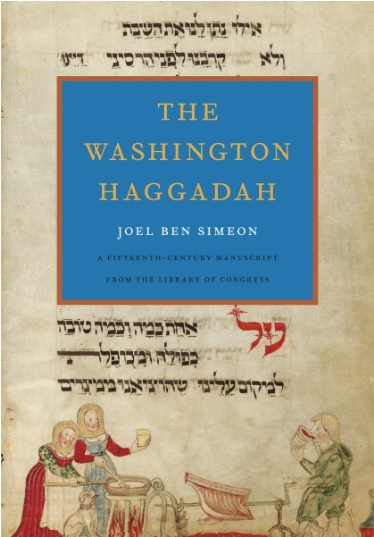
This page introduces the “Washington Haggadah,” a fifteenth-century illuminated Jewish manuscript used in Passover ritual practice. As a material artifact of late-medieval Jewish life in Europe, it highlights how religious identity was sustained through home and communal liturgy, Hebrew learning, and shared ritual calendars. The manuscript format also illustrates the cultural sophistication and durability of Jewish communities despite legal and social vulnerability. Source
Jewish belief and practice—especially monotheism, Torah study, and ritual observance—helped preserve identity within often-hostile Christian majorities.
Social and economic roles
Jewish communities frequently lived in distinct neighborhoods and maintained transregional ties through family and trade.
In some Christian kingdoms, Jews served as merchants, craft workers, and sometimes moneylenders or fiscal agents, partly because Christian authorities often restricted Christian lending at interest.
Rulers could value Jewish expertise for taxation and credit, while simultaneously treating Jews as politically vulnerable dependents.
Restrictions and persecution
Many authorities imposed visible or legal separation (special taxes, limits on offices, residence constraints).
Periodic violence and scapegoating occurred, including accusations tied to religious difference and moments of crisis (such as economic stress or disease).
Some regions moved toward expulsions or coerced conversions late in the period, reflecting intensified religious policing and state consolidation.
Islam in Medieval Europe
Muslim belief and practice—monotheism, daily prayer, fasting, almsgiving, and legal traditions—shaped European society most directly where Muslim rule or sizeable Muslim communities persisted.
Where Islam mattered most
Iberian Peninsula (al-Andalus): Long-standing Muslim presence created multi-religious societies where Muslims, Christians, and Jews interacted under shifting political control.
Mediterranean islands and coastal zones: Muslim communities existed under varying rulers, including in parts of Italy and Sicily at different times, influencing agriculture, trade, and administration.
Cultural and economic influence
Muslims participated in urban economies and Mediterranean commerce, linking Europe to broader Afro-Eurasian markets.
Islamic learning contributed to European intellectual life through the movement of texts and techniques (especially in medicine, mathematics, and philosophy) via translation and scholarly contact.
Architectural and artistic forms in some regions reflected Islamic styles and building knowledge.
Conquest and changing status
As Christian kingdoms expanded, Muslim communities increasingly lived under Christian rule, where they might initially retain local customs but often faced growing pressure: special taxes, legal limits, and eventual forced conversion or expulsion in some areas.
Interactions Among the Three Faiths
Religious diversity shaped social order through both everyday coexistence and formal boundaries.
Coexistence: Trade, shared languages, and local governance sometimes enabled practical cooperation.
Conflict: Religious identity could be mobilized for political legitimacy, producing discrimination, violence, and campaigns to homogenize belief.
Exchange: Interfaith contact supported knowledge transfer, helping connect European scholarship to wider intellectual traditions.
Practice Questions
(2 marks) Give one way Judaism and one way Islam, alongside Christianity, shaped European society in the period c. 1200–1450.
1 mark: valid Judaism example (e.g., Jewish communal institutions; roles in trade/finance; minority legal status).
1 mark: valid Islam example (e.g., Muslim communities in Iberia; cultural/intellectual transmission; Mediterranean trade links).
(6 marks) Compare the experiences of Jewish and Muslim communities living under non-co-religionist rule in medieval Europe (c. 1200–1450). Use specific evidence.
1 mark: identifies a similarity (e.g., special taxes/legal restrictions; protected-but-subordinate status).
1 mark: supports similarity with evidence (e.g., segregation rules; fiscal utility to rulers).
1 mark: identifies a difference (e.g., geography/scale: Muslims concentrated in Iberia; Jews dispersed).
1 mark: supports difference with evidence (e.g., reconquest changing Muslim status; expulsions/persecutions).
1 mark: explains how religious identity affected social/political treatment (not just description).
1 mark: overall comparison is coherent and historically defensible.
FAQ
Christian authorities often restricted usury for Christians, creating niches Jews could fill under royal protection.
Scholars worked in multilingual settings, rendering Arabic texts into Latin (often via intermediaries) for European universities and courts.
Some initially kept property and worship with taxes, but pressures often increased over time, including conversion campaigns or expulsions.
Limited. They often governed internal affairs (family law, charity) but remained subject to rulers’ taxation and legal constraints.
Prejudice and theological hostility could intensify during crises, when communities were scapegoated and targeted by mobs or authorities.