AP Syllabus focus: ‘Europe was largely agricultural and depended on free and coerced labor, including serfdom, which shaped social organization.’
Medieval European life (c. 1200–1450) revolved around farming. Land, labor obligations, and access to resources structured daily work and social rank, linking agricultural production to systems of free and coerced labor.
Agricultural Foundations of Medieval Europe
Land use and rural production
Most Europeans lived in villages and worked the countryside, where wealth came primarily from controlling land and extracting agricultural surplus.
The dominant setting was the manor: a landed estate with fields, pastures, and woodlands supporting both elites and peasants.
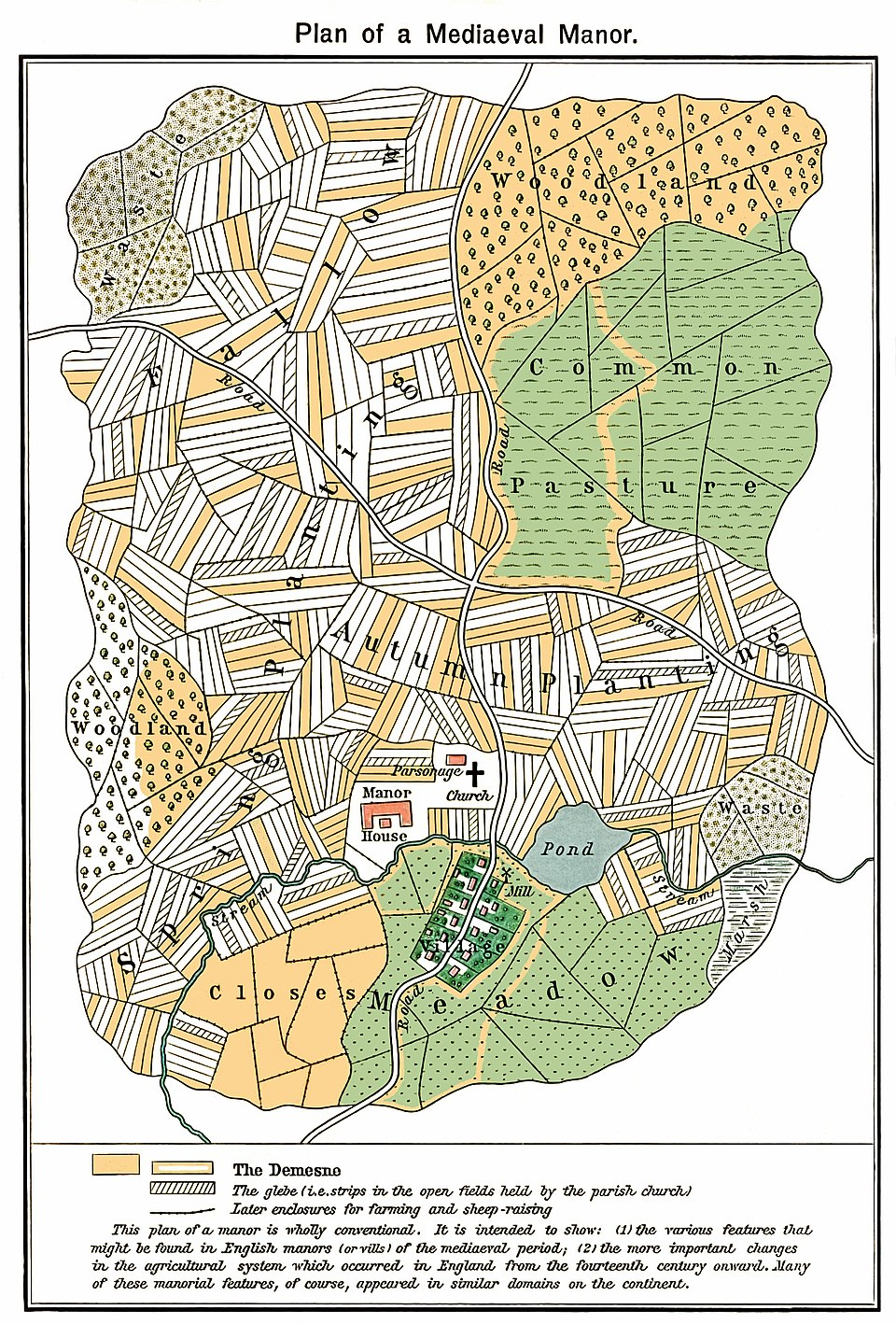
Labeled plan of a medieval manor (a schematic), showing the village, open fields divided into strips, and areas reserved as the lord’s demesne alongside shared resources like pasture and woodland. It illustrates how land organization structured both production and social hierarchy, including where obligatory labor on demesne lands typically fit into the rural economy. Source
Farming choices were shaped by climate and soils, but shared patterns included grain cultivation (wheat, rye, oats) and mixed farming with livestock for traction, manure, and food.
Common resources mattered:
Commons (shared grazing/meadow) supported smallholders’ animals.
Woodlands supplied fuel and building materials, often regulated by lords.
Agricultural techniques and productivity
Agriculture remained labor-intensive, with improvements that modestly raised output in many regions.
Three-field system rotated winter crops, spring crops, and fallow land to reduce soil exhaustion and spread risk.
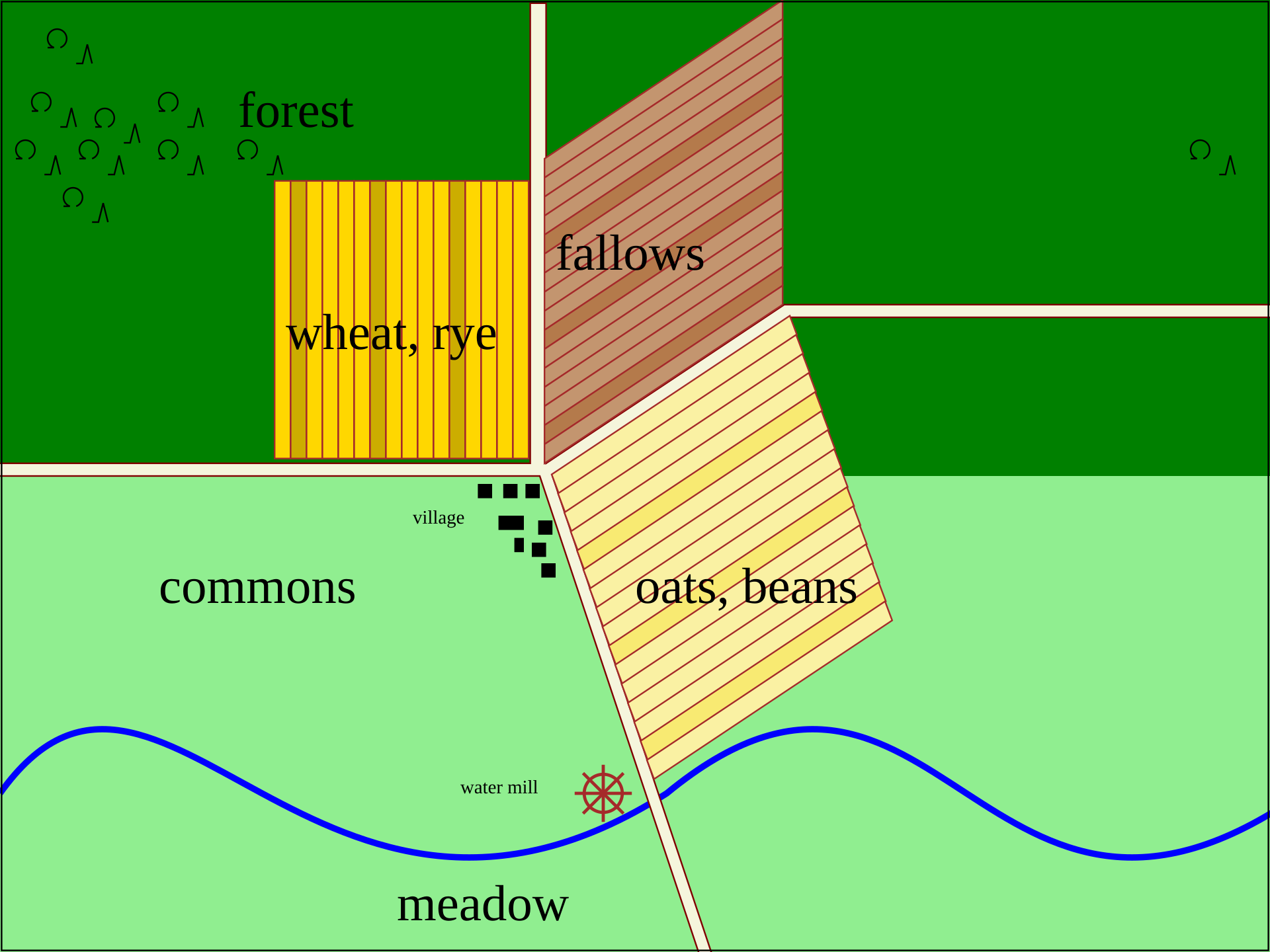
Diagram of the medieval three-field system, showing how arable land was divided into three sections that rotated between winter crops, spring crops, and fallow. This layout helps explain how communities increased the share of land under cultivation while still allowing soil recovery. Source
Heavier ploughing in northern Europe and better animal traction increased the amount of land that could be cultivated.
Despite gains, yields were vulnerable to weather shocks, war disruption, and disease, keeping most households near subsistence.
Labor Systems: Free and Coerced
Peasant labour and obligations
Serfdom: A system of coerced rural labor in which peasants (serfs) were legally bound to a lord’s land and owed labour services and dues in exchange for access to farmland and protection.
Serfdom varied by region, but typically tied labor to landholding and customary obligations rather than wages.
Labour services: required days working the lord’s demesne (the lord-controlled fields).
Rents and dues: payments in kind (grain, animals) or money as markets expanded.
Restrictions: limits on movement, marriage arrangements, and inheritance terms, enforced through manorial courts.
Free labour and wage work
Not all labor was coerced. Free peasants held land with fewer constraints and could negotiate rents or relocate, especially where land was more available.
Seasonal wage labour existed even in rural areas (harvest work, herding, carting), often supplementing household production.
In towns and growing market centers, craft and service work offered alternatives to agricultural labour, though food supply still tied urban life to the countryside.
Shock and change: scarcity of workers
From the mid-14th century, demographic crisis (notably plague outbreaks) reduced the workforce in many areas, intensifying competition for labour.
In some regions, peasants demanded lower obligations or higher pay, encouraging commutation of labour services into money rents.
Elites often resisted through legal restrictions and renewed enforcement of dues, producing uneven outcomes rather than a uniform “end” to serfdom.
Social Organisation Shaped by Agrarian Life
Hierarchy and rural community structure
Agriculture and labour obligations underpinned a stratified society.
Nobility/landlords: drew income from land rights and peasant dues; their status was reinforced by control of justice and local privileges.
Clergy and monasteries: major landholders who collected rents and tithes; they also organised charity and preserved social authority in villages.
Peasantry: internally diverse:
Better-off tenants could accumulate land, tools, and animals.
Land-poor labourers faced insecurity and dependence on access to commons or wages.
Gendered division of labour
Household production relied on a gendered but flexible division of work.
Men commonly handled heavy ploughing, long-distance hauling, and some field tasks requiring teams.
Women’s labour was central to food processing, dairy, textile production, gardening, and seasonal fieldwork, sustaining both subsistence and local exchange.
Because obligations were tied to households, families organised labour to meet dues while maintaining their own survival.
Local regulation and customary order
Village life was governed by custom and local institutions that connected work to social control.
Manorial courts and village assemblies regulated field access, grazing, and disputes.
Seasonal rhythms (planting, harvest) coordinated collective labour in open-field areas, reinforcing cooperation alongside hierarchy.
Practice Questions
Describe one way in which serfdom shaped agricultural labour in Europe c. 1200–1450. [2 marks]
1 mark for identifying a feature of serfdom (e.g., serfs bound to the land; owed labour services/dues).
1 mark for linking that feature to agricultural labour on a manor (e.g., required to work the lord’s demesne during peak seasons such as harvest).
Explain how reliance on both free and coerced labour influenced European social organisation in the period c. 1200–1450. [5 marks]
1 mark for explaining coerced labour’s role (e.g., serf obligations produced surplus for lords).
1 mark for explaining free labour’s role (e.g., free tenants/wage labour created bargaining or mobility in some regions).
1 mark for connecting labour systems to hierarchy (e.g., landlords/clergy at top supported by dues and rents).
1 mark for connecting labour to village/community structure (e.g., manorial regulation of commons/fieldwork reinforced social control).
1 mark for using a relevant piece of supporting evidence (e.g., labour services on demesne; money rents replacing some services; seasonal wage harvest work).
FAQ
No. Obligations differed by region and estate.
In some places, serfs owed heavy weekly labour services; elsewhere, dues were lighter or more often paid in kind or cash, depending on local custom and market access.
Commons reduced risk for poorer households.
Grazing rights supported animals that provided manure, traction, milk, and meat.
Access to wood and forage lowered the need for cash, making households less vulnerable in bad harvest years.
Enforcement was typically local and routine.
Manorial courts could fine tenants, adjudicate disputes over land use, and record customary duties, turning social pressure and legal practice into a mechanism for extracting labour and dues.
Rural wages were not limited to field labour.
Examples include carting goods to market, maintaining roads/bridges, building barns or fences, and tending animals for wealthier tenants—often paid seasonally when demand was highest.
Money rents could loosen direct control over daily labour while increasing dependence on markets.
Peasants needed cash (selling surplus, spinning textiles, or wage work), and lords became more interested in reliable payments—sometimes encouraging record-keeping and stricter accounting of obligations.