AP Syllabus focus: ‘Christianity and its core beliefs and practices continued to shape European societies in the period from c. 1200 to c. 1450.’
Christianity was the dominant cultural force in medieval Europe. Between c. 1200 and 1450, Christian institutions structured daily life, justified political authority, shaped learning and art, and defined ideals of morality, community, and social obligation.
Christianity as a Social Framework
Core beliefs embedded in daily life
Most Europeans understood life through a Christian worldview of sin, salvation, and divine judgement, reinforced through regular worship and communal rituals.
Parish life organized local communities around a church, priest, and calendar of holy days.
The liturgical year (Advent, Lent, Easter, saints’ days) shaped work rhythms, markets, and village celebrations.
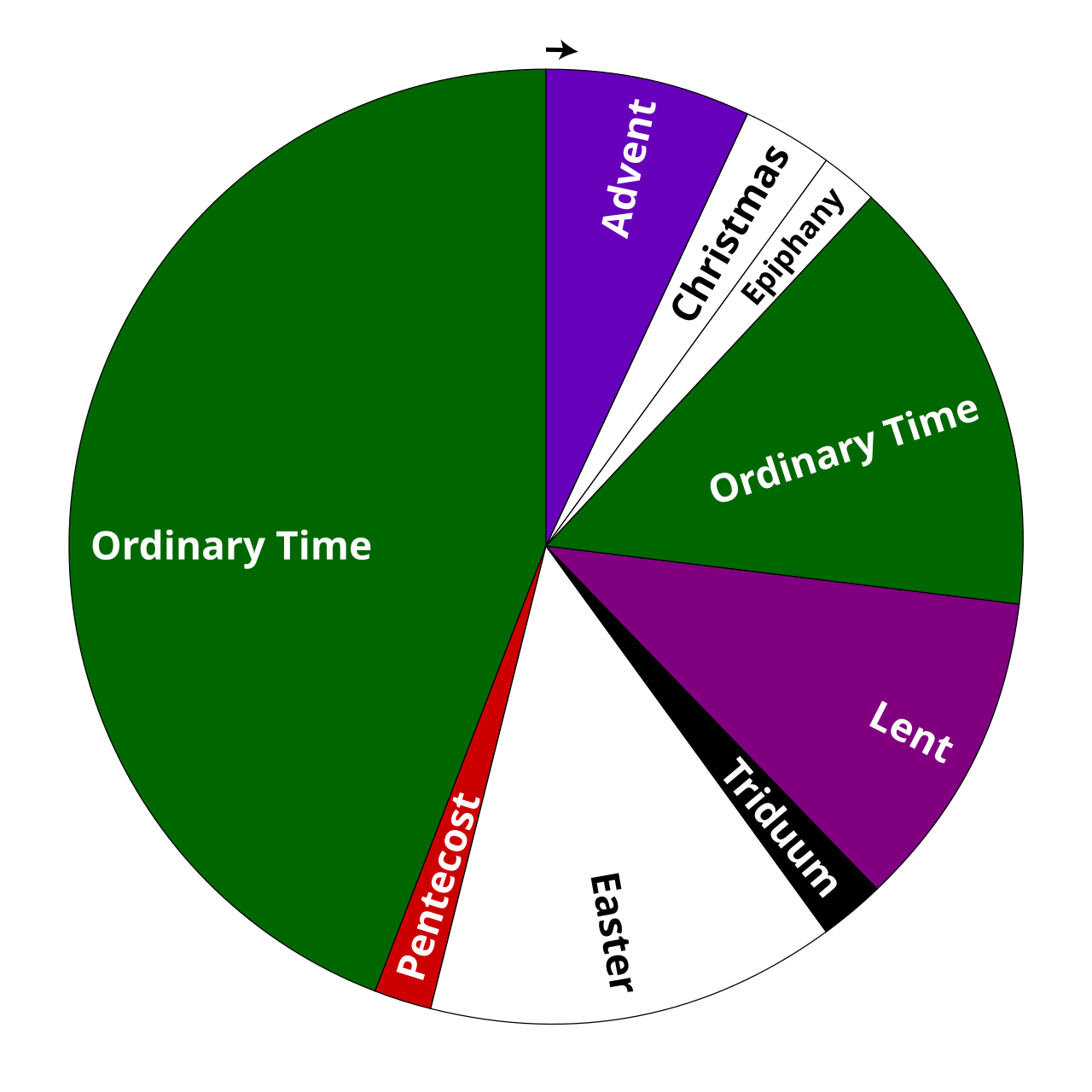
This diagram maps the Western Christian liturgical year as a cyclical calendar, emphasizing how feasts and seasons repeat annually rather than following a purely “secular” schedule. Seeing the year as a loop helps explain why religious observances structured timekeeping, communal gatherings, and expectations for work and worship in medieval society. Source
Devotional practices included prayer, confession, and veneration of saints, encouraging people to see spiritual meaning in ordinary events (illness, harvests, wars).
Sacraments and moral regulation
Sacraments: Church-authorised sacred rites (such as baptism and the Eucharist) believed to convey divine grace and mark major stages of Christian life.
Participation in sacraments strengthened community identity and gave clergy ongoing influence over family formation, sexuality, and burial customs.
Marriage became more clearly treated as a religious bond, encouraging Church oversight of legitimacy and inheritance.
Confession and penance promoted norms of repentance and obedience while expanding clerical authority over morality.
The Medieval Church as an Institution of Power
Clergy, hierarchy, and Church wealth
European Christianity was primarily organized through the Roman Catholic Church, with a hierarchy linking local parishes to bishops and, ultimately, the papacy.

This chart lays out the formal hierarchy of the Roman Catholic Church, clarifying how authority was organized from the pope through senior church leadership to local clergy and the laity. As a study aid, it makes the Church’s institutional structure easy to recall when explaining why clerics could influence law, politics, and daily community life. Source
The Church accumulated wealth through tithes, landholding, and donations.
Many monasteries and bishoprics were major landlords, influencing peasant obligations and local justice through their estates.
Canon law and social order
Church courts and rules shaped public life by defining religious and social offences.
Canon law guided decisions on marriage disputes, inheritance legitimacy, clerical discipline, and moral behaviour.
Tools such as excommunication and interdict gave Church leaders leverage over individuals and rulers by threatening spiritual and communal isolation.
Christianity and Political Legitimacy
Sacred authority and rulers
Christianity helped legitimise medieval governance by presenting political order as part of a divinely approved hierarchy.
Monarchs used coronations, oaths, and religious imagery to frame rule as morally sanctioned.
Rulers funded churches, monasteries, and cathedrals to display piety and reinforce authority.
Church officials sometimes served as royal administrators because literacy and record-keeping were concentrated in clerical circles.
Tensions between Church and state
Because both kings and popes claimed authority over Christian society, conflicts emerged over appointments, taxation, and jurisdiction.
Disputes over who controlled bishops and Church revenues reflected competition between spiritual authority and secular power.
These tensions mattered socially because they could disrupt local governance, reshape loyalties, and redefine the limits of monarchy.
Monasticism, Reform, and Social Services
Monasteries and religious orders
Monastic communities were central to Christian practice and social stability.
Monasteries promoted ideals of discipline, poverty, and prayer, while also acting as landlords and centres of production.
Reform movements sought to reduce corruption and enforce stricter religious observance, reinforcing the Church’s claim to moral leadership.
Charity, hospitals, and community support
Christian teaching emphasised almsgiving and care for the vulnerable.
Religious institutions helped provide poor relief, shelters, and hospitals.
Charity reinforced social hierarchies (patrons gained status through giving) while offering minimal safety nets in times of famine or disease.
Christianity in Learning, Art, and Cultural Life
Education and universities
Christian institutions shaped education because clergy dominated literacy and schooling.
Cathedral schools and later universities developed in an environment where theology was a prestigious field.
Scholasticism encouraged disciplined reasoning to explain Christian doctrine, helping standardise elite learning.
Architecture, art, and shared identity
Public Christianity was visible and immersive.

This transverse section of Notre-Dame de Paris shows the cathedral’s interior levels (nave and aisles, triforium, clerestory) alongside key structural elements such as rib vaulting and flying buttresses. The cutaway view helps connect medieval religious life to the built environment by showing how Gothic engineering enabled taller walls and larger windows, intensifying the sensory experience of worship. Source
Cathedrals and parish churches expressed communal pride and religious devotion through construction campaigns and patronage.
Art, music, and drama taught biblical themes to largely non-literate populations, creating shared cultural reference points across regions.
Practice Questions
Identify one way Christianity shaped everyday community life in Europe between c. 1200 and 1450. (2 marks)
1 mark for identifying a valid way (e.g., parish structure, liturgical calendar, sacraments, festivals, charity).
1 mark for a brief, accurate description of how it shaped community life.
Explain how Christianity influenced both social organisation and political authority in Europe from c. 1200 to c. 1450. Use specific evidence. (5 marks)
1 mark for a clear claim about social influence (e.g., parish life, sacraments, moral regulation, charity).
1 mark for specific social evidence (e.g., marriage oversight, confession/penance, monasteries providing welfare).
1 mark for a clear claim about political influence (e.g., legitimising rulers, Church personnel in governance).
1 mark for specific political evidence (e.g., coronation rituals, excommunication/interdict, Church courts/canon law).
1 mark for explaining linkage or reasoning (how religious authority translated into social control and/or state legitimacy).
FAQ
Indulgences were Church-granted reductions of temporal punishment for sin.
They were tied to acts such as prayer, pilgrimage, or charitable giving, and were promoted through authorised preaching. Controversies grew when fundraising became closely associated with indulgence campaigns.
Mendicant friars (e.g., Franciscans and Dominicans) worked in growing urban settings.
Preached to lay audiences in marketplaces and churches
Heard confessions and promoted orthodox teaching
Provided pastoral care for migrants and the urban poor
Their mobility helped spread common religious norms across regions.
Relics (physical remains or objects linked to holy figures) were believed to provide spiritual benefits.
They attracted pilgrims, enhanced a church’s prestige, and could support local economies through donations and trade linked to pilgrimage traffic.
It strengthened expectations for lay religious participation.
Key impacts included reinforcing annual confession and communion norms and clarifying Church teachings, which increased clerical supervision of daily morality and parish discipline.
Teachings encouraged both acceptance of social hierarchy and moral limits on economic behaviour.
Ideas about “just” dealing, charity obligations, and suspicion of greed shaped preaching and community expectations, even as commerce expanded in many regions.