

CIE Syllabus focus:
'Understand how to identify and calculate the elements of direct and indirect costs, including material and labour costs.'
Accurate cost classification helps a business price output sensibly, measure efficiency, and make reliable decisions. This topic focuses on separating direct costs from indirect costs, especially for materials and labor.
Why cost classification matters
A business needs to know whether a cost belongs directly to a product or service, or whether it is a shared cost of operating production. This affects costing, profit measurement, and management decisions.
When a cost is being classified, the key question is: Can this cost be traced specifically and fully to one cost unit? If the answer is yes, it is usually direct. If not, it is usually indirect.
A cost unit may be a product, a batch, a job, or a service provided to a customer. The same rule is applied in each case.
Direct cost: A cost that can be identified specifically and charged in full to one product, job, batch, or service.
Direct costs are important because they form the main costs of making or providing the output itself. They are often easier to measure accurately than indirect costs.
Direct costs
Direct costs usually include direct materials, direct labor, and sometimes other direct expenses. In this subtopic, the most important areas are materials and labor.
Direct materials
Direct materials are materials that become part of the finished product, or are clearly used in providing a service, and can be traced to a specific cost unit.
Direct material: Material that can be identified as part of a specific product or service and charged directly to it.
Typical features of direct materials are:
they are physically used in making the product or providing the service
they are measurable for each unit, batch, or job
their cost is significant enough to be worth tracing
Examples may include:
timber in furniture
fabric in clothing
flour in bread production
spare parts fitted to a particular repair job
The cost of direct materials is based on the cost of materials issued to production or used on the service. In practice, the business must record usage carefully so that the correct amount is charged to each cost unit.
Not every material used in production is direct. If the material cannot be conveniently traced, or if the amount used per unit is very small, it is more likely to be treated as indirect.
Direct labor
Direct labor is the cost of employees whose work can be directly identified with a cost unit. These employees are actively involved in making the product or delivering the service.
Direct labor: Wages and related employment costs of workers whose time can be traced directly to a specific product, job, batch, or service.
Examples may include:
assembly workers on a production line
machine operators working on a particular batch
carpenters making a named customer order
mechanics carrying out a specific repair
Direct labor is usually calculated from time records.
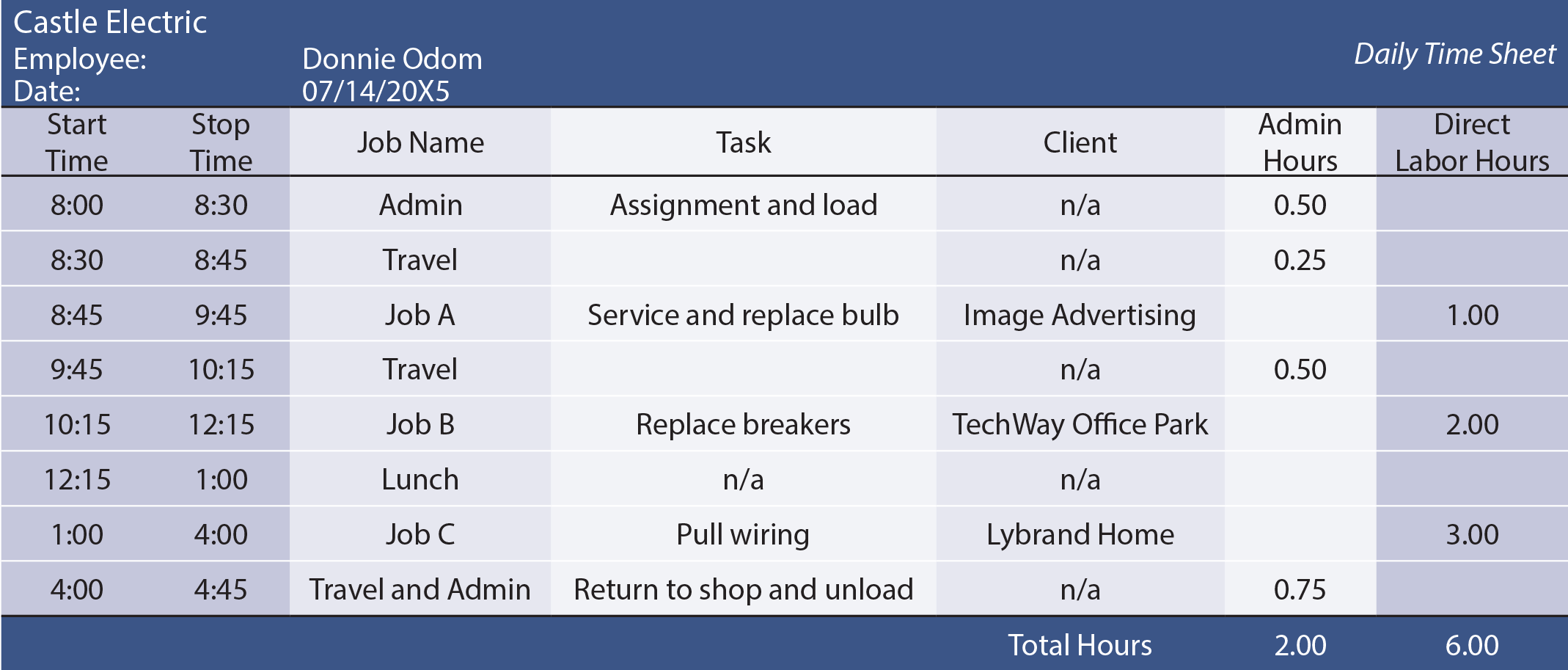
This daily time sheet illustrates how labor time can be recorded by job so that direct labor hours are traceable to specific cost units. It also highlights that some time (e.g., travel/admin) may be logged separately, helping explain why not all wages are treated as direct labor. Source
The basic relationship is:
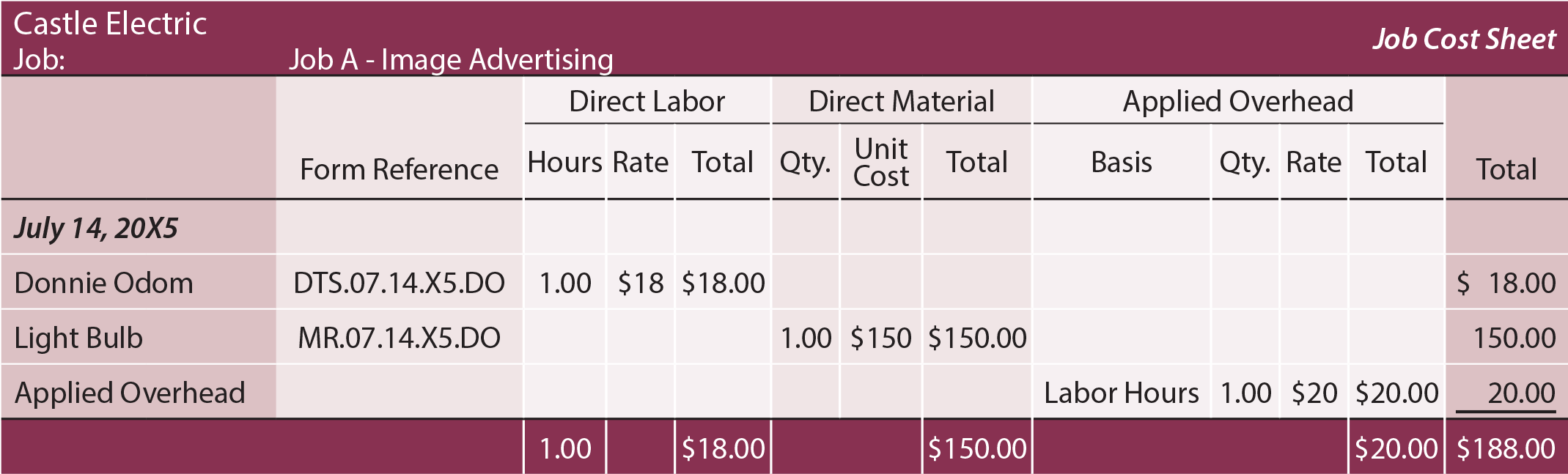
This job cost sheet shows how a single job accumulates traced costs (direct materials and direct labor) and then adds allocated overhead as an indirect cost. The direct labor section explicitly records hours and rate, linking the labor charge to time spent on that specific cost unit. Source
= wages charged directly to a specific cost unit
= direct time spent on that cost unit, in hours
= labor cost per hour
To classify labor as direct, the time worked must be traceable to the output. If an employee’s time cannot be linked clearly to one cost unit, the labor cost should not be treated as direct.
Other direct costs
Some businesses also incur other direct costs that can be charged specifically to one job or product. These are less common than materials and labor, but they follow the same principle of traceability. The cost must relate clearly to one cost unit and be measurable.
Indirect costs
If a cost cannot be traced fully and conveniently to a single cost unit, it is an indirect cost. These costs support production or service provision as a whole.
Indirect cost: A cost that cannot be identified specifically with one cost unit and must be shared between units.
Indirect costs are often collected together as overheads.
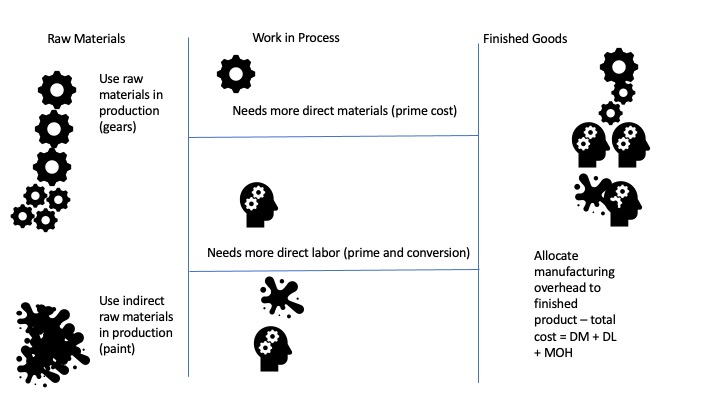
This diagram summarizes how manufacturing costs are grouped and carried through production: direct materials and direct labor are traced into work in process, while manufacturing overhead is allocated as an indirect cost. It helps you see why overheads are treated as shared costs that cannot be charged fully to a single cost unit. Source
They are necessary for the business to operate, but they do not belong only to one unit of output.
Indirect materials
Indirect materials are materials used in production or service provision that cannot be traced directly to one cost unit.
Examples include:
lubricants for machinery
cleaning materials
nails, glue, or thread where usage per unit is too small to measure economically
small tools and workshop consumables
These materials help production take place, but their cost is treated as indirect because tracing them to each unit would be impractical or uneconomical.
Indirect labor
Indirect labor is the cost of employees who support production or service provision but whose work is not directly traceable to one cost unit.
Examples include:
supervisors
maintenance staff
factory cleaners
stores personnel
quality control staff working across many units
These workers are essential, but their time is shared across several products, batches, or jobs. Their wages are therefore indirect costs.
Other indirect costs
Businesses also incur many other indirect costs, such as:
factory rent
lighting and heating
insurance
depreciation of factory equipment
These are not materials or labor, but they are still indirect because they cannot be charged wholly to one cost unit.
How to identify direct and indirect costs
A useful approach is to ask:
Traceability: Can the cost be linked specifically to one cost unit?
Measurement: Can the amount used by that cost unit be measured reliably?
Economic usefulness: Is it worth tracing the cost, or would that be too time-consuming and expensive?
A cost should be classified as direct only when it can be charged specifically, fully, and sensibly to the output. If it is shared, supportive, or too minor to trace economically, it should be classified as indirect.
Correct classification of materials and labor is especially important because errors can distort product costs and lead to poor pricing and decision-making.
Practice Questions
State two characteristics of a direct cost. (2 marks)
1 mark for stating that the cost can be traced specifically to a product, job, batch, or service.
1 mark for stating that the cost can be charged in full directly to that cost unit.
A manufacturing business employs the following workers and uses the following materials:
assembly workers
factory supervisor
machine maintenance staff
steel used in production
lubricating oil for machines
glue used in very small amounts on all units
Required: Classify each item as either direct or indirect and explain the reason for each classification. (6 marks)
Award 1 mark each for correct classification and explanation, up to 6 marks total:
assembly workers = direct labor because their time can be traced to production units
factory supervisor = indirect labor because supervision supports all production and is not traceable to one unit
machine maintenance staff = indirect labor because their work supports operations generally
steel used in production = direct material because it forms part of the product and is traceable
lubricating oil for machines = indirect material because it supports production and is not part of one unit
glue used in very small amounts on all units = indirect material because tracing it per unit is not economical
FAQ
Yes. Classification depends on whether the cost can be traced to the specific cost unit in that business.
For example:
fabric is usually a direct material in clothing manufacture
cleaning chemicals in the same factory are indirect materials
The nature of the business and the costing system both matter. A cost is not automatically direct or indirect in every situation.
Their labor cost may be split if reliable time records exist.
For example:
time spent making a customer order can be treated as direct labor
time spent cleaning the workshop or waiting for materials may be treated as indirect labor
If the split cannot be measured reliably, the business may classify more of the cost as indirect to avoid inaccurate charging.
Because accounting should be useful as well as accurate.
If a material is very cheap and used in tiny amounts, tracing it to each unit may cost more in administration than the value of the information gained.
Examples may include:
pins
thread
small amounts of glue
In these cases, the business usually treats the cost as indirect material for practical reasons.
Not always. The full labor cost to the employer may include related employment costs if they are attributable to direct workers.
Depending on the accounting approach used, this may include items such as:
basic wages
payroll-related employment costs
other directly attributable labor costs
The key point is that the total included must still relate specifically to labor traceable to the cost unit.
If direct costs are understated, the business may set prices too low and earn less profit than expected.
If indirect costs are incorrectly treated as direct, one product or job may appear more expensive than it really is.
This can lead to:
poor quotations
wrong product comparisons
weak cost control
bad management decisions
Good classification improves the reliability of all later costing information.
