

CIE Syllabus focus:
'Understand how to identify and calculate fixed costs, variable costs, semi-variable costs and stepped costs for pricing and decision-making.'
Cost behavior shows how costs respond to changes in activity. Managers use it to estimate total cost, support pricing, and judge whether higher or lower output will improve decisions.
Understanding cost behavior
Cost behavior is the relationship between a cost and an activity level, such as units produced, labor hours, machine hours, or sales volume. The activity measure must be clear before any cost is classified.
Fixed costs
Fixed costs do not change in total when activity changes, provided the business stays within the same period and operating range.
Fixed cost: A cost that remains constant in total regardless of changes in the level of activity, within a relevant range and for a given period.
The total fixed cost stays the same, but the fixed cost per unit changes as output changes. Rent, insurance, and salaries of administrative staff are common examples. For pricing, fixed costs matter because the business must recover them over time from sales revenue.
Variable costs
Variable costs move directly with activity.
Variable cost: A cost that changes in total in direct proportion to changes in the level of activity.
A variable cost is usually constant per unit if the rate paid for each unit does not change. Direct material often behaves in this way. Variable costs are important in decision-making because they usually change immediately when output changes.
Semi-variable costs
Some costs have both a fixed part and a variable part. These are semi-variable costs.
Semi-variable cost: A cost that includes both a fixed element and a variable element, so it changes with activity but not in direct proportion from zero.
A utility bill with a standing charge plus a usage charge is a common example. When activity is zero, the fixed element may still be payable. As activity rises, the variable element increases the total cost. Managers need to recognize both parts when using cost data for pricing.
Stepped costs
Some costs remain constant for a band of activity, then rise to a new level. These are stepped costs.
Stepped cost: A cost that remains constant within a range of activity but increases by set amounts when activity passes certain levels.
Supervision costs often behave this way because one supervisor can manage only up to a limit. Stepped costs do not rise smoothly. A small rise in activity near a threshold can therefore cause a noticeable jump in total cost.
Identifying behavior from information
To classify a cost, first identify the relevant activity measure. Then examine whether the total cost, the cost per unit, or both change as activity changes.
A useful relationship is:
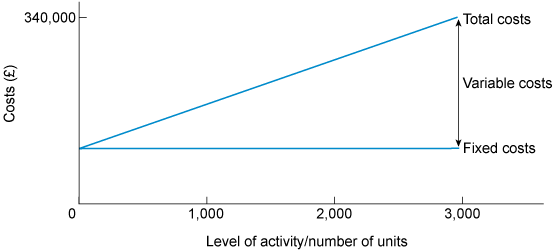
A combined cost-behaviour diagram showing a horizontal fixed-cost line and an upward-sloping total-cost line as activity increases. Visually, it reinforces that total cost is the sum of a fixed component plus a variable component that grows with activity. Source
= total cost in dollars
= total fixed cost in dollars
= variable cost for one unit of activity in dollars
= number of units or other measure of activity
This is especially useful when a cost is fully fixed, fully variable, or when a semi-variable cost has been separated into its two elements.
When reading information, look for these patterns:
If the total stays unchanged as activity changes, the cost is likely fixed.
If the cost per unit stays unchanged, the cost is likely variable.
If there is a constant base amount plus a usage-related amount, the cost is likely semi-variable.
If cost stays unchanged for a range and then rises suddenly, it is likely stepped.
Question wording often provides clues:
Per unit, per hour, and per sale usually suggest a variable element.
Monthly rent or annual insurance usually suggest fixed behavior.
Basic charge plus usage suggests semi-variable cost.
Additional supervisor after a limit suggests stepped cost.
Why classification matters
Correct classification supports better pricing. If managers ignore fixed costs, prices may be too low to cover total cost over time. If they misunderstand variable cost, they may accept business that adds too little toward profit.
It also improves decision-making. Managers need to know which costs will actually change if output changes. Variable costs usually change with output. Fixed costs may not change immediately. Stepped costs may change only when activity passes a threshold.
Cost behavior is also important in planning. Treating a semi-variable cost as entirely fixed or entirely variable can make forecasts inaccurate. Treating a stepped cost as if it rose smoothly can also mislead management.
Common classification mistakes
A common mistake is to confuse total cost with cost per unit. A fixed cost is fixed in total, not per unit. A variable cost is variable in total, not usually per unit.
Another mistake is to classify costs by name only. For example, labor is not always variable. It depends on how workers are paid and whether the amount changes with activity.
For pricing and decisions, the key question is always: how will total cost change if activity changes?
Practice Questions
State two features of a semi-variable cost. (2 marks)
1 mark for stating that it has a fixed element.
1 mark for stating that it has a variable element or that total cost changes with activity but not in direct proportion from zero.
A manufacturer has the following monthly costs at an output of 3,000 units:
factory rent 12,000
direct materials 5 per unit
power charge 800 plus 0.40 per unit
inspection staff cost 2,000 for each block of 1,500 units
Required:
(a) Classify each cost as fixed, variable, semi-variable, or stepped. [4]
(b) Calculate the total power charge at 3,000 units. [1]
(c) Calculate the total inspection staff cost at 3,000 units. [1]
(6 marks)
(a)
factory rent = fixed [1]
direct materials = variable [1]
power charge = semi-variable [1]
inspection staff cost = stepped [1]
(b)
[1]
(c)
[1]
FAQ
The relevant range is the band of activity within which a cost pattern is expected to stay valid. A cost may be fixed only while the business operates within existing capacity.
If activity moves outside that range, the behavior may change. Extra space, more supervisors, or different supplier terms can cause a new cost pattern.
If data are averaged over a long period, each jump in cost can be spread across many units. That can make the cost appear to rise smoothly.
This is why managers should examine the capacity limits behind the figures. Monthly or departmental data often reveal the step pattern more clearly than annual averages.
Guaranteed pay is usually fixed for the period, while overtime pay changes with hours worked or output. Together, they often create a semi-variable labor cost.
To classify it properly, separate the contractual minimum from the activity-related part. Payroll records and overtime policies are useful evidence.
A single month may include unusual repairs, shutdowns, seasonal demand, or temporary supplier prices. These can distort the normal relationship between cost and activity.
A better approach is to compare several periods and look for a repeated pattern. Reliable classification depends on consistency, not isolated figures.
Not always. A material cost can still be variable even if the price per unit rises, because the total still changes with output.
What changes is the rate, not necessarily the behavior type. However, new minimum charges, bulk discounts, or quantity thresholds can change a cost from simple variable behavior to semi-variable or stepped behavior.
