

CIE Syllabus focus:
'Calculate closing inventory using first in first out and weighted average cost methods under perpetual and periodic inventory systems.'
Inventory valuation determines the cost attached to closing inventory and to inventory issued during a period. For this topic, you must distinguish clearly between FIFO and AVCO and between perpetual and periodic systems.
Why inventory valuation matters
Inventory methods assign costs to units remaining in inventory after some units have been issued. The chosen method affects the value of closing inventory in the ledger and in financial statements. In cost accounting, it also affects the cost charged to production or to sales, so accuracy is essential. A small change in unit cost can produce a significant change in total inventory value when quantities are large.
When answering exam questions, always separate two decisions:
which valuation basis is being used: FIFO or AVCO
which inventory system is being used: perpetual or periodic
Inventory systems
Perpetual inventory system
When a business uses a perpetual inventory system, inventory records are updated after every receipt and issue.
Perpetual inventory system: A system that continuously updates inventory quantities and inventory values whenever inventory is received or issued.
Under this system, each movement is recorded in sequence. The order of purchases matters because the cost attached to an issue depends on the inventory balance immediately before that issue. This is especially important for AVCO, where the average cost may change several times during a period.
Periodic inventory system
A periodic inventory system updates the inventory record only at the end of the accounting period.
Periodic inventory system: A system in which inventory quantities and values are determined at the end of the period, rather than after each individual transaction.
Under this system, purchases are accumulated during the period, and closing inventory is valued only after total units available and total units remaining are known. Physical counting at period end is therefore crucial because the closing quantity is determined then. Because no running balance is kept for each issue, the timing of issues within the period does not affect a periodic AVCO calculation.
FIFO
With first in, first out (FIFO), the earliest cost is assigned first when inventory is issued, so the oldest units are treated as leaving inventory before newer units. FIFO therefore works through inventory in cost layers, starting with the oldest layer available.

Worked FIFO illustration showing multiple purchase lots (“cost layers”) and the rule that the unit issued is valued from the earliest lot first. This helps students visualise how FIFO pulls costs from the oldest layer before moving to later layers when required. Source
FIFO: A method of inventory valuation in which units issued are valued at the cost of the earliest units in inventory.
In a perpetual FIFO system, each issue is priced from the oldest cost layers still in hand at that date. If the issue is larger than the quantity in the oldest layer, the valuation moves to the next oldest layer, and so on. Closing inventory is therefore made up of the most recent purchase costs still in inventory at the end.
In a periodic FIFO system, the same basic idea is applied at the end of the period. Since the oldest units are assumed to have been issued first, the units remaining in closing inventory are valued using the latest purchase costs available. In many exam questions, FIFO gives the same final closing inventory figure under both perpetual and periodic systems, provided the inventory data are complete and consistent.
When prices are rising, FIFO usually gives a higher closing inventory value because the newest, higher costs remain in inventory. When prices are falling, the opposite tendency appears.
AVCO
With average cost (AVCO), each unit is valued at an average cost rather than at a specific purchase price.
AVCO: A method of inventory valuation in which units are valued at an average cost calculated from the costs of units available.
This method smooths out price fluctuations because high and low purchase prices are blended into one average figure. It is called a weighted average because quantities bought at each price influence the final average.
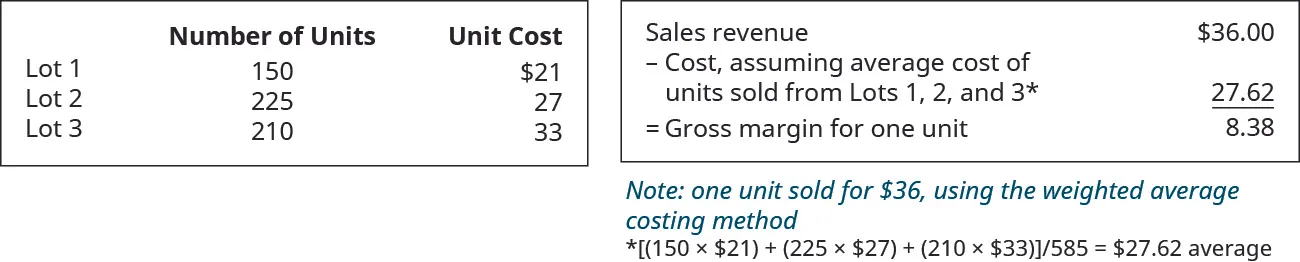
Weighted-average (AVCO) illustration combining several purchase lots into a single average unit cost (shown as a computed figure for one unit). It reinforces that AVCO blends costs across quantities rather than tracking individual cost layers like FIFO. Source
Under a periodic AVCO system, one weighted average cost is calculated for the whole period using opening inventory and all purchases made during the period.

Formula diagram summarising the periodic weighted-average cost per unit as “cost of goods available for sale ÷ units available for sale.” It provides a fast check that the AVCO unit cost is computed as a single blended rate before valuing closing inventory. Source
= average cost per unit used to value closing inventory
= total cost of opening inventory and purchases during the period
= total units of opening inventory and purchases during the period
After this average has been found, the closing inventory units are multiplied by the average unit cost. Because the average is calculated once, after all purchases have been considered, the timing of issues during the period does not change the average.
Under a perpetual AVCO system, a new weighted average cost is calculated each time additional inventory is received. This is often called a moving average. Each issue is then valued using the current average cost in the inventory record at that moment. As a result, the average can change several times in one period, and the closing inventory value may differ from the value produced by periodic AVCO.
What to focus on in exam questions
Read carefully to identify whether the question requires perpetual or periodic valuation.
For FIFO, track cost layers in date order.
For periodic AVCO, combine opening inventory with all purchases before calculating one average cost.
For perpetual AVCO, recalculate the average only after each receipt, not after each issue.
Closing inventory is valued from the units left at the end, so quantity accuracy matters as much as cost accuracy.
Keep units and costs separate in your working: first determine remaining quantities, then apply the correct valuation basis.
If purchase prices change during the period, expect FIFO and AVCO to produce different inventory values.
Present workings clearly, because marks are often awarded for method as well as the final figure.
Practice Questions
A business has 40 units in closing inventory. Under periodic AVCO, the average cost per unit is .
Calculate the value of closing inventory. (2 marks)
or equivalent: 1 mark
Correct value of : 1 mark
A business uses a perpetual inventory system.
January 1 opening inventory: 50 units at
January 4 purchased 30 units at
January 10 issued 60 units
January 18 purchased 40 units at
January 25 issued 20 units
Calculate the value of closing inventory on January 31 using: (a) FIFO [2] (b) AVCO [3]
(5 marks)
(a) FIFO
After the January 10 issue, remaining inventory correctly identified as 20 units at : 1 mark
After the January 25 issue, closing inventory correctly valued at 40 units at : 1 mark
(b) AVCO
Average after January 4 purchase correctly calculated as per unit, or issue on January 10 valued consistently from this average: 1 mark
After January 18 purchase, new average correctly calculated as per unit: 1 mark
Closing inventory correctly valued at : 1 mark
FAQ
A simple average would just average the prices, ignoring how many units were bought at each price.
A weighted average gives more influence to prices attached to larger quantities. For example:
a large purchase at one price affects the average more than a very small purchase
this makes the valuation more realistic than just averaging listed prices
Purchase returns reduce both the quantity and the cost of inventory available.
In practice:
under FIFO, the return is usually removed from the same cost layer from which those units came
under AVCO, the return reduces inventory at the relevant average or purchase cost, depending on the system and the record details given
Always follow the information provided in the question.
It is usually safer to keep the average cost to several decimal places in your workings and round only the final answer, unless the question tells you otherwise.
Early rounding can create small differences in:
issue values
closing inventory
totals carried forward
If a question produces a slight difference due to rounding, method marks are often still available if your process is correct.
Use the physical count for the closing quantity, because closing inventory in the accounts must reflect what is actually on hand.
Then apply the required valuation method to that corrected quantity.
The difference between the record and the count normally indicates:
loss
damage
theft
recording error
This difference should not be ignored when valuing closing inventory.
No. FIFO is a cost flow assumption for valuation, not always a statement about the physical movement of goods.
A business may physically issue newer items first for practical reasons, but still use FIFO to assign costs in its accounting records.
This is why inventory valuation methods can differ from the actual handling of goods in the warehouse.
