CIE Syllabus focus:
'Understand accounting for material and labour costs and use relevant information to support informed business decisions.'
Accurate records for materials and labor help businesses measure production cost, control waste, prevent errors, and make better decisions about pricing, efficiency, staffing, and profitability.
Why accounting for materials and labor costs matters
Materials and labor are major elements of production cost. If they are recorded inaccurately, product costs, profits, and inventory values will be unreliable. Good accounting systems allow a business to:
identify the cost of production
control waste, theft, and inefficiency
charge costs to the correct department, job, or process
compare actual cost with expected cost
support decisions about pricing, output, and staffing
The main aim is not just record keeping. Management uses the information to improve performance and reduce unnecessary cost.
Accounting for material costs
Recording material movements
Material costs should be recorded from the moment items are ordered until they are used in production. Common source documents include:
purchase requisition: request to buy materials
purchase order: sent to the supplier
goods received note: confirms quantity received
supplier invoice: shows the amount payable
material requisition note: authorizes issue from stores to production
materials returned note: records unused materials returned to stores
When materials are received, the business checks quantity and condition before updating stores records. This reduces the risk of paying for goods not received or accepting damaged items.
Material requisition note: An internal document authorizing the issue of materials from stores to production, a department, or a job.
A clear audit trail is essential. Each movement of materials should be supported by documentation so that the business can trace losses, errors, or unauthorized use.
Maintaining stores records
A storekeeper or stores department usually keeps detailed records of receipts, issues, and balances. These records help management know:
what materials are available
when to reorder
whether unusual losses are occurring
how much material has been charged to production
Stores ledger: A record showing quantities and values of materials received, issued, and remaining in inventory.
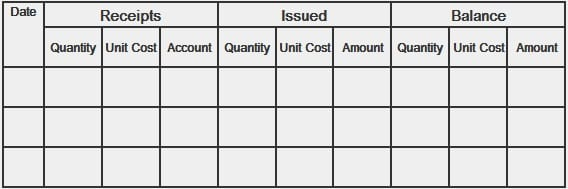
A specimen format of a materials (stores) ledger card, organized into receipts, issues, and balance columns. It illustrates how each movement of inventory is recorded with both quantity and value so management can monitor stock levels and charge materials accurately to production. Source
The accounting treatment depends on how the material is used. Materials used directly in making a product are charged to production. Materials used for general factory purposes, such as cleaning supplies or lubricants, are treated as part of overhead cost rather than direct production cost.
Materials returned to suppliers, materials returned from production, and shortages found during inventory counts must also be recorded promptly. This keeps the accounting records reliable and helps management investigate waste or pilferage.
Control of material costs
Material cost accounting is closely linked to control. Important controls include:
secure storage areas
authorized purchasing only
checking deliveries against orders
regular inventory counts
separation of duties between ordering, receiving, and recording
investigation of excessive waste or losses
If actual usage is higher than expected, management may review production methods, staff training, machine condition, or supplier quality. Rising material cost may lead to negotiations with suppliers, substitution of materials, or changes in selling price.
Accounting for labor costs
Recording labor time and wages
Labor cost accounting begins with measuring time worked and linking it to production.
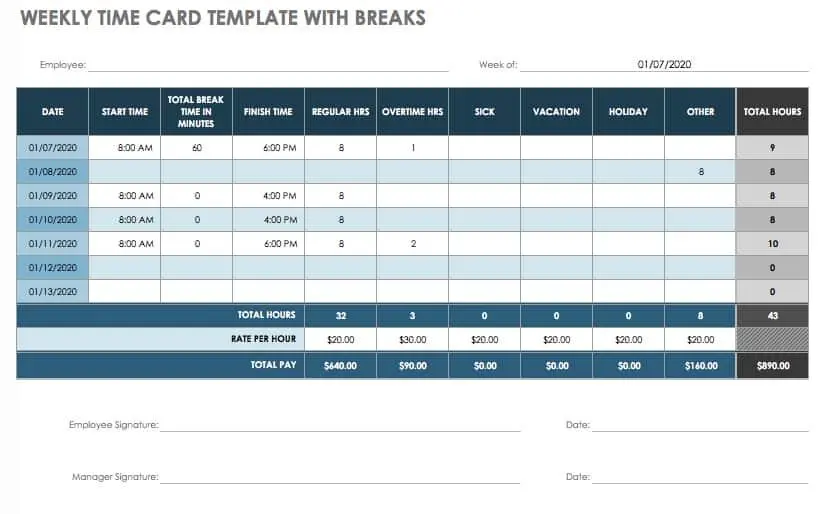
A structured weekly timesheet/time card layout used to capture daily hours worked across a pay period. This kind of source document supports accurate payroll calculation and provides the raw data needed to classify labor time (e.g., direct work, overtime, and other categories) for costing purposes. Source
Common records include:
clock cards or attendance records
time sheets showing total hours worked
job cards or job sheets showing time spent on specific jobs
payroll records showing gross pay, deductions, and net pay
These records allow wages to be analyzed correctly. Time spent directly making a product is charged to production. Time spent on supervision, maintenance, stores, or administration is charged elsewhere according to the nature of the work.
Payroll: The record of employees’ earnings, deductions, and net amounts payable for a period.
Accurate payroll accounting is important because labor cost can be affected by overtime, bonuses, idle time, and errors in time recording. If these are ignored, the cost of production may be misstated.
Special labor cost issues
One important issue is idle time, when workers are paid but no production takes place because of machine breakdowns, material shortages, or power failure.
Idle time: Paid time during which employees are not producing output.
Normal idle time may be treated as part of production cost, while abnormal idle time should be highlighted for management attention. Overtime also needs careful treatment. If overtime is caused by general pressure of work, it may be included in production cost. If it arises for a special reason, management may charge the extra amount separately so that decisions are based on relevant cost data.
Businesses may also use bonus schemes or piece-rate systems. These can increase productivity, but they must still be recorded accurately so that product costing remains reliable.
Using labor cost information in decisions
Labor records provide information for management to evaluate:
productivity of workers or departments
whether overtime is excessive
whether more employees should be recruited
the effect of training on efficiency
whether labor-intensive production remains economical
If labor cost per unit is rising, management may investigate poor scheduling, low output, or unnecessary overtime. If one department has high idle time, the business may reorganize workflow or improve material supply. Labor information can also support decisions about automation, subcontracting, or changing production methods.
Using material and labor information together
Management decisions are stronger when material and labor data are considered together. For example:
poor-quality materials may increase labor time and rework
labor shortages may cause material wastage
delays in stores may create idle time
inefficient production planning may increase both usage and wage cost
Relevant information should be timely, accurate, and linked to the area being managed. Historical records show what has happened, but they also help managers identify trends, compare departments, and take corrective action. In this way, accounting for materials and labor costs supports informed business decisions rather than simply recording past transactions.
Practice Questions
State two documents used to record or control material costs in a manufacturing business. (2 marks)
1 mark for each valid document stated, up to 2 marks.
Accept answers such as:
purchase order
goods received note
supplier invoice
material requisition note
materials returned note
stores ledger
Explain how a business accounts for labor costs and how the information obtained can support management decision-making. (6 marks)
Award up to 6 marks for valid points, including:
labor time is recorded using time sheets, clock cards, or job cards (1)
payroll records gross pay, deductions, and net pay (1)
direct labor is charged to production, jobs, or processes (1)
indirect labor is charged to overheads or relevant departments (1)
overtime and idle time should be identified and treated appropriately (1)
information helps decisions on staffing, overtime, productivity, training, or cost control (1)
FAQ
Separation of duties reduces the risk of fraud and error.
For example:
one employee orders materials
another receives them
another records them in the accounts
If one person controls the whole process, unauthorized purchases or missing materials may go unnoticed. Strong separation also improves reliability when inventory records are checked against physical stock.
Payroll fraud can overstate labor cost and distort product costing.
Common risks include:
fictitious employees on the payroll
overstated hours on time records
unauthorized overtime claims
Controls such as supervisor approval, independent payroll checks, and matching payroll to personnel records help reduce these risks. Reliable labor accounting depends on both accurate records and strong internal control.
Attendance records show how long an employee was present at work.
Job time records show how that time was spent, such as on a specific job, process, or department.
A worker may attend for eight hours but only spend six hours on direct production. The remaining time may be indirect work or idle time. Businesses need both records to classify labor cost correctly.
Total wages alone do not show efficiency.
A better measure is the relationship between labor cost and output, such as:
labor cost per unit
hours per unit
output per employee
This helps management see whether higher wages are matched by better productivity. It is possible for total wages to rise while unit labor cost falls if output increases faster.
Material losses reduce the amount of usable input available for production.
This can lead to:
lower output
higher cost per unit
delayed deliveries
extra purchases
Management may respond by reviewing supplier quality, storage conditions, handling methods, or employee training. Even if purchase prices stay the same, high losses make production less efficient and reduce profitability.