

Edexcel Syllabus focus:
'Know the structure and properties of cell membranes, including the phospholipid bilayer, membrane proteins, cholesterol and membrane fluidity.'
Cell membranes are dynamic barriers that control movement into and out of cells. Their structure explains why they are flexible, selectively permeable, stable, and able to support essential cellular processes.
Overall organization
The cell membrane surrounds the cell and separates the internal environment from the external environment. Membranes also surround many organelles, so the same basic structural plan is used throughout cells. At this level, the most important membrane components are phospholipids, membrane proteins, and cholesterol.
These molecules are arranged in a way that gives the membrane its properties. A membrane is not a rigid wall. Instead, it behaves as a thin, flexible boundary whose components can move within it.
The phospholipid bilayer
Phospholipids are the main structural molecules in membranes. Each phospholipid has a phosphate-containing head that is hydrophilic and two fatty acid tails that are hydrophobic. Because of this, phospholipids arrange themselves in a double layer when surrounded by water.
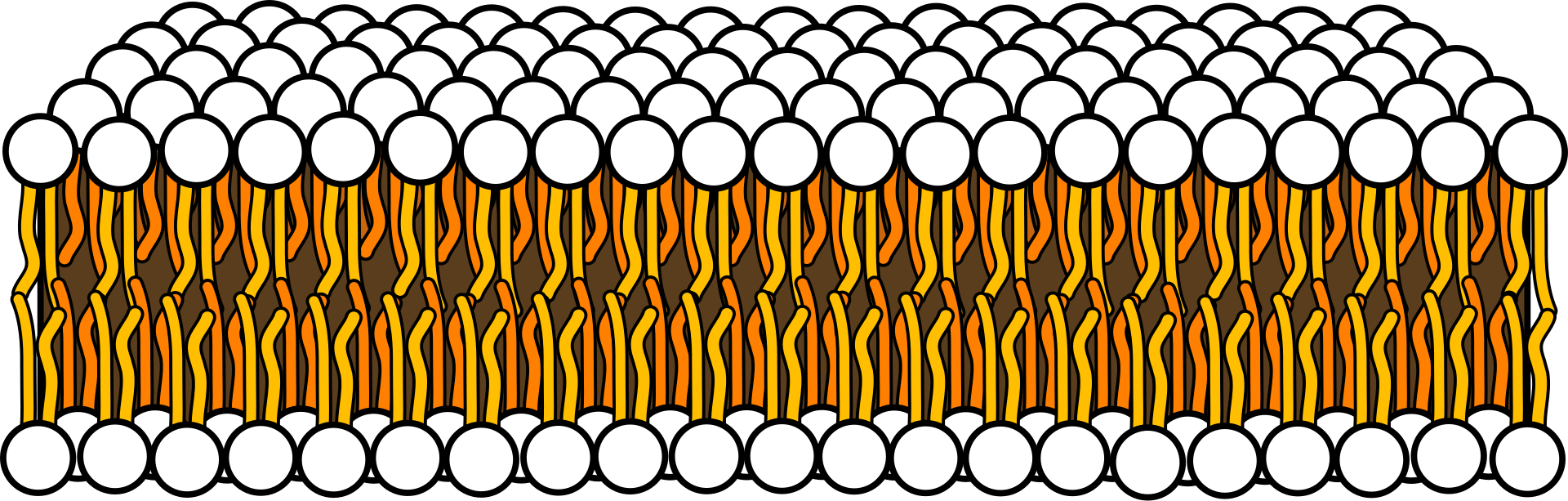
Schematic cross-section of a lipid bilayer showing hydrophilic head groups on both outer surfaces and hydrophobic fatty-acid tails forming the interior core. This visualization helps link phospholipid amphipathic structure to bilayer self-assembly and the membrane’s selectively permeable hydrophobic barrier. Source
Phospholipid bilayer: A double layer of phospholipid molecules with hydrophilic heads facing the watery environments on either side and hydrophobic tails facing inward.
This arrangement is stable because the heads can interact with water in the cytoplasm and outside the cell, while the tails are kept away from water in the center of the membrane.
Why the bilayer matters
The hydrophobic core of the bilayer makes it difficult for many water-soluble or charged substances to cross directly. This is why membranes are selectively permeable: some substances pass through more easily than others.
Small nonpolar molecules pass through the phospholipid part of the membrane more readily than ions or large polar molecules. As a result, the bilayer acts as an effective barrier, helping the cell maintain the conditions needed for metabolism.
The phospholipid bilayer also gives the membrane flexibility. Individual phospholipids are not fixed in one position, so the membrane can bend without breaking. This is important because cells may change shape and membranes must be able to form vesicles and repair small disturbances.
Membrane proteins
Embedded within or attached to the bilayer are membrane proteins.
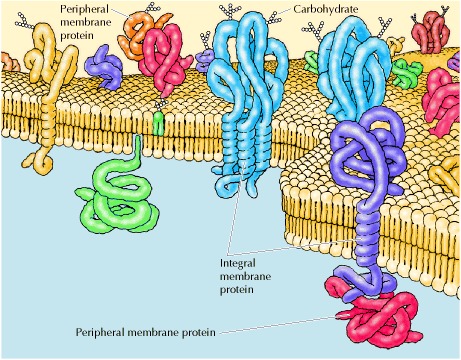
Diagram of the fluid mosaic model illustrating how membrane proteins are arranged within a phospholipid bilayer. It distinguishes integral (embedded/transmembrane) proteins from peripheral (surface-associated) proteins, reinforcing how protein placement enables transport, signaling, and other membrane functions. Source
Some proteins span the whole membrane, while others are attached to only one surface. Many have hydrophobic regions inside the bilayer and hydrophilic regions exposed to water, allowing them to remain in a stable position.
The presence of proteins means the membrane is not made of lipid alone. Proteins give it a wider range of properties and functions than the bilayer could provide by itself.
Roles of membrane proteins
Membrane proteins contribute to membrane properties in several ways:
They provide specific pathways for substances that cannot pass easily through the phospholipid bilayer.
They act as receptors, allowing cells to detect signals.
They can act as enzymes, catalyzing reactions at the membrane surface.
They may help with cell recognition or structural support.
Because different cells and organelles contain different proteins, membranes can have specialized properties. This means a membrane is not just a barrier; it is also a functional surface involved in communication and control.
Cholesterol in membranes
Cholesterol is found between phospholipid molecules in many animal cell membranes. It is a small hydrophobic molecule that fits between the fatty acid tails.
Cholesterol affects how phospholipids pack together.
At higher temperatures, it reduces phospholipid movement, making the membrane less likely to become too fluid. At lower temperatures, it prevents phospholipids packing too closely, so the membrane is less likely to become too rigid.
As a result, cholesterol helps maintain membrane stability across a range of conditions. It also reduces the permeability of the membrane to some very small water-soluble molecules, helping the membrane remain an effective barrier.
Membrane fluidity
A key property of cell membranes is membrane fluidity. This refers to the movement of phospholipids and some proteins within the membrane itself.
Membrane fluidity: The ability of phospholipids and some proteins to move sideways within the membrane, so the membrane behaves as a flexible structure rather than a rigid sheet.
Fluidity allows the membrane to change shape and keeps membrane proteins in a working arrangement. However, a membrane must not be too fluid or too rigid. The balance between phospholipids and cholesterol helps maintain the correct level of fluidity.
Why fluidity is important
It allows membranes to be flexible rather than brittle.
It helps proteins remain able to function within the membrane.
It supports membrane shape changes during normal cell activity.
It allows the membrane to act as a dynamic boundary instead of a fixed layer.
How structure determines membrane properties
The properties of cell membranes can be explained directly by their structure:
The phospholipid bilayer forms the basic boundary of the membrane.
The hydrophobic interior creates a barrier to many substances.
Proteins give the membrane specificity and functional variety.
Cholesterol increases stability and helps regulate fluidity.
The movement of phospholipids and some proteins makes the membrane flexible and dynamic.
These features together allow cell membranes to separate cell contents from the surroundings while still controlling exchange and supporting cell activity.
Practice Questions
State two properties of cell membranes that arise from the phospholipid bilayer. (2 marks)
Any two from:
selectively permeable (1)
flexible (1)
fluid / not rigid (1)
forms a barrier between cell contents and surroundings (1)
Explain how the structure of a cell membrane gives it its properties. Include the roles of phospholipids, membrane proteins, cholesterol, and membrane fluidity. (6 marks)
phospholipids are arranged in a bilayer (1)
hydrophilic heads face outward toward water and hydrophobic tails face inward (1)
hydrophobic center acts as a barrier to many water-soluble or charged substances, so membrane is selectively permeable (1)
membrane proteins are embedded in or attached to the membrane and provide specific functions such as transport or receptors (1)
cholesterol fits between phospholipids and helps stabilize the membrane / reduces permeability (1)
cholesterol helps regulate fluidity by restricting movement at higher temperatures and preventing tight packing at lower temperatures (1)
FAQ
Phospholipids are amphipathic, meaning one part interacts well with water and one part does not.
The hydrophilic heads face the water.
The hydrophobic tails turn away from the water.
Because each phospholipid has two tails, the molecules pack well into a sheet-like double layer. This arrangement is energetically stable, so bilayers form spontaneously.
The shape of the tails changes how tightly phospholipids can pack together.
Saturated tails are straighter, so they pack more closely and make membranes less fluid.
Unsaturated tails have bends caused by double bonds, so they pack less tightly and make membranes more fluid.
This means lipid composition can strongly affect membrane flexibility and stability.
Not all membrane proteins have the same freedom of movement.
Some are relatively mobile because they are surrounded by fluid phospholipids. Others are held in place because they are:
attached to the cytoskeleton
linked to structures outside the cell
clustered in specialized membrane regions
So membrane fluidity does not mean every component moves equally.
The two sides of a membrane are not identical. Different lipids and proteins may be found on the inner and outer surfaces.
This matters because orientation affects function. For example:
receptor sites must face the correct side
attachment points may need to be inside the cell
signaling molecules may only work from one surface
A membrane is therefore organized, not random.
No. Cholesterol content varies between membranes and between organisms.
Animal cell membranes often contain significant cholesterol.
Plant cells use other sterols instead.
Prokaryotes usually do not use cholesterol in the same way animal cells do.
Even within one animal, some membranes contain more cholesterol than others, depending on how much stability and controlled fluidity they need.

