

Edexcel Syllabus focus:
'Understand passive transport, including simple diffusion and facilitated diffusion, and the involvement of channel and carrier proteins.'
Substances cross cell membranes without energy input in different ways. This page focuses on passive transport, especially the difference between simple diffusion and facilitated diffusion, and the roles of channel proteins and carrier proteins.
Passive Transport
Cells often exchange substances with their surroundings by moving them down a concentration gradient. This means there is a higher concentration on one side of the membrane than on the other.
Passive transport: The movement of substances across a membrane from a region of higher concentration to a region of lower concentration, without the use of ATP.
In passive transport, particles still move randomly, but there is a net movement from high concentration to low concentration. This happens because more particles leave the high-concentration side than move back in the opposite direction.
Passive transport is important because it allows cells to take in some substances and remove others efficiently without direct energy expenditure. Two key types are simple diffusion and facilitated diffusion.
Simple Diffusion
Simple diffusion happens when particles pass directly through the membrane itself.
Simple diffusion: The net movement of particles from a region of higher concentration to a region of lower concentration directly through the phospholipid bilayer, without the help of membrane proteins.
In simple diffusion, molecules move through the phospholipid bilayer. This is most suitable for substances that are small and nonpolar, because they can pass through the hydrophobic interior of the membrane more easily.
Examples include:
oxygen
carbon dioxide
A common exam point is that molecules are always moving in both directions. However, if there is a concentration gradient, the overall or net movement is from high to low concentration.
Simple diffusion:
does not require ATP
does not require transport proteins
only works well for certain substances
continues until there is no net movement across the membrane
If concentrations become equal on both sides, particles still move randomly, but movement in one direction is balanced by movement in the other.
Facilitated Diffusion
Some substances cannot diffuse directly through the phospholipid bilayer. They may be charged, polar, or relatively large, so they need help from membrane proteins.
Facilitated diffusion: The net movement of substances from a region of higher concentration to a region of lower concentration across a membrane using specific channel or carrier proteins, without the use of ATP.
Facilitated diffusion is still a form of passive transport, so substances move down their concentration gradient. The difference is that the membrane proteins provide an alternative pathway through or across the membrane.
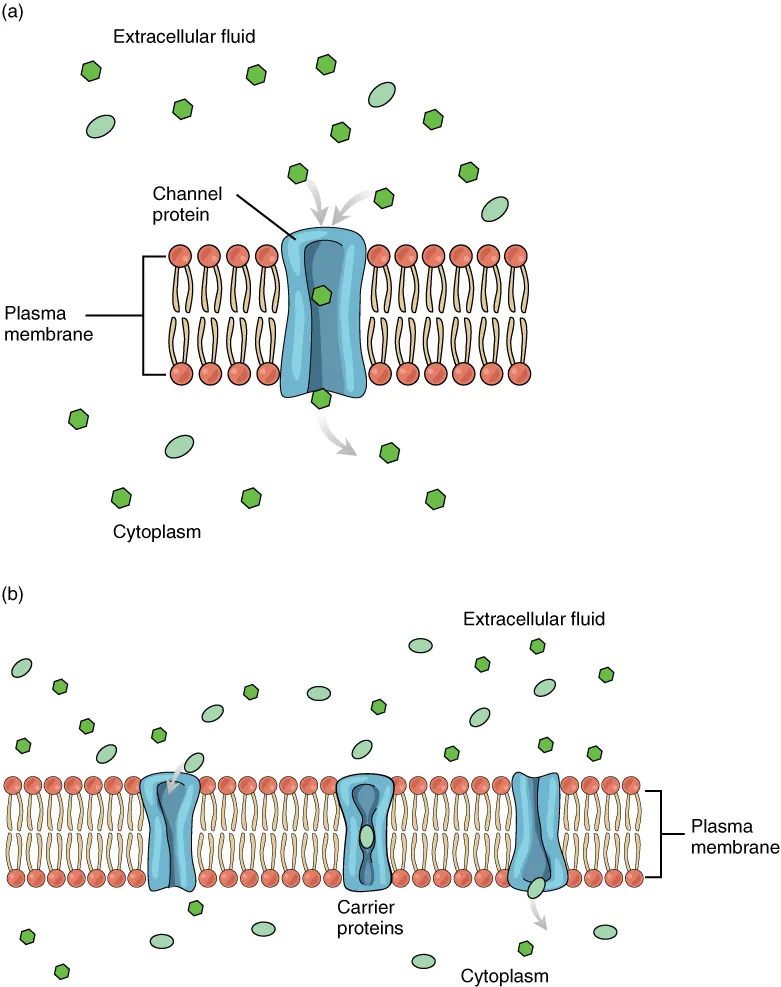
Facilitated diffusion uses membrane proteins to provide a hydrophilic route across the plasma membrane without ATP. This diagram contrasts channel proteins (pores that let specific solutes pass) with carrier proteins (bind-and-change-shape transport), highlighting why charged or polar molecules can cross the bilayer only with protein help. Source
Substances commonly transported by facilitated diffusion include:
ions, such as sodium or potassium
glucose
some other polar molecules
This process is selective. A protein that transports one substance will not necessarily transport another, because the protein has a specific shape and chemical properties.
Facilitated diffusion can also show saturation.
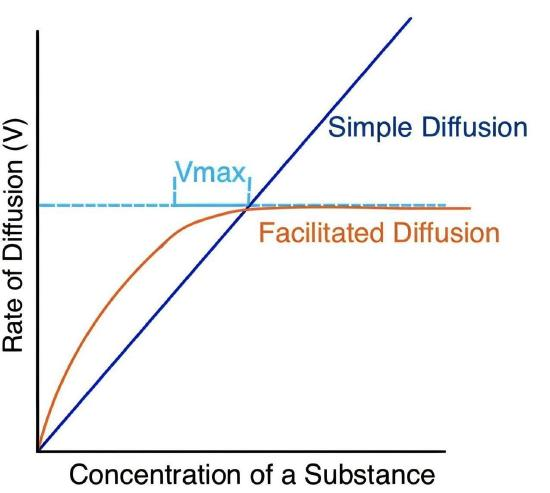
This graph compares how transport rate changes with increasing solute concentration for simple diffusion versus facilitated diffusion. Simple diffusion scales approximately linearly with the driving gradient, whereas facilitated diffusion rises then plateaus at a maximum rate once all transport proteins are occupied (saturation). Source
If all the available transport proteins are in use, increasing the concentration further will not increase transport proportionally.
Channel Proteins
Channel proteins form water-filled pores through the membrane. These pores allow specific ions or other suitable particles to pass through without entering the hydrophobic core of the phospholipid bilayer.
Channel proteins are important because:
they provide a hydrophilic route across the membrane
they allow rapid movement of suitable particles
they are often specific to particular ions or molecules
Selectivity depends on the shape and properties of the channel. For example, the diameter of the pore and the charges on the inside of the channel can determine which ions pass through.
Some channel proteins are always open, while others may open and close. Even when channels change between open and closed states, transport through them is still passive if particles move down their concentration gradient.
Carrier Proteins
Carrier proteins work differently from channel proteins. Instead of forming an open pore, a carrier protein binds to a specific substance on one side of the membrane.
When binding occurs:
the protein changes shape
the substance is moved across the membrane
the substance is released on the other side
This makes carrier proteins highly specific. Only molecules with the correct shape or chemical features will bind to a particular carrier protein.
Carrier proteins are often involved in the facilitated diffusion of larger polar molecules, such as glucose. Because each transport event depends on binding and a shape change, carrier proteins may transport substances more slowly than open channel proteins.
Like channel proteins, carrier proteins do not use ATP in facilitated diffusion as long as movement is down the concentration gradient.
Comparing Simple Diffusion and Facilitated Diffusion
Both processes are forms of passive transport, but they differ in important ways.
Similarities:
both move substances from high concentration to low concentration
both involve net movement down a concentration gradient
neither requires ATP
Differences:
simple diffusion occurs directly through the phospholipid bilayer
facilitated diffusion requires membrane proteins
simple diffusion is mainly for small nonpolar molecules
facilitated diffusion is used for ions and larger or polar molecules
facilitated diffusion is usually more selective
facilitated diffusion can become limited by the number of proteins available
A useful way to distinguish them is to ask whether the substance can cross the membrane unaided. If it can pass through the bilayer, it uses simple diffusion. If it needs a channel protein or carrier protein, it uses facilitated diffusion.
Practice Questions
State two differences between simple diffusion and facilitated diffusion. (2 marks)
1 mark for stating that simple diffusion occurs directly through the phospholipid bilayer, whereas facilitated diffusion uses membrane proteins.
1 mark for stating that simple diffusion is for small nonpolar molecules, whereas facilitated diffusion is for ions or polar/larger molecules.
Explain how channel proteins and carrier proteins are involved in facilitated diffusion across cell membranes. (5 marks)
1 mark for stating that facilitated diffusion is passive and moves substances from high concentration to low concentration.
1 mark for stating that channel proteins provide a hydrophilic pathway/pore through the membrane.
1 mark for stating that channel proteins are selective for particular ions or molecules.
1 mark for stating that carrier proteins bind to a specific substance.
1 mark for stating that the carrier protein changes shape to move the substance across the membrane and releases it on the other side.
FAQ
Channel proteins are selective because the inside of the channel has a particular shape and chemical environment.
This means selectivity can depend on:
the diameter of the pore
the charge of amino acids lining the channel
how strongly the ion interacts with the channel interior
As a result, two ions that seem similar may still be separated by different channels.
Facilitated diffusion depends on a limited number of transport proteins in the membrane.
If all channel or carrier proteins are occupied or operating as fast as possible, the rate cannot keep increasing in direct proportion to concentration. This is called saturation.
It is especially noticeable with carrier proteins, because each molecule must bind and trigger a shape change before transport occurs.
Yes. The direction depends on the concentration gradient.
If the concentration is higher outside the cell, there will be net movement inward. If the concentration becomes higher inside the cell, the same protein may allow net movement outward.
The protein itself does not decide the direction. The gradient does.
An open channel allows suitable particles to pass whenever they are present and the concentration gradient favors movement.
A gated channel changes between open and closed states. The gate may respond to:
voltage changes
chemical signals
mechanical pressure
When the gate is closed, diffusion through that channel stops even if the concentration gradient is still present.
A mutation could alter the amino acid sequence of a channel or carrier protein. This may change its three-dimensional shape.
Possible effects include:
the transport protein no longer binding the correct substance
the pore becoming the wrong shape or charge
the protein failing to insert properly into the membrane
slower transport across the membrane
Even a small structural change can greatly reduce specificity or transport rate.
