

Edexcel Syllabus focus:
'Understand endocytosis and exocytosis as bulk transport processes that move materials into and out of cells using vesicles.'
Some substances are too large or too numerous to cross the cell surface membrane individually. Cells solve this by using membrane-bound vesicles to move material in bulk.
Bulk transport across cell membranes
Cells often need to move large molecules, particles, or many molecules at once. These substances cannot pass directly through the phospholipid bilayer in the same way as small molecules.
Bulk transport: The movement of substances into or out of a cell in membrane-bound packages rather than as individual molecules crossing the membrane.
Bulk transport is especially important when the material is too large to pass through membrane proteins or when a cell must transfer a large amount of material quickly.
A vesicle is the key structure used in both endocytosis and exocytosis.
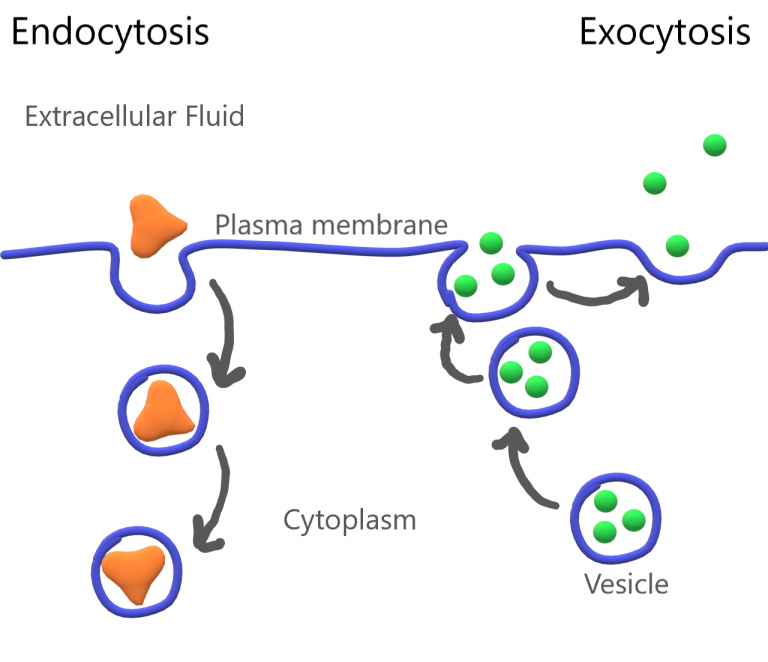
This diagram contrasts the two vesicle-based bulk transport pathways at the cell surface membrane. It shows endocytosis as membrane invagination and vesicle formation to bring external material into the cytoplasm, and exocytosis as vesicle fusion with the membrane to release contents outside the cell. Source
Vesicle: A small membrane-bound sac that carries substances within the cell or across the cell surface membrane.
Because vesicles are made from membrane, the cell surface membrane can change shape to surround material or fuse with a vesicle to release it.
Endocytosis
What endocytosis is
Endocytosis moves substances into the cell. The cell surface membrane folds inward and surrounds the material. It then pinches off to form a vesicle inside the cytoplasm.
Endocytosis: A bulk transport process in which the cell surface membrane engulfs material and forms a vesicle to bring that material into the cell.
This allows cells to take in substances that are too large for simple diffusion, facilitated diffusion, or active transport across the membrane.
How endocytosis happens
The process can be described in steps:
material is next to the cell surface membrane
the membrane invaginates, meaning it folds inward
the membrane surrounds the material
the edges of the membrane join together
a vesicle pinches off into the cytoplasm
the contents are now inside the cell
The material taken in may be:
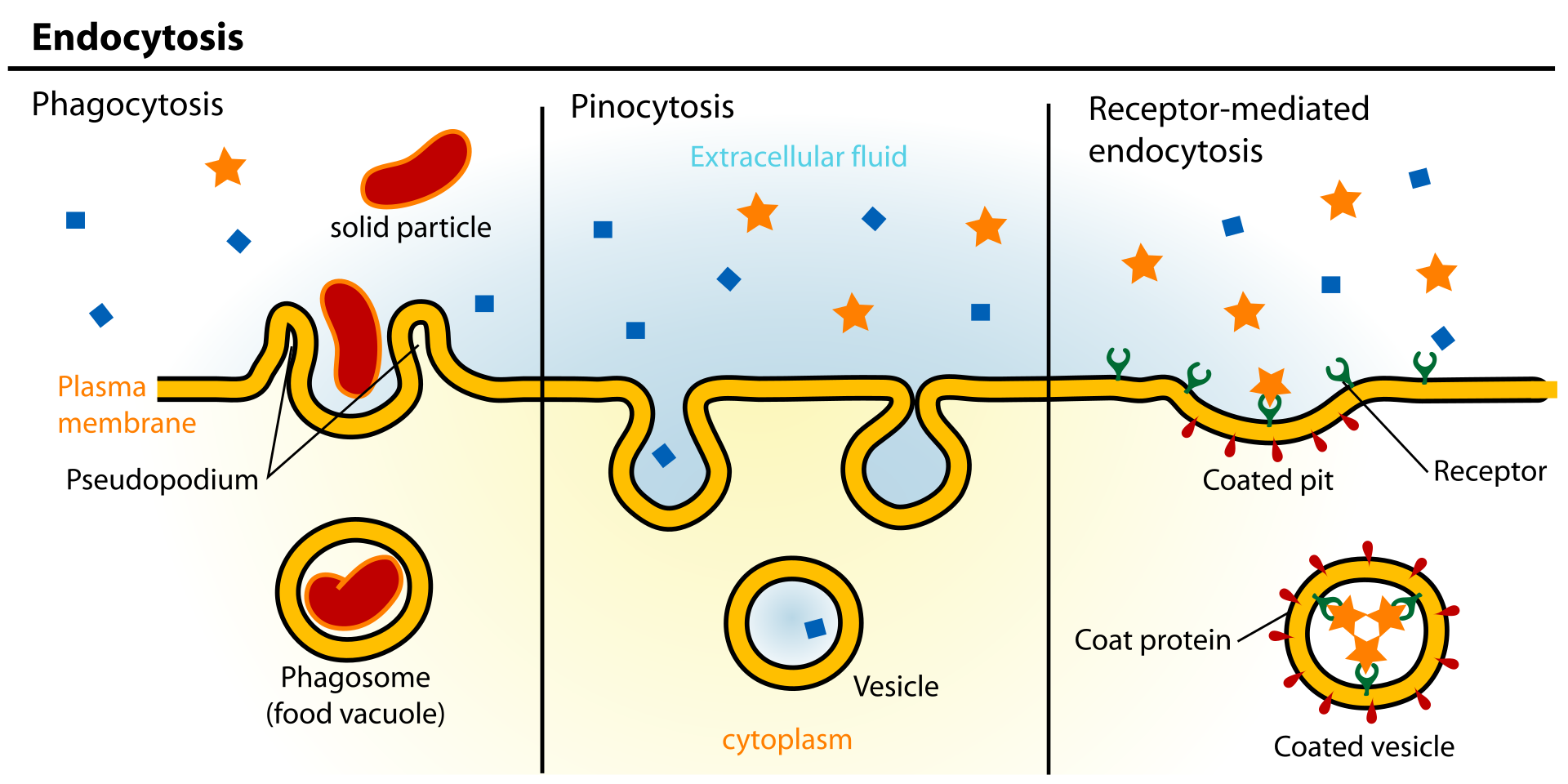
This figure summarizes major types of endocytosis and emphasizes that uptake occurs by membrane engulfment to form internal vesicles. It helps you connect the general steps you listed (invagination → enclosure → vesicle) to common biological contexts such as fluid uptake and receptor-mediated uptake. Source
droplets of extracellular fluid
large molecules such as proteins
particles such as cell debris or microorganisms in specialized cells
Endocytosis is called bulk transport because many molecules can be moved together inside one vesicle. The membrane is not transporting each molecule separately. Instead, it encloses the whole group of substances at once.
Importance of endocytosis
Endocytosis is useful when cells need to:
absorb materials from their surroundings
take in substances that are too large to pass through membrane proteins
remove material from the outside of the cell and bring it into the cytoplasm
In some cases, the vesicle formed by endocytosis later joins with internal compartments so that its contents can be processed, broken down, or sorted.
Exocytosis
What exocytosis is
Exocytosis moves substances out of the cell. A vesicle inside the cytoplasm moves to the cell surface membrane and fuses with it. The contents of the vesicle are then released outside the cell.
Exocytosis: A bulk transport process in which a vesicle fuses with the cell surface membrane and releases its contents outside the cell.
Exocytosis is therefore the reverse overall direction of endocytosis, although both depend on vesicles and membranes.
How exocytosis happens
The process can be described in steps:
substances to be exported are enclosed in a vesicle inside the cell
the vesicle moves toward the cell surface membrane
the vesicle membrane fuses with the cell surface membrane
the contents of the vesicle are released outside the cell
the vesicle membrane becomes part of the cell surface membrane
This is important in cells that secrete substances, because it allows the cell to release materials in a controlled way.
Importance of exocytosis
Exocytosis is used to:
secrete useful products made by the cell
remove substances from the cell
deliver membrane components to the cell surface membrane
Examples of materials released by exocytosis can include:
enzymes
hormones
mucus
other cell products packaged for export
Because the vesicle membrane joins the cell surface membrane, exocytosis can increase the surface membrane area.
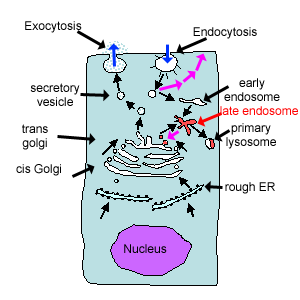
This pathway diagram shows how vesicles move between the plasma membrane and internal compartments during endocytosis and exocytosis. It is especially helpful for visualizing the idea of membrane recycling and how vesicle traffic helps maintain membrane balance over time. Source
Endocytosis can reduce it by taking membrane inward. In many cells, these two processes help maintain membrane balance.
Comparing endocytosis and exocytosis
Similarities
Endocytosis and exocytosis are similar because they both:
are bulk transport processes
use vesicles
involve the cell surface membrane
move substances that are often too large to cross the membrane directly
Both processes depend on changes in membrane shape. This makes them different from transport processes where substances move through the membrane itself.
Differences
The main difference is the direction of movement:
endocytosis moves material into the cell
exocytosis moves material out of the cell
There is also a difference in membrane movement:
in endocytosis, the membrane folds inward to form a vesicle
in exocytosis, a vesicle fuses with the membrane
Another key difference is what happens to the transported material:
in endocytosis, material becomes enclosed inside a vesicle within the cell
in exocytosis, material is released from a vesicle to the outside of the cell
Why vesicles are essential
Vesicles allow cells to move substances without those substances passing directly through the phospholipid bilayer. This is especially important for:
very large molecules
many molecules together
materials that must stay enclosed during transport
Without vesicles, cells would be much less able to take in large materials from their environment or release important products efficiently.
Practice Questions
State what is meant by: a) endocytosis b) exocytosis (2 marks)
1 mark for stating that endocytosis is the uptake of material into a cell by the cell surface membrane forming a vesicle
1 mark for stating that exocytosis is the release of material from a cell when a vesicle fuses with the cell surface membrane
Explain how vesicles are involved in endocytosis and exocytosis, and compare the two processes. (5 marks)
1 mark: endocytosis brings substances into the cell
1 mark: cell surface membrane folds inward / engulfs material / forms a vesicle in endocytosis
1 mark: exocytosis releases substances out of the cell
1 mark: vesicle fuses with the cell surface membrane in exocytosis
1 mark: both are bulk transport processes using vesicles / both move large amounts or large substances
FAQ
The phospholipid bilayer has a hydrophobic interior, so it acts as a barrier to many substances.
Large particles and very large molecules are physically too big to move through the membrane directly, even with membrane proteins.
That is why cells use vesicles:
the material is enclosed as a package
the membrane moves around it
the whole package is transported at once
No. Endocytosis can take in different kinds of material.
Depending on the cell and the situation, it may bring in:
extracellular fluid
dissolved molecules
large particles
microorganisms
This means endocytosis is a flexible process, not one limited to only one type of substance.
Some cells use receptor-mediated endocytosis.
In this process:
specific receptor proteins in the membrane bind to particular molecules
only molecules with the correct shape can bind
the membrane then folds inward and forms a vesicle
This makes uptake more selective than simply surrounding whatever happens to be nearby.
Yes. Although it is useful, some harmful agents can exploit it.
For example:
certain viruses enter cells by triggering endocytosis
some toxins are taken in after binding to membrane receptors
So, a normal transport mechanism can sometimes be used by pathogens to gain entry into cells.
Vesicles do not always drift randomly. Their movement is often assisted by the cytoskeleton and associated motor proteins.
These components can:
guide vesicles to specific parts of the cell
help position vesicles near the cell surface membrane
support efficient secretion
This is especially important in cells that release substances rapidly or repeatedly.

