

Edexcel Syllabus focus:
'Understand active transport, including how ATP acts as an immediate energy source and how carrier proteins move substances across membranes.'
Active transport allows cells to move substances across membranes when diffusion would not be enough. It depends on membrane carrier proteins and a direct, usable supply of energy from ATP.
What active transport means
Active transport: Movement of substances across a membrane from a lower concentration to a higher concentration using energy from ATP and membrane carrier proteins.
Many cells need to take in ions or molecules even when the concentration inside the cell is already greater than outside. In these situations, movement must happen against the concentration gradient. This is different from passive movement, because particles are not moving in the direction they would naturally diffuse.
Active transport is therefore an energy-dependent process. The cell must supply energy to force particles across the membrane in the required direction. This allows cells to control their internal contents much more precisely than diffusion alone would allow.
Active transport is carried out by carrier proteins found in the cell surface membrane. These proteins have specific binding sites, so only certain substances can be transported. This makes active transport selective as well as energy-dependent.
A brief comparison is useful: both active transport and some forms of passive transport use membrane proteins, but only active transport uses ATP and can move substances from lower to higher concentration.
ATP as the immediate energy source
ATP: Adenosine triphosphate, the cell’s immediate energy source, which releases energy when one phosphate group is removed.
ATP is called the immediate energy source because the energy it stores can be released in a single step and used straight away by the cell.
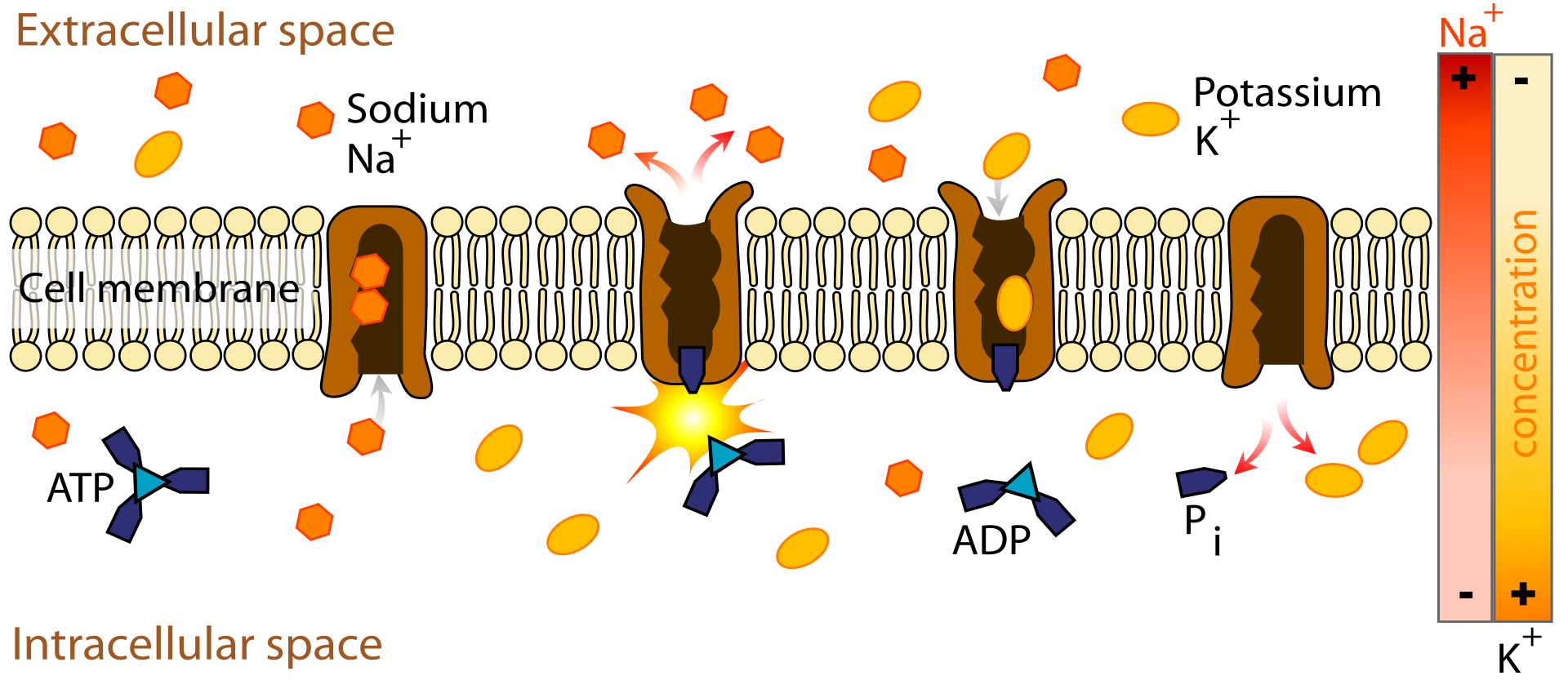
Schematic of the sodium–potassium pump illustrating primary active transport powered by ATP hydrolysis. The figure emphasizes that chemical energy from ATP is converted into directed transport via protein conformational changes, rather than passive movement down a gradient. It also reinforces selectivity by showing distinct binding/release steps for different ions on opposite sides of the membrane. Source
In active transport, ATP is broken down to ADP and inorganic phosphate, releasing energy that is transferred directly to the carrier protein.
This direct supply matters because active transport cannot occur just from the presence of a membrane protein. The carrier protein must be powered to change shape and move the substance across the membrane. If ATP is not available, the transport process stops.
The need for ATP links active transport closely to respiration. Cells that carry out a lot of active transport must keep making ATP continuously. A fall in ATP supply reduces the rate of active transport, even if the carrier proteins are still present in the membrane.
How carrier proteins move substances
Carrier proteins do more than simply provide a passage through the membrane. They take part actively in the movement of the substance.
The general sequence is:
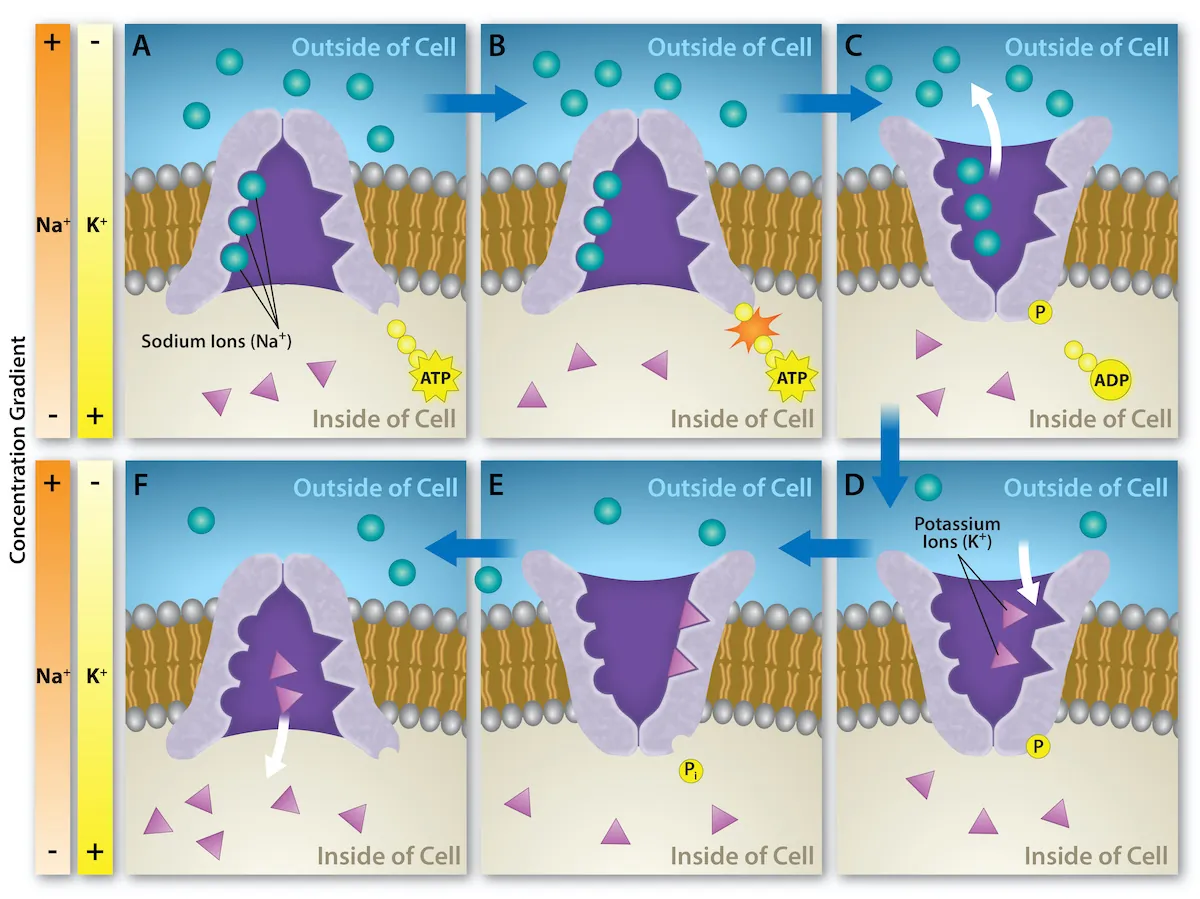
Diagram of the sodium–potassium pump (a classic ATP-driven carrier protein) showing a full transport cycle. It highlights how ATP hydrolysis is coupled to conformational changes that move ions across the membrane in a specific direction (typically 3 Na⁺ out and 2 K⁺ in per ATP). This provides a concrete, labeled example of primary active transport powered directly by ATP. Source
a specific ion or molecule binds to a carrier protein on one side of the membrane
ATP is hydrolyzed and energy is released
the carrier protein changes shape
this shape change moves the substance across the membrane
the substance is released on the other side of the membrane
the carrier protein returns to its original shape
This means the membrane can move particles in a controlled and directed way. The transported substance does not just drift through. Instead, the protein uses energy from ATP to carry it across.
Because the binding site has a particular shape, the carrier protein is specific. A substance must fit the binding site well enough to bind. As a result, different carrier proteins transport different substances.
Specificity and membrane control
Active transport is especially useful for ions and other substances that cannot pass easily through the membrane by themselves. Small non-polar molecules usually do not need this mechanism, but many charged or polar particles do.
Some carrier proteins act as pumps, repeatedly transporting the same substance each time ATP is used. The presence or absence of these proteins helps determine what a cell can absorb or remove. Different cell types therefore have different transport abilities depending on which carrier proteins they contain.
If a carrier protein loses its correct shape, it may no longer bind the substance properly. This would reduce or prevent active transport for that substance.
Why active transport matters
Active transport is important because cells often need concentrations inside them to be different from the concentrations outside. Without this process, cells would be much less able to control their internal environment.
Important roles of active transport include:
uptake of mineral ions by plant cells from dilute surroundings
absorption of useful substances when their external concentration is low
removal of substances from cells when this is needed to maintain normal cell function
This process allows substances to be accumulated inside cells. It also allows movement to continue even when diffusion would work in the opposite direction. That is why active transport is essential for many normal biological functions.
Factors that affect the rate of active transport
The rate of active transport depends on both the supply of ATP and the properties of the membrane proteins involved.
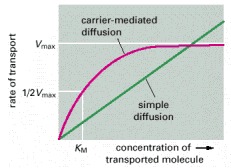
Textbook graph comparing simple diffusion with carrier-mediated transport, showing that carrier-mediated processes reach a maximum rate () when transport proteins become saturated. This supports the idea that the number (and turnover) of membrane carriers can limit transport rate, even when a concentration difference exists. It also helps distinguish protein-mediated transport from diffusion by its characteristic non-linear rate curve. Source
Important factors include:
ATP availability: less ATP means less energy for transport
respiration rate: slower respiration usually means slower ATP production
number of carrier proteins: more carriers can increase the rate of transport
temperature: low temperature can reduce carrier protein activity and ATP production
metabolic inhibitors: substances that interfere with respiration reduce active transport
Very high temperatures can also reduce active transport if carrier proteins lose their shape. Since the process depends on both protein structure and ATP, anything that affects either of these will affect transport rate.
Cells specialized for rapid active transport often have many mitochondria, helping provide the ATP needed for continuous movement across membranes.
Practice Questions
State two features of active transport. (2 marks)
Movement is against the concentration gradient / from lower concentration to higher concentration. (1)
Requires energy from ATP. (1)
Uses carrier proteins in the membrane. (1)
Accept any two points for a maximum of 2 marks.
Explain how ATP and carrier proteins are involved in active transport across a cell membrane. (5 marks)
Substance binds to a specific carrier protein. (1)
Carrier protein is specific because it has a complementary binding site / shape. (1)
ATP is hydrolyzed to ADP and inorganic phosphate. (1)
Energy released from ATP causes the carrier protein to change shape. (1)
Substance is moved across the membrane and released on the other side. (1)
Movement is against the concentration gradient / from lower to higher concentration. (1)
Maximum 5 marks.
FAQ
Active transport can reach a maximum rate because there are only so many carrier proteins in the membrane.
If all binding sites are occupied, adding more of the transported substance will not increase the rate further until some carrier proteins become free again.
ATP supply can also limit the rate. Even with many carrier proteins, transport cannot continue quickly if the cell is not making enough ATP.
A carrier protein binds to a substance and changes shape to move it across the membrane.
A channel protein forms a pore that allows certain particles to pass through without the protein changing shape in the same way each time.
In active transport, carrier proteins are important because movement requires both:
specific binding
a conformational change
energy input from ATP
Ions are charged particles, so they do not pass easily through the hydrophobic interior of the membrane.
Because of this, cells often need membrane proteins to move ions across. If the ion must be moved against its concentration gradient, ATP is also needed.
This is why ion uptake and ion balance frequently depend on active transport rather than simple diffusion.
Yes. Active transport can move substances in either direction across a membrane.
The important point is not the direction relative to the cell, but the direction relative to the concentration gradient. If a substance is moved from lower concentration to higher concentration, the process is active transport whether it is entering or leaving the cell.
Many cells use outward active transport to maintain internal conditions.
The sodium-potassium pump is a membrane carrier protein found in many animal cells.
It uses ATP to:
move sodium ions out of the cell
move potassium ions into the cell
This is a classic example of active transport because it shows all the key features:
a specific membrane carrier protein
direct use of ATP
movement of ions against their concentration gradients
It is important in maintaining conditions needed for normal cell activity, especially in nerve and muscle cells.

