

Edexcel Syllabus focus:
'Understand osmosis as the movement of free water molecules through a partially permeable membrane, without requiring water potential.'
Osmosis explains how water moves into and out of cells. To understand it well, focus on free water molecules, partially permeable membranes, and why water shows a net movement between solutions.
What osmosis means
Osmosis is a special kind of transport involving water only. It happens when two solutions are separated by a membrane that allows water to pass through but restricts at least some other substances.
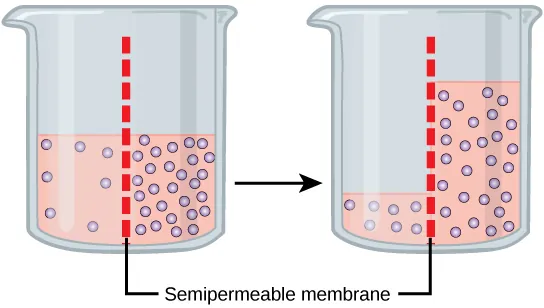
Diagram of osmosis across a semipermeable membrane separating two solutions with different solute concentrations. It visualises that water moves across the membrane to reduce the imbalance, producing a net change in volume/level on one side while solute is restricted. Source
This can be explained fully without using water potential.
Osmosis: The net movement of free water molecules through a partially permeable membrane from a region of higher concentration of free water molecules to a region of lower concentration of free water molecules.
In exam answers, the word free is important.
Free water molecules: Water molecules that are not closely associated with solute particles and are available to move through a partially permeable membrane.
A dilute solution contains relatively few dissolved solute particles, so it has a higher concentration of free water molecules. A concentrated solution contains more dissolved solute particles, so it has a lower concentration of free water molecules. This difference is what drives osmosis. Water is still present on both sides of the membrane, but there is a difference in how much of that water is free to move.
The role of a partially permeable membrane
A membrane is essential for osmosis. If there is no partially permeable membrane, water may still spread out, but that is not called osmosis.
Partially permeable membrane: A membrane that allows some molecules to pass through, especially water, but prevents others from crossing freely.
In cells, the cell surface membrane acts as the partially permeable membrane. Artificial membranes used in labs can also show osmosis. The key idea is that water can cross, while some solute particles cannot. Because of this, water movement can occur even when the solute stays mainly on one side.
How osmosis produces a net movement
Water molecules move randomly all the time. They do not move in only one direction. However, if one side of a membrane has more free water molecules than the other, then more water molecules will cross from that side per second. This creates a net movement.
The process can be thought of in stages:
water molecules move across the membrane in both directions
the side with more free water sends more molecules across
the side with less free water sends fewer molecules back
the overall result is a net movement toward the side with fewer free water molecules
This is why osmosis is described as the net movement of water, not simply the movement of water. Individual water molecules continue to move both ways. What matters is the overall balance of movement.
Why dissolved solutes change water movement
When a substance such as salt or sugar dissolves in water, the solute particles interact with nearby water molecules. This means fewer water molecules are free to move across the membrane.
That is why adding solute reduces the concentration of free water molecules. A solution with a lot of dissolved solute is therefore less able to supply free water for osmosis than a more dilute solution.
A common exam mistake is to say that water moves “from high solute concentration to low solute concentration.” That is incorrect for osmosis. Water moves according to the concentration of free water molecules, not because solute is moving.
Osmosis in cells
Osmosis is very important in living organisms because cells constantly gain or lose water depending on the solution around them. This affects cell volume and normal cell function.
In a more dilute surrounding solution
If the solution outside a cell is more dilute than the cytoplasm, there are more free water molecules outside the cell than inside. Water will move into the cell by osmosis.
As water enters, the cell may swell. In plant cells, the cell wall helps resist expansion, so the cell becomes firm.
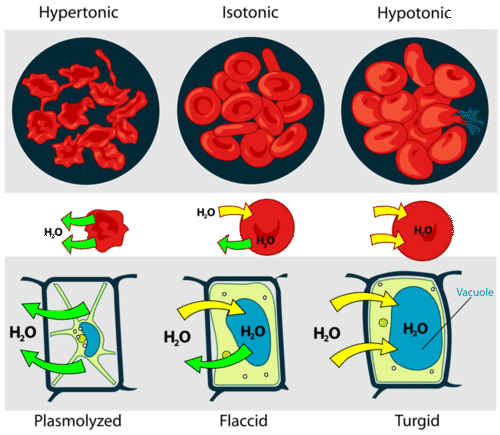
Diagram of plant cells in hypertonic, isotonic, and hypotonic surroundings, highlighting plasmolysis versus turgidity. It emphasizes that the cell wall limits bursting, while net water movement changes vacuole size and whether the membrane pulls away from the wall. Source
In animal cells, which do not have a cell wall, too much water entry can cause damage.
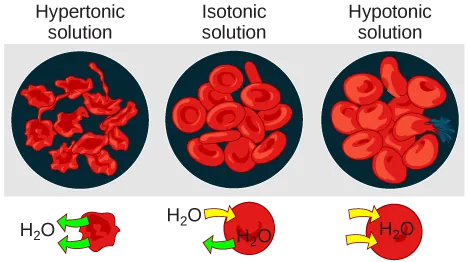
Illustration of red blood cells in hypotonic, isotonic, and hypertonic solutions, showing swelling/lysis, normal shape, and crenation respectively. This links the direction of net water movement to observable changes in cell volume when a cell lacks a supporting cell wall. Source
In a more concentrated surrounding solution
If the solution outside a cell is more concentrated than the cytoplasm, there are fewer free water molecules outside the cell than inside. Water will move out of the cell by osmosis.
The cell then loses water and becomes smaller. This can affect how well the cell works because enzyme activity, shape, and internal conditions may all be disturbed.
In similar conditions on both sides
If the concentration of free water molecules is similar on both sides of the membrane, water still moves in both directions, but there is no net movement. This does not mean osmosis has completely stopped at the molecular level. It means the movement is balanced.
Common mistakes and exam points
Osmosis only involves water molecules.
A partially permeable membrane must be present.
The movement is of free water molecules, not solute particles.
Osmosis is a net movement, because water moves both ways.
A dilute solution has more free water molecules.
A concentrated solution has fewer free water molecules.
Do not describe osmosis as the movement of “water from high concentration to low concentration” unless the membrane and free water idea are clear.
Do not say substances such as sugar or salt move by osmosis.
If a question only asks about osmosis, you do not need to use water potential.
The best answers usually mention free water molecules, partially permeable membrane, and net movement.
Practice Questions
Define osmosis. (2 marks)
net movement of free water molecules (1)
through a partially permeable membrane from a region of higher concentration of free water molecules to a region of lower concentration of free water molecules (1)
A cell is placed in a solution with a higher concentration of dissolved sugar than the cytoplasm of the cell.
Explain what happens to the water in and around the cell.
(5 marks)
the outside solution is more concentrated / has fewer free water molecules than the cytoplasm (1)
the cell surface membrane is partially permeable (1)
water molecules move across the membrane in both directions (1)
there is a net movement of free water molecules out of the cell (1)
the cell loses water and becomes smaller / shrinks (1)
FAQ
Osmosis does not require a living cell.
It only requires:
water
a difference in free water concentration
a partially permeable membrane
Dialysis tubing acts as an artificial partially permeable membrane, so water can move through it by osmosis even though no metabolism is involved.
As water enters a plant cell, the vacuole expands and pushes the cytoplasm against the cell wall.
The cell wall resists further expansion, creating pressure inside the cell. This pressure opposes additional water entry, so the rate of osmosis decreases as the cell becomes more swollen.
This is why plant cells can become firm without bursting.
Higher temperature gives water molecules more kinetic energy.
As a result:
molecules move faster
they collide with the membrane more often
the net movement of water can happen more quickly
However, very high temperatures may damage biological membranes, so in living systems the effect is not unlimited.
Red blood cells have a cell surface membrane but no cell wall.
In pure water, there is a very high concentration of free water molecules outside the cell, so water enters rapidly by osmosis. Without a rigid wall to resist expansion, the cell can swell and burst.
Plant cells are protected by a strong cellulose cell wall, which limits expansion.
At equilibrium, water molecules are still moving across the membrane in both directions.
The difference is that:
the rate of movement in one direction equals the rate in the other direction
there is no net movement overall
So equilibrium does not mean the molecules have stopped moving. It means the movements are balanced.
