

Edexcel Syllabus focus:
'Know the bases thymine, uracil, cytosine, adenine and guanine, and which bases are found in DNA and RNA.'
DNA and RNA contain specific nitrogenous bases that help distinguish the two nucleic acids. Learning the names of these bases and where they occur is essential for accurate biological vocabulary and later genetics topics.
The five nitrogenous bases
Nucleic acids are built using a limited set of bases. Each of these is a nitrogenous base.
Nitrogenous base: One of the organic bases present in DNA or RNA.
In A-Level Biology, you need to know the five base names and their single-letter abbreviations:
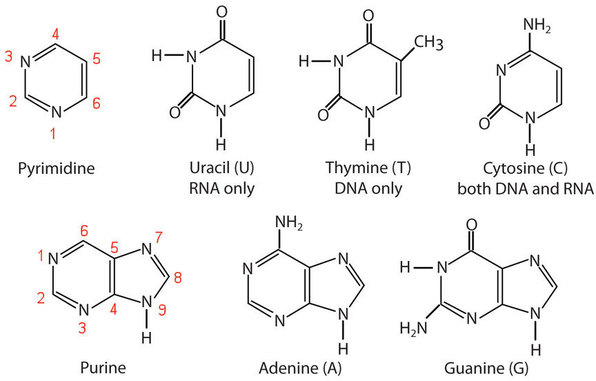
Structural formulas for the five nitrogenous bases grouped into pyrimidines (C, T, U) and purines (A, G). The labels emphasize that thymine is DNA-only and uracil is RNA-only, while adenine, cytosine, and guanine occur in both nucleic acids. Source
Adenine (A) — found in DNA and RNA
Guanine (G) — found in DNA and RNA
Cytosine (C) — found in DNA and RNA
Thymine (T) — found in DNA only
Uracil (U) — found in RNA only
These bases may appear as full names in written questions or as single letters in diagrams and sequences. Students should recognize both forms immediately.
In longer sequences, scientists nearly always use the one-letter system because it is much faster to read and write. In exam answers, either full names or correct abbreviations are usually acceptable if the question does not specify otherwise.
This is a factual part of the course, so precision matters. Mixing up thymine and uracil is one of the most common errors.
Bases found in DNA
DNA contains four bases: adenine, thymine, cytosine, and guanine.
In abbreviated form, these are A, T, C, and G.
When you see a DNA sequence written out, every letter should be one of these four. If a sequence includes U, it is not standard DNA.
Of the five named bases in this subsubtopic, thymine is the base that most clearly identifies DNA, because it is present in DNA but absent from standard RNA. This is often the quickest way to tell that a sequence, diagram, or molecule being described is DNA.
Three DNA bases are shared with RNA: adenine, cytosine, and guanine. This means DNA and RNA are similar in some respects, but they are not identical in base composition.
Be careful with wording. It is correct to say DNA contains thymine instead of uracil. It is not correct to say DNA contains all five bases.
Key point for DNA
DNA bases: A, T, C, G
Not found in DNA: U
Remembering ATCG is a simple way to check whether a list of bases matches DNA.
Bases found in RNA
RNA also contains four bases, but one of them is different.
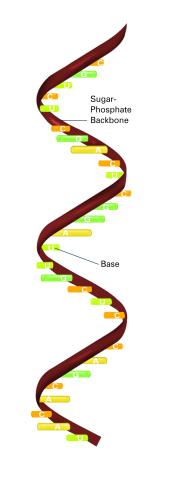
Labeled illustration of an RNA strand showing a sugar–phosphate backbone with bases represented by their letters (A, U, C, G). The presence of uracil (U) in the sequence provides a visual cue for distinguishing RNA from DNA when reading base-letter diagrams. Source
RNA contains adenine, uracil, cytosine, and guanine, abbreviated to A, U, C, and G.
When you see U in a nucleic acid sequence, that is a strong sign that the sequence is RNA. Standard RNA does not contain T.
In RNA, uracil takes the place of thymine. This is the single most important difference between the base composition of DNA and RNA at this level.
Like DNA, RNA shares adenine, cytosine, and guanine with the other nucleic acid. Only one base differs between them.
All the main RNA types that students usually meet, such as messenger RNA, transfer RNA, and ribosomal RNA, use the same standard set of four bases: A, U, C, and G.
Key point for RNA
RNA bases: A, U, C, G
Not found in RNA: T
A quick memory aid is: RNA uses U.
Comparing DNA and RNA bases
The easiest comparison is to sort the bases into groups:
Found in both DNA and RNA: adenine, cytosine, guanine
Found only in DNA: thymine
Found only in RNA: uracil
This means that DNA and RNA share three bases and differ by one base. That single difference is very useful, because it lets biologists distinguish between DNA and RNA quickly.
The difference between T and U can also help you interpret biological diagrams. A strand labeled with U is being described as RNA, even if the word RNA is not written. A strand labeled with T is DNA.
Questions may ask for the names of the bases, the letters used to represent them, or which bases are present in each nucleic acid. Read the wording carefully and answer at the correct level of detail.
If a question asks for bases, do not write about phosphate groups or sugars, because those are different parts of nucleic acids. It is also important not to confuse a base with a nucleotide. A base is only one part of a nucleotide.
Common exam mistakes
Writing uracil as a DNA base
Writing thymine as an RNA base
Saying DNA and RNA both contain all five bases
Forgetting the single-letter abbreviations
Giving extra structural detail when the question only asks for the names of the bases
Most questions on this area reward exact biological vocabulary. Learning the five base names and placing them correctly into DNA or RNA is the core requirement for this subsubtopic.
Practice Questions
State the three bases found in both DNA and RNA. (3 marks)
adenine (1)
cytosine (1)
guanine (1)
A student says, “DNA and RNA contain exactly the same bases.” Explain why this statement is incorrect. (5 marks)
both DNA and RNA contain adenine (1)
both DNA and RNA contain cytosine (1)
both DNA and RNA contain guanine (1)
DNA contains thymine / DNA does not contain uracil (1)
RNA contains uracil / RNA does not contain thymine (1)
FAQ
Uracil is chemically similar to thymine, but it is slightly simpler and cheaper for cells to make.
DNA uses thymine because this helps repair systems recognize when cytosine has been chemically changed into uracil by damage. Using thymine in normal DNA makes accidental uracil easier to spot.
The bases fall into two structural groups:
Purines: adenine and guanine
Pyrimidines: cytosine, thymine, and uracil
Purines have a two-ring structure, while pyrimidines have a one-ring structure. You do not need full chemical detail for this subsubtopic, but the grouping helps when you meet base pairing later.
Yes. Some RNA molecules, especially tRNA and rRNA, can contain modified bases made after the RNA is first synthesized.
These modifications can help with folding, stability, or recognition. However, for Edexcel A-Level Biology, standard RNA is described as containing A, U, C, and G, so that is the expected exam answer.
Not from that sequence alone.
A, C, and G are found in both DNA and RNA, so you need extra information, such as:
whether T or U appears elsewhere
the type of sugar present
the source or role of the molecule
This is why short sequences made only of A, C, and G can be ambiguous.
Yes. Viral genetic material still follows the same basic base rules for DNA and RNA.
DNA viruses use A, T, C, G
RNA viruses use A, U, C, G
The key point is that the type of nucleic acid determines whether thymine or uracil is present, not whether the genetic material comes from a cell or a virus.
