

Edexcel Syllabus focus:
'Know the basic structure of mononucleotides: deoxyribose or ribose linked to a phosphate group and a nitrogenous base.'
Mononucleotides are small but essential biological molecules. Understanding their three-part structure is the foundation for learning how DNA and RNA store genetic information in living organisms.
What a mononucleotide is
A mononucleotide is a single nucleotide unit found as one basic component of nucleic acids.
Mononucleotide: A molecule made of a pentose sugar linked to a phosphate group and a nitrogenous base.
Each mononucleotide has three linked parts, explained separately below. For Edexcel, you should be able to identify these parts clearly and name the correct sugar found in DNA or RNA.
The most important idea is that a mononucleotide is one complete unit, not just a sugar or just a base. All three components must be present for it to be described as a mononucleotide.
The three components of a mononucleotide
Pentose sugar
The sugar in a mononucleotide is a pentose sugar, meaning a sugar with five carbon atoms. In DNA, the sugar is deoxyribose. In RNA, the sugar is ribose.
The sugar is the central part of the mononucleotide. Both the phosphate group and the base are attached to it. This means the sugar connects the other two components together.
Deoxyribose and ribose are very similar molecules, but they are not identical.
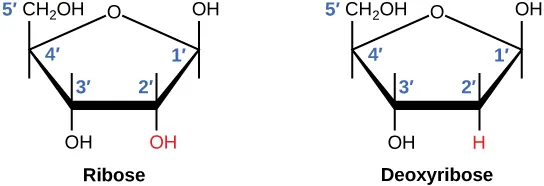
Comparison of ribose and deoxyribose structures, emphasizing the 2′ carbon: ribose has an –OH group, while deoxyribose has H instead. This single substitution explains why DNA mononucleotides contain deoxyribose whereas RNA mononucleotides contain ribose. Source
Deoxyribose has one less oxygen atom than ribose. This small structural difference is enough to distinguish a DNA mononucleotide from an RNA mononucleotide.
In exam answers, it is better to write deoxyribose or ribose rather than just writing “sugar,” because the exact sugar matters.
Phosphate group
A phosphate group is attached to the sugar. This is one of the three essential parts of every mononucleotide in DNA or RNA.
The phosphate group contains phosphorus and oxygen atoms. In simplified diagrams, it is often shown as a circle or labeled P. Even though the diagram may be simple, you should remember that it is a distinct chemical group and not part of the sugar or the base.
Students sometimes forget the phosphate group when describing a mononucleotide. This loses marks, because a mononucleotide must include all three parts:
a pentose sugar
a phosphate group
a base
Nitrogenous base
A nitrogenous base is the third component of the mononucleotide.
Nitrogenous base: An organic base containing nitrogen that is attached to the sugar in a mononucleotide.
The nitrogenous base is attached to the sugar, not directly to the phosphate group. Different mononucleotides can have different bases, so the base is the part that varies between different mononucleotides.
For this subtopic, the key point is structural: every mononucleotide contains one nitrogenous base as one of its three components.
How the parts are arranged
In a mononucleotide, the sugar acts as the central component. The phosphate group is linked to the sugar, and the nitrogenous base is also linked to the sugar.
A useful way to picture a mononucleotide is:
one pentose sugar
one phosphate group
one nitrogenous base
These are not three separate molecules floating independently. They are linked together to form one mononucleotide. If one of these parts is missing, the molecule is not a complete mononucleotide.
In simplified biological diagrams, the sugar is often shown as a pentagon, the phosphate as a circle, and the base as a rectangle.
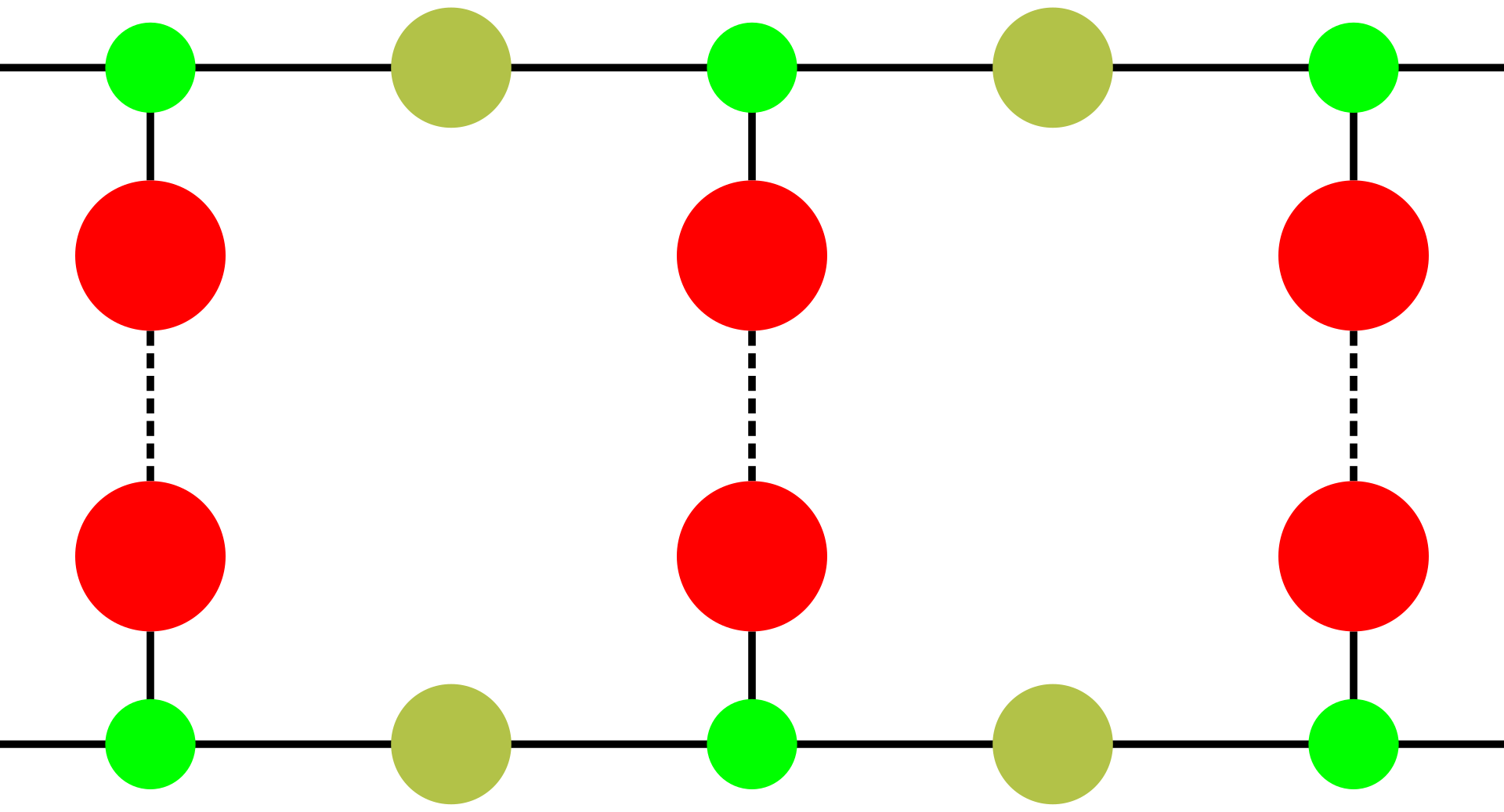
Schematic of a nucleic acid segment using standard educational symbols: sugar (pentose), phosphate, and nitrogenous base. This reinforces that nucleotides are built from these three chemically distinct components, even when diagrams simplify their shapes. Source
These shapes are only symbols. In an exam, you should focus on identifying the actual components, not just memorizing diagram shapes.
DNA mononucleotides and RNA mononucleotides
The main structural difference between a DNA mononucleotide and an RNA mononucleotide is the sugar present.
A DNA mononucleotide contains deoxyribose
An RNA mononucleotide contains ribose
Both types still contain:
a phosphate group
a nitrogenous base
This means DNA and RNA mononucleotides follow the same basic three-part pattern. The sugar is the key distinguishing feature required here.
A common exam mistake is to think that DNA and RNA mononucleotides are completely different in overall plan. They are not. Both are built from the same kinds of components, but one uses deoxyribose and the other uses ribose.
Using precise biological language
In biology, small differences in wording matter. Saying “DNA contains sugar” is less accurate than saying “a DNA mononucleotide contains deoxyribose.” Saying “there is a base” is less precise than saying “there is a nitrogenous base.”
It is also important to separate the idea of a mononucleotide from the larger molecules built from these units. A mononucleotide is one structural unit, not an entire DNA or RNA molecule.
When a question asks for the basic structure of a mononucleotide, the safest full answer is always the same:
deoxyribose or ribose
a phosphate group
a nitrogenous base
Common misunderstandings to avoid
A common mistake is to describe a mononucleotide as only a sugar and a base. This is incomplete because the phosphate group must also be included.
Another mistake is to forget that the sugar can differ. In this topic:
DNA uses deoxyribose
RNA uses ribose
Keep these points clear when revising:
mononucleotide means one complete unit
the sugar is either ribose or deoxyribose
the phosphate group is a separate component
the nitrogenous base is a separate component
the sugar links the other two parts together
Practice Questions
State the three components of a mononucleotide. (3 marks)
1 mark for phosphate group
1 mark for pentose sugar or ribose/deoxyribose
1 mark for nitrogenous base
Explain how a DNA mononucleotide differs from an RNA mononucleotide, and describe how the parts of a mononucleotide are arranged. (5 marks)
1 mark for stating that a DNA mononucleotide contains deoxyribose
1 mark for stating that an RNA mononucleotide contains ribose
1 mark for stating that both contain a phosphate group
1 mark for stating that both contain a nitrogenous base
1 mark for stating that the sugar is the central part and is linked to both the phosphate group and the nitrogenous base
FAQ
A pentose sugar is a sugar with five carbon atoms.
This can be confusing because, in many diagrams, the sugar is drawn as a ring with only part of the full structure visible. Even when shown in a ring form, it still has five carbons in total.
The term helps distinguish ribose and deoxyribose from other sugars, such as hexose sugars like glucose, which have six carbons.
“Deoxy-” means that deoxyribose has one less oxygen atom than ribose.
More specifically:
ribose has an $OH$ group on the $2'$ carbon
deoxyribose has an $H$ atom instead
This small difference makes deoxyribose chemically distinct from ribose and is one reason DNA and RNA are treated as different nucleic acids.
Prime numbers are used to identify the carbon atoms in the sugar and to distinguish them from positions on the base.
This helps scientists describe structures accurately. For example:
the base is attached to the $1'$ carbon
the phosphate group is commonly attached at the $5'$ position
You do not always need these labels for basic structure questions, but they are useful when reading diagrams in advanced biology.
They are called bases because they have chemical properties associated with bases, especially the ability of some nitrogen atoms to accept protons.
In biology, the word does not simply mean “high pH.” Instead, it refers to the molecule’s chemical behavior and structure.
The word nitrogenous is included because these molecules contain nitrogen atoms, which are important to their chemical properties.
Textbook diagrams are simplified to make the main parts easy to identify quickly.
They usually show:
a circle for the phosphate
a pentagon for the sugar
a rectangle for the base
Real molecular structures are much more detailed, with specific atoms, bond angles, and spatial arrangements. Simplified diagrams are useful for learning the overall organization, while full structural formulas are used when more chemical detail is needed.

