

Edexcel Syllabus focus:
'Know that DNA and RNA are polynucleotides made from mononucleotides joined by condensation reactions.'
These notes explain how nucleic acids are built from repeating monomers, showing why DNA and RNA are classified as polynucleotides and how condensation reactions create the covalent links that hold each chain together.
DNA and RNA as polymers
The meaning of polynucleotide
DNA and RNA are members of the nucleic acid group. Each is built from repeating nucleotide units rather than being one small molecule. Because the repeating units are nucleotides, DNA and RNA are described as polynucleotides.
Polynucleotide: A long chain molecule made from many mononucleotides joined together.
Both DNA and RNA are therefore polymers. The important idea is that many nucleotides are chemically linked in sequence to form a much larger molecule, not simply grouped near each other.
A DNA molecule contains very long nucleotide chains. RNA is also made from nucleotide chains, although RNA molecules are often shorter. In both cases, the chain structure is essential to the molecule.
Building the chain
Mononucleotides as subunits
Every polynucleotide is assembled from mononucleotides. A mononucleotide is the monomer, or repeating unit, from which the larger polymer is made. Each mononucleotide contains a sugar, a phosphate group, and a nitrogen-containing base.
The mononucleotides used in DNA and RNA are similar in overall plan. What matters in this subtopic is that each one is capable of joining to another, allowing a long chain to be formed by repeated reactions.
As more mononucleotides are added, the molecule develops a repeated structural pattern. The sugar and phosphate parts form the regular framework of the chain, while the bases extend from that framework.
Condensation reactions
Mononucleotides are not simply placed side by side; they are joined by condensation reactions. This is the reaction type that must be linked with polynucleotide formation.
Condensation reaction: A reaction in which two molecules join together and a small molecule, usually water, is removed.
In nucleic acids, a condensation reaction links one nucleotide to the next. When the same reaction happens many times, the chain becomes longer until a polynucleotide has been produced.
Each new link forms when part of one nucleotide reacts with part of the next nucleotide. As the bond forms, a molecule of water is released. That loss of water is why the reaction is called condensation.
Bonds and backbone
Phosphodiester bonds
The covalent link formed between neighboring nucleotides is called a phosphodiester bond.
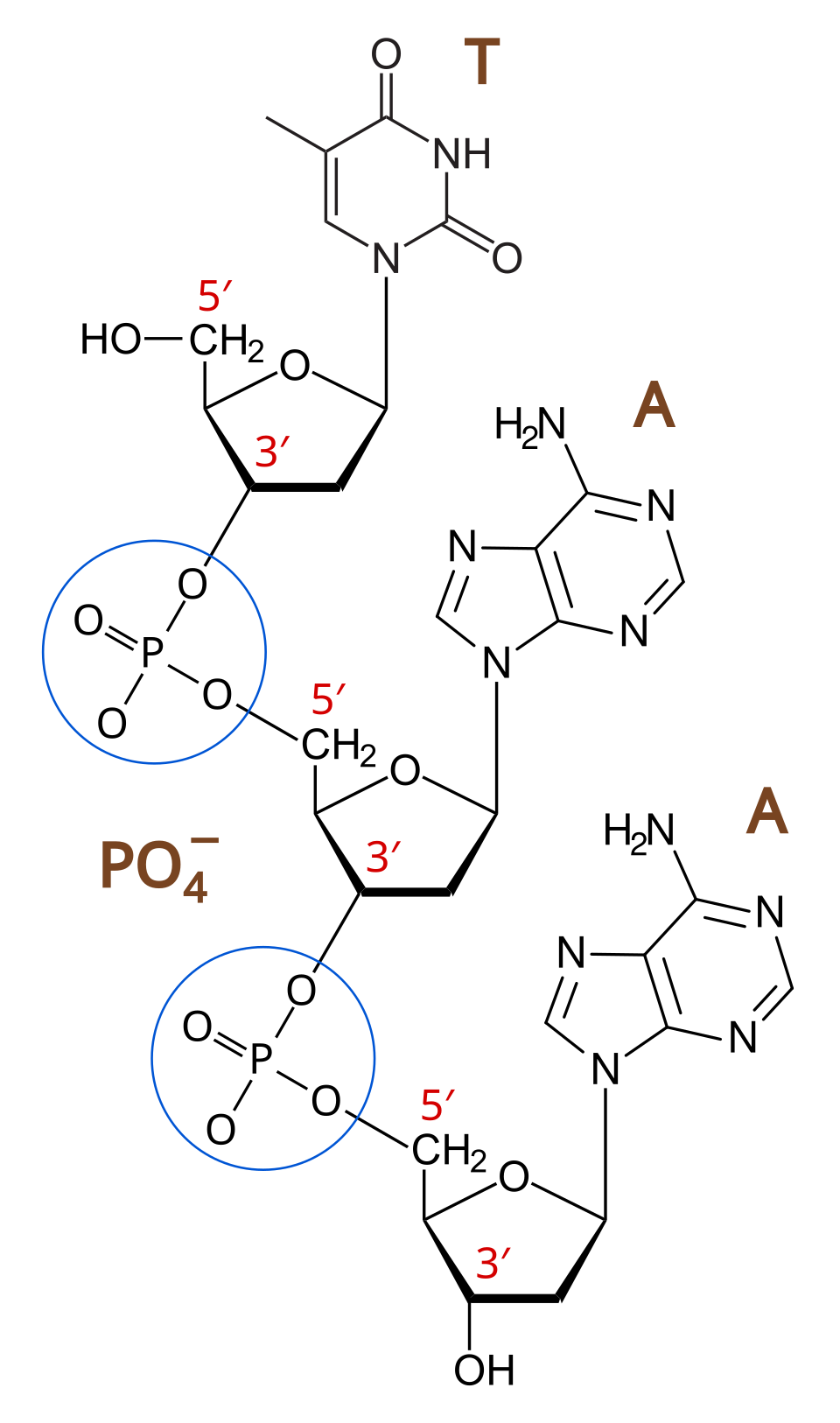
Diagram of a short nucleotide chain highlighting the phosphodiester linkages that join adjacent sugars via phosphate groups. This makes the “repeat unit” idea concrete: each new nucleotide is covalently connected into the same backbone pattern to extend the polynucleotide. Source
This bond gives the polynucleotide chain continuity and strength.
Phosphodiester bond: A covalent bond that joins adjacent nucleotides in a polynucleotide chain.
A phosphodiester bond forms between the phosphate associated with one nucleotide and the sugar of the next nucleotide. Repeated phosphodiester bond formation produces the continuous chain seen in both DNA and RNA.
The sugar-phosphate backbone
The repeating framework created by these bonds is called the sugar-phosphate backbone.
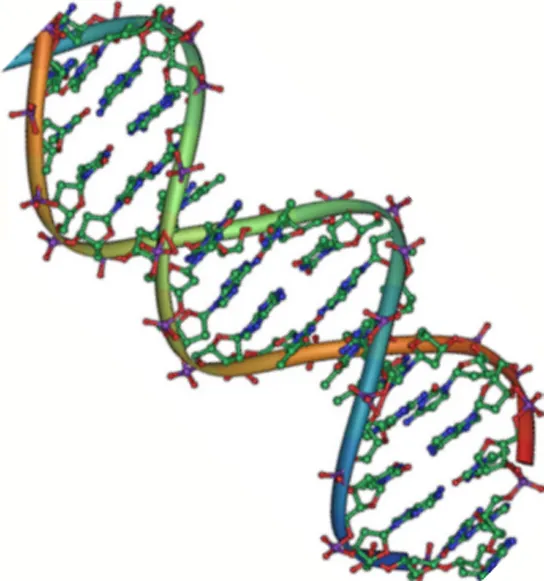
Textbook DNA schematic emphasizing that the sugar–phosphate backbone forms the structural framework of nucleic acids, with bases positioned toward the interior. This complements the idea that a polynucleotide’s repeating sugar–phosphate pattern is what makes it a true polymer rather than a loose collection of nucleotides. Source
This backbone is a key structural feature of all polynucleotides.
Because the same linkage is repeated many times, very long molecules can be built from relatively simple subunits. This repeated backbone is what makes nucleic acids polymers rather than loose collections of separate nucleotides.
Although the backbone follows a repeated pattern, the sequence of bases can vary along the chain. This means one polynucleotide can differ from another even though both are formed by the same type of reaction.
What this means for DNA and RNA
One structural principle for both molecules
For this specification point, the main comparison is simple: both DNA and RNA are polynucleotides. They should not be thought of as completely different kinds of molecules in terms of how they are built.
Instead, both follow the same structural principle:
begin with mononucleotides
join neighboring mononucleotides by condensation reactions
form phosphodiester bonds
produce a long nucleotide chain with a sugar-phosphate backbone
This means that any accurate description of DNA or RNA at this level should include the idea of repeated nucleotide units and the reaction that links them together.
Common mistakes to avoid
A common exam mistake is to give the wrong bond or the wrong reaction. Peptide bonds join amino acids in proteins, not nucleotides in nucleic acids. The correct bond here is the phosphodiester bond, and it is formed during condensation.
Another common mistake is to describe DNA or RNA only as a set of bases. Bases are part of each mononucleotide, but the full structure depends on sugars, phosphates, and covalent links between neighboring nucleotides.
The essential facts to learn are:
DNA and RNA are polynucleotides
a polynucleotide is made from many mononucleotides
mononucleotides are joined by condensation reactions
each condensation reaction releases water
the bond formed between nucleotides is a phosphodiester bond
repeated phosphodiester bonds create a sugar-phosphate backbone
Practice Questions
State what is meant by a polynucleotide and name the type of reaction that joins mononucleotides together. (2 marks)
1 mark for stating that a polynucleotide is a long chain made of many mononucleotides
1 mark for naming the reaction as a condensation reaction
Explain how mononucleotides are joined to form a polynucleotide in DNA or RNA. (5 marks)
1 mark for stating that many mononucleotides join together to make one long chain
1 mark for stating that adjacent mononucleotides are joined by condensation reactions
1 mark for stating that water is removed or released
1 mark for stating that the phosphate of one nucleotide joins to the sugar of the next nucleotide
1 mark for stating that phosphodiester bonds are formed, creating a sugar-phosphate backbone
FAQ
“Phospho” refers to the phosphate group. “Diester” means the phosphate is involved in two ester-type links within the backbone.
In a polynucleotide, one phosphate helps connect two sugars, so it acts as a bridge between adjacent nucleotides.
Hydrolysis is the reverse of condensation. Instead of removing water to make a bond, water is added to break a bond.
If phosphodiester bonds are hydrolyzed, a polynucleotide can be split into shorter fragments or individual nucleotides.
The sugar in each nucleotide has numbered carbon atoms, so the two ends of a chain are chemically different. These ends are usually called the 5' end and the 3' end.
Because the ends are different, a nucleotide sequence is written and read in a defined direction rather than randomly.
A nucleoside is made of a sugar joined to a nitrogenous base. It does not include phosphate.
A nucleotide is a nucleoside with one or more phosphate groups attached. The phosphate is important because it allows nucleotides to link together into a polynucleotide.
A single RNA chain is flexible, and some regions can interact with other parts of the same molecule.
These internal interactions can produce loops, bends, and short paired sections, giving RNA a variety of three-dimensional shapes.

