

Edexcel Syllabus focus:
'Know how complementary base pairing and hydrogen bonding between two complementary strands form the DNA double helix.'
DNA stores genetic information in a form that is both stable and precise. This depends on strict base-pairing rules and many weak bonds working together across two linked strands.
Complementary strands and base pairing
A DNA molecule is made of two polynucleotide strands arranged side by side. The bases project inward, where they pair with bases on the opposite strand. The order of bases on one strand determines the order on the other.
When the bases on one strand match specific bases on the other strand, this is called complementary base pairing.
Complementary base pairing: The specific pairing of bases in DNA, where adenine pairs with thymine and cytosine pairs with guanine.
This means the two DNA strands are complementary, not identical. If one strand has a particular base sequence, the second strand must have the matching sequence required by the pairing rules.
Specific pairing is essential because each base can form stable interactions only with its correct partner. In DNA:
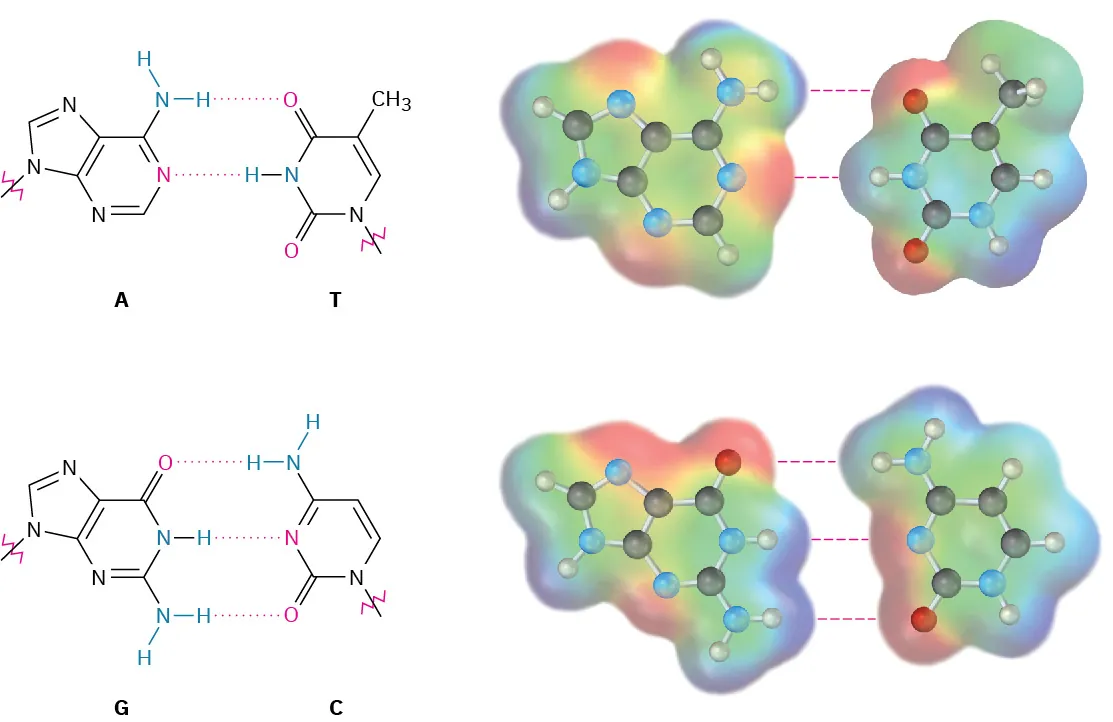
Diagram of the two Watson–Crick base pairs, showing hydrogen bonds as dotted lines. It highlights that adenine–thymine pairs form two hydrogen bonds, whereas cytosine–guanine pairs form three, linking base identity to bonding pattern and overall stability. Source
A pairs with T
C pairs with G
These fixed pairings give DNA a regular and predictable structure along its whole length. Complementary pairing also ensures that the information stored in base sequences is organized in a consistent way across the molecule.
Because the pairing rules never change, any stretch of DNA can be described as one strand plus its complement. The sequence on the second strand is different, but it is linked exactly to the first by base-pairing rules at every position.
Hydrogen bonding between the bases
The two strands are held together by hydrogen bonds formed between complementary bases.
Hydrogen bond: A weak attractive force between parts of molecules or between molecules, important in holding complementary DNA bases together.
Although each hydrogen bond is weak on its own, DNA contains very large numbers of them along the length of the molecule. Together, they provide enough stability to keep the two strands associated.
In DNA:
A and T are joined by two hydrogen bonds
C and G are joined by three hydrogen bonds
Because C-G pairs have more hydrogen bonds than A-T pairs, regions with many C-G pairs are slightly harder to separate. The key idea for this specification is that hydrogen bonds link the two complementary strands and help maintain the structure of the whole DNA molecule.
Hydrogen bonds form between bases on opposite strands, not along the sugar-phosphate backbone of a single strand. This distinction matters because the paired bases are the part of DNA that connects one strand to the other.
The large number of hydrogen bonds across a DNA molecule creates a strong overall effect. DNA is therefore stable as a complete structure, even though the individual bonds are weak compared with stronger chemical bonds elsewhere in the molecule.
How the double helix is formed
When two complementary strands line up and hydrogen bonds form between their paired bases, the whole molecule twists into the DNA double helix.
DNA double helix: The three-dimensional structure of DNA in which two complementary strands coil around each other in a spiral.
The term double refers to the presence of two strands, and helix refers to the spiral shape. A useful mental image is a twisted ladder:
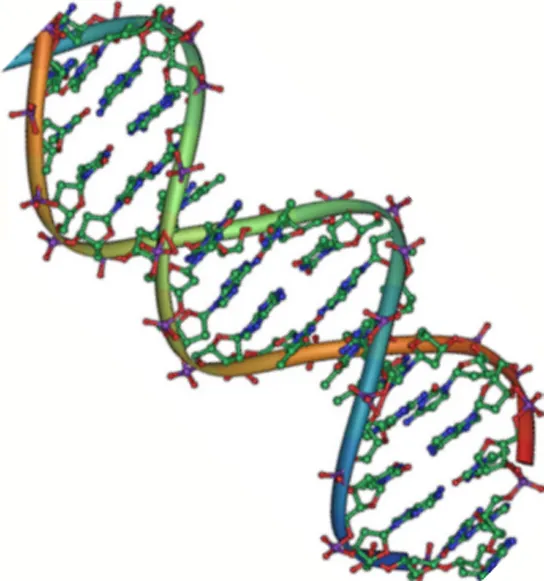
Diagram of native DNA as a double helix, emphasizing that the sugar–phosphate backbones lie on the outside while the bases face inward. This supports the ‘twisted ladder’ model by connecting backbone placement (sides) to base pairing (rungs) within the helical twist. Source
the sugar-phosphate backbones form the sides
the paired bases form the rungs
the entire structure twists to form the helix
The arrangement of bases is central to this structure. Because only specific complementary pairs form, the two strands fit together in a precise way. Repeated pairing all the way along the molecule produces a stable, regular spiral rather than a random shape.
The bases face inward toward the center of the molecule, while the backbones lie on the outside. This positioning allows the bases on one strand to meet and bond with their complementary partners on the other strand. Without complementary base pairing, the two strands would not align correctly, and the double helix could not be maintained.
The strands also run in opposite directions, often described as antiparallel.
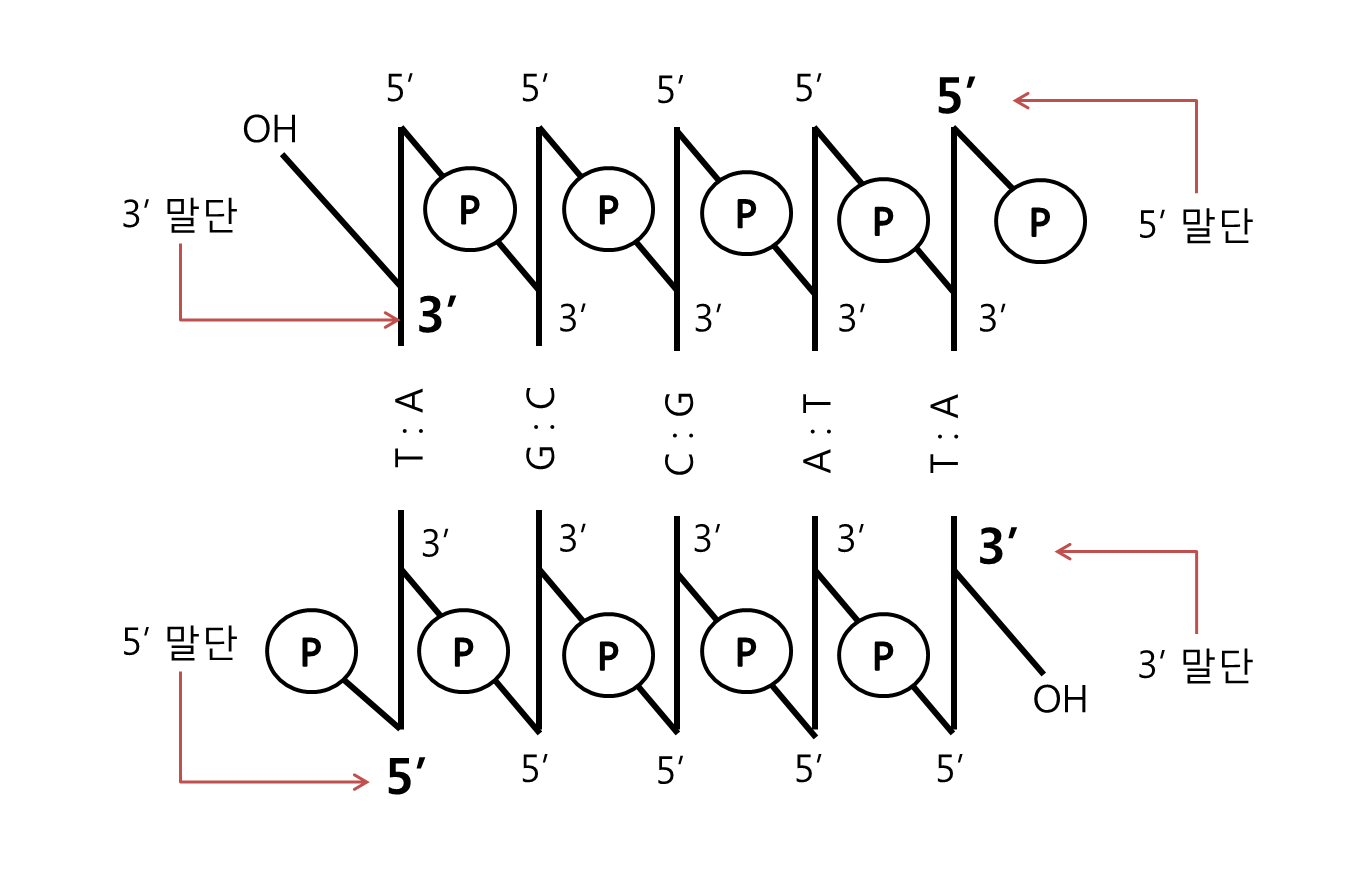
Labeled schematic showing two DNA strands running antiparallel (one and the other ). This makes the strand directionality explicit and helps explain why bases align across the center of the molecule in a consistent, repeatable way. Source
This opposite orientation helps the bases line up properly across the center of the molecule, supporting the overall helical structure.
The twisting also helps make the molecule compact while preserving the exact relationship between paired bases. The regular coiling is therefore a structural result of many complementary base pairs and many hydrogen bonds acting together along the full length of DNA.
Why this structure is effective
Specificity
Complementary base pairing means that every base has a defined partner. This makes the relationship between the two strands exact. Knowing the sequence on one strand allows the complementary sequence on the other strand to be predicted.
Stability
Hydrogen bonds are individually weak, but the very large number of them across a DNA molecule makes the full structure stable. The spiral arrangement of the two strands also helps the molecule remain compact and orderly.
Regular structure
Because the same base-pairing rules operate throughout the molecule, DNA keeps a repeated pattern along its length. This regularity is an important feature of the double helix.
Common mistakes to avoid
Complementary does not mean identical.
Hydrogen bonds join bases across the two strands, not neighboring bases on the same strand.
A DNA molecule is made of two strands, not one.
The double helix is formed by the combination of complementary base pairing and hydrogen bonding.
If the bases did not pair specifically, the strands would not form the correct helical structure.
Practice Questions
State the complementary base pairs found in DNA and name the type of bond that joins the paired bases. (3 marks)
Adenine pairs with thymine. (1)
Cytosine pairs with guanine. (1)
Hydrogen bonds join the paired bases / join complementary bases. (1)
Explain how complementary base pairing and hydrogen bonding contribute to the formation of the DNA double helix. (6 marks)
DNA consists of two strands / two polynucleotide strands. (1)
The strands are complementary. (1)
Adenine pairs with thymine. (1)
Cytosine pairs with guanine. (1)
Complementary bases are joined by hydrogen bonds. (1)
The two strands coil around each other to form a double helix / twisted spiral. (1)
FAQ
DNA keeps a fairly constant width because each base pair contains one larger base and one smaller base.
Adenine and guanine are purines, which have a double-ring structure. Thymine and cytosine are pyrimidines, which have a single-ring structure. Pairing a purine with a pyrimidine keeps the distance between the two backbones consistent. If two purines or two pyrimidines paired together, the helix would become uneven.
The outside of the DNA molecule is exposed to the watery environment of the cell, so the more water-friendly parts of the molecule are positioned there.
The sugar-phosphate backbone is hydrophilic, while the bases are less water-friendly and are better protected inside the helix. Keeping the bases in the center also allows them to stack closely and pair accurately with bases on the opposite strand.
Base stacking is the close packing of neighboring bases above and below each other inside the helix.
These interactions add extra stability to DNA beyond hydrogen bonding alone. So, the double helix is supported not only by bonds between opposite bases, but also by the way adjacent bases line up and stack along each strand. This helps the helix stay compact and ordered.
Two key ideas helped support the model.
First, Chargaff's data showed that the amount of adenine is similar to thymine, and the amount of cytosine is similar to guanine. Second, X-ray diffraction work by Rosalind Franklin and Maurice Wilkins showed that DNA had a helical structure with a regular repeating pattern. Together, these findings strongly supported the double helix model with specific base pairing.
Yes. The most common cellular form is B-DNA, which is the standard double helix usually taught at this level.
However, under different conditions, DNA can adopt other forms such as A-DNA or Z-DNA. These forms still involve paired strands, but the helix is shaped differently. For Edexcel A-Level Biology, the main structure to know is the normal DNA double helix formed by complementary base pairing and hydrogen bonding.

