

Edexcel Syllabus focus:
'Understand patterns of inheritance in the context of monohybrid inheritance, including the interpretation of genetic pedigree diagrams.'
Monohybrid inheritance tracks how one gene passes from parents to offspring. To answer inheritance questions accurately, you need to connect allele combinations, expected ratios, and the family patterns shown in pedigree diagrams.
Monohybrid inheritance
Monohybrid inheritance: Inheritance involving one gene, usually with two alleles, where the transmission of a single characteristic is followed from parents to offspring.
In a monohybrid cross, each parent contributes one allele in a gamete, and the offspring receives two alleles, one from each parent. The pair of alleles forms the genotype, and this influences the phenotype that is expressed.
A dominant allele is expressed when only one copy is present. A recessive allele is expressed only when both alleles are recessive. Therefore, a heterozygous individual shows the dominant phenotype, while a homozygous recessive individual shows the recessive phenotype.
Biologists usually represent the two alleles of one gene with the same letter. A capital letter represents the dominant allele and a lowercase letter represents the recessive allele. This makes it easier to compare possible offspring genotypes.
Predicting inheritance patterns
Patterns of monohybrid inheritance are predicted by considering all possible allele combinations at fertilization.
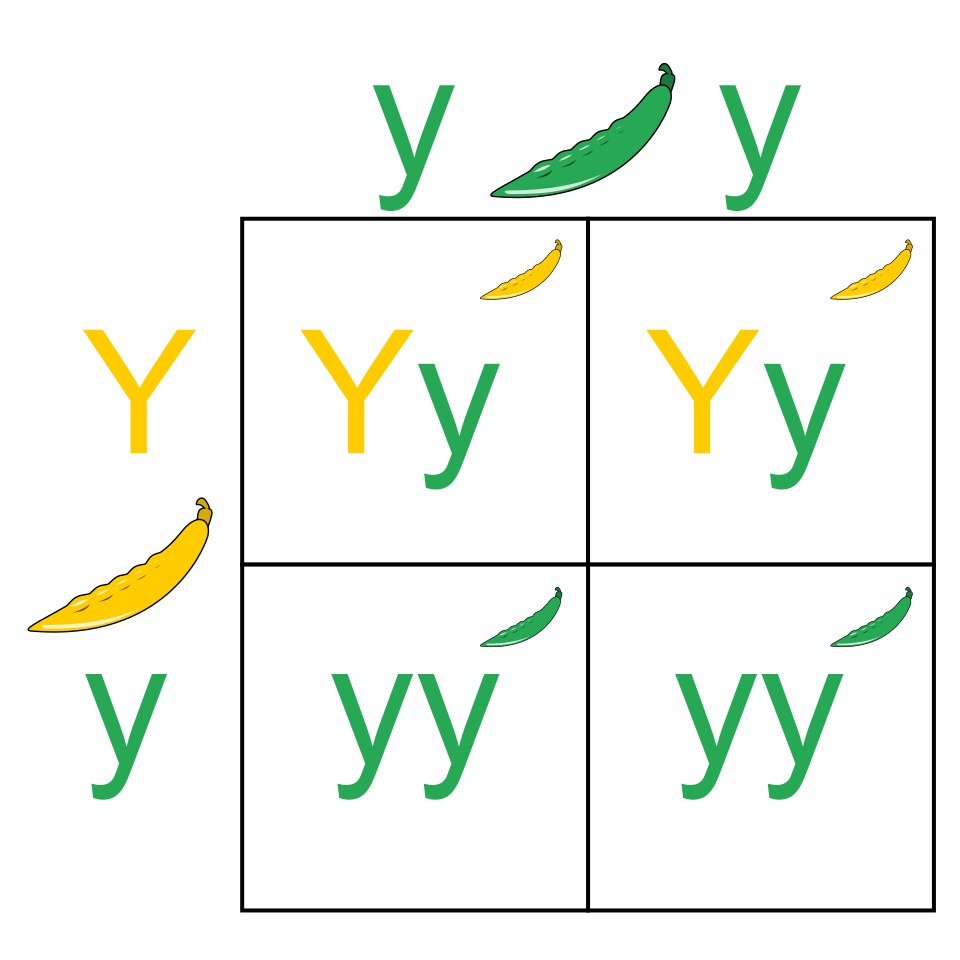
This Punnett square shows how parental gametes combine to form offspring genotypes for a single-gene (monohybrid) cross. It makes clear why heterozygous genotypes can arise in more than one way, and how genotype counts translate into expected phenotype ratios under complete dominance. Source
Punnett squares help organize these possibilities, but the important idea is that each offspring is produced by a random combination of one allele from each parent.
Common inheritance patterns include:
Heterozygous x heterozygous parents: expected genotype ratio of 1 homozygous dominant : 2 heterozygous : 1 homozygous recessive. The expected phenotype ratio is 3 dominant : 1 recessive.
Heterozygous x homozygous recessive parents: expected genotype ratio of 1 heterozygous : 1 homozygous recessive. The expected phenotype ratio is 1 dominant : 1 recessive.
Homozygous dominant x homozygous recessive parents: all offspring are expected to be heterozygous and show the dominant phenotype.
These are expected ratios, not guaranteed outcomes. Each offspring is an independent event, so a small family may not show the exact predicted ratio even when the genetic model is correct.
Probability in monohybrid crosses
Monohybrid inheritance is closely linked to probability. If the probability of an offspring having a recessive phenotype is one in four, this does not mean every set of four offspring must contain one recessive individual. It means that, over many offspring, the proportion is expected to approach that ratio.
This is why exam questions often distinguish between expected and observed outcomes. Observed numbers may differ because of chance, especially when the number of offspring is low.
Pedigree diagrams
Pedigree diagram: A family tree that uses standardized symbols to show the inheritance of a phenotype through multiple generations.
Pedigree diagrams are used instead of genetic crosses when studying human inheritance. They show relationships between family members and whether individuals are affected or unaffected by a phenotype. Standard symbols are used so that the pattern can be interpreted consistently.
A pedigree usually includes:
Squares for males
Circles for females
Shaded symbols for affected individuals
Unshaded symbols for unaffected individuals
A horizontal line joining parents
Vertical lines leading to offspring
Reading a pedigree systematically
Generations are read from top to bottom, and individuals within the same generation are usually read from left to right. A pedigree gives evidence across the whole family, so it should be analyzed step by step rather than by guessing from one person.
A useful approach is:
identify all affected individuals
look for unaffected parents with affected offspring
decide whether the pattern fits dominant or recessive inheritance
assign any genotypes that are certain before considering genotypes that are only possible
Interpreting pedigree patterns
When you interpret a pedigree, first identify whether the phenotype behaves as a dominant trait or a recessive trait.
Clues that suggest a dominant phenotype include:
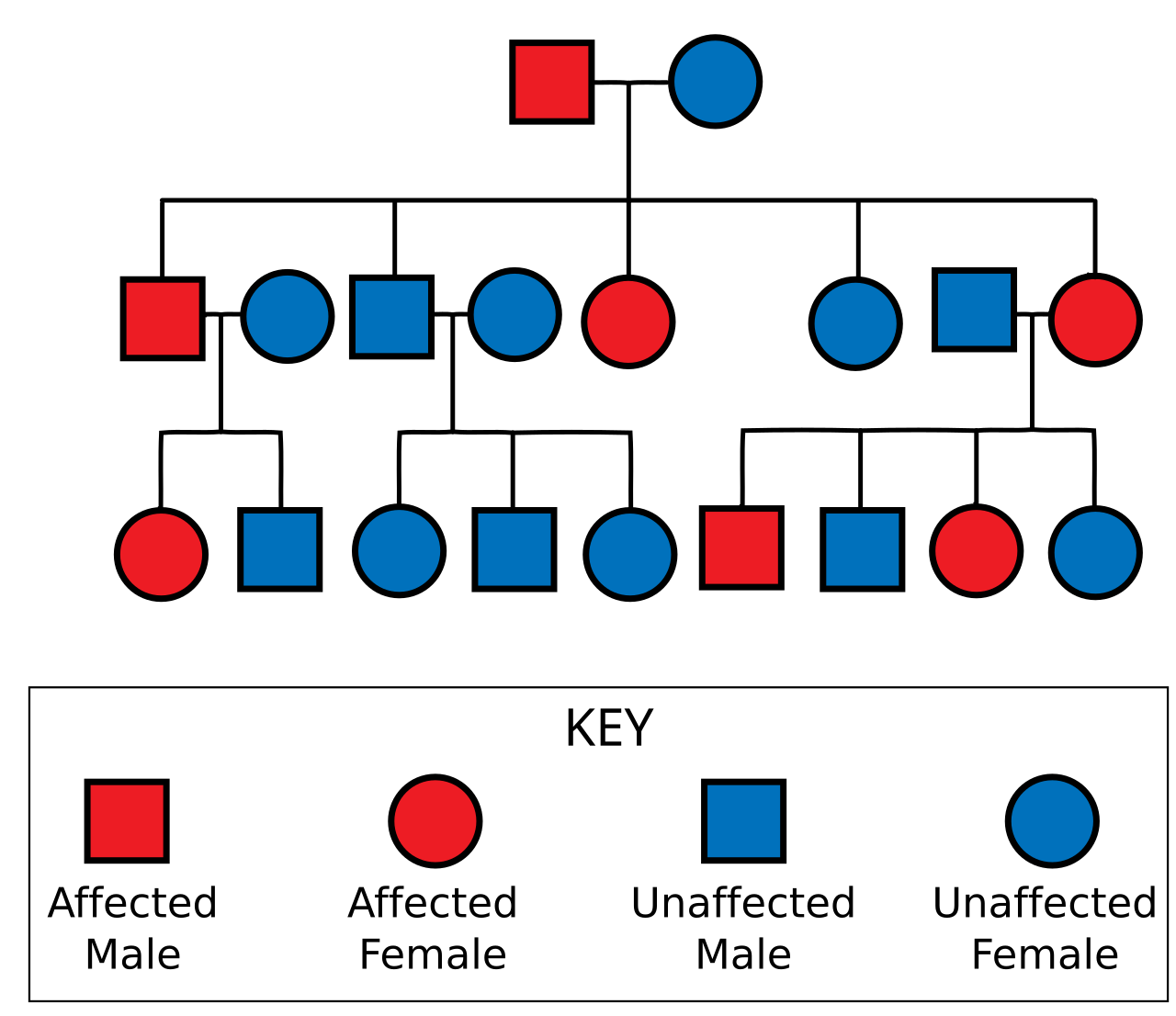
This pedigree shows a typical autosomal dominant pattern, where the phenotype tends to appear in successive generations. It supports systematic interpretation by making it easy to check whether affected individuals have affected parents and whether the trait is broadly transmitted through the family line. Source
The phenotype usually appears in every generation
An affected individual usually has at least one affected parent
Two unaffected parents do not usually produce an affected child
Clues that suggest a recessive phenotype include:
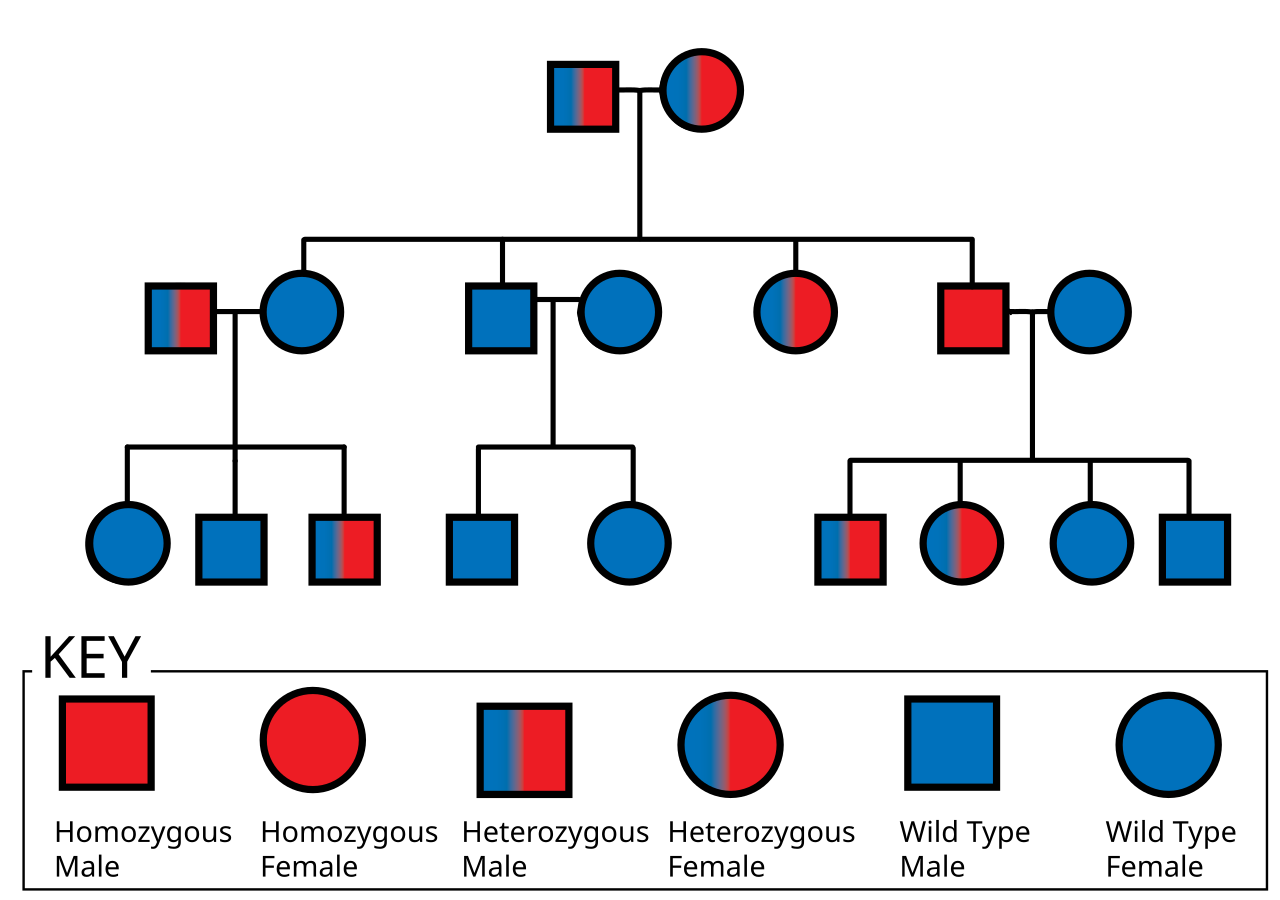
This pedigree illustrates an autosomal recessive inheritance pattern across multiple generations using standard pedigree symbols (squares for males, circles for females, shading for affected status). It is especially useful for spotting recessive traits because affected individuals can appear even when both parents are unaffected carriers. Source
The phenotype can skip generations
Two unaffected parents can produce an affected child
Affected individuals may have parents who are both unaffected carriers
These patterns are not rules that work in isolation. You should always use the whole pedigree, not a single pair of parents, before deciding which inheritance pattern fits best.
Using pedigrees to infer genotype
Once the inheritance pattern is identified, likely genotypes can be assigned.
If the phenotype is dominant:
Unaffected individuals must be homozygous recessive
Affected individuals may be homozygous dominant or heterozygous
If an affected parent has an unaffected child, that affected parent must be heterozygous
If the phenotype is recessive:
Affected individuals must be homozygous recessive
Unaffected individuals may be homozygous dominant or heterozygous carriers
If two unaffected parents produce an affected child, both parents must be heterozygous carriers
This reasoning allows pedigrees to reveal more than just who has the phenotype. They can also show which people are certain carriers, possible carriers, or impossible carriers.
Common interpretation errors
A common mistake is to assume that an affected individual with a dominant phenotype is always homozygous dominant. In fact, many affected individuals in pedigrees are more likely to be heterozygous, especially if they have unaffected relatives.
Another mistake is to ignore individuals who are unaffected. Unaffected family members often provide the key evidence for deciding whether a trait is dominant or recessive.
You should also avoid forcing perfect ratios onto pedigree data. Human families are small, so pedigree patterns are interpreted using logic about genotypes and generations rather than exact numerical ratios.
Practice Questions
Round seeds are dominant to wrinkled seeds. Two heterozygous plants are crossed.
State the expected:
genotype ratio
phenotype ratio
(2 marks)
1 mark for genotype ratio: 1 homozygous dominant : 2 heterozygous : 1 homozygous recessive
1 mark for phenotype ratio: 3 round : 1 wrinkled
A human condition is caused by a single gene. In a pedigree, two unaffected parents in Generation I have two children in Generation II: one affected daughter and one unaffected son. The unaffected son later has a child with an unaffected partner, and that child is affected.
Explain whether the condition is caused by a dominant or recessive allele. Deduce the most likely genotypes of:
the two parents in Generation I
the affected daughter
the unaffected son
the unaffected son's partner
Use A and a to represent the alleles.
(6 marks)
1 mark for identifying the condition as recessive
1 mark for explaining that two unaffected parents producing an affected child indicates recessive inheritance
1 mark for Generation I parents both being heterozygous: Aa and Aa
1 mark for affected daughter being aa
1 mark for unaffected son being Aa
1 mark for unaffected partner being Aa
FAQ
Controlled crosses are not possible in humans because they would be unethical.
Pedigrees allow biologists to study inheritance by using existing family information instead. They are especially useful because human generation times are long, family sizes are small, and traits must be analyzed without experimental mating.
An obligate carrier is a person who must carry a recessive allele based on the pedigree pattern.
A possible carrier might carry the allele, but the pedigree does not prove it. This distinction matters when assigning genotypes, because some answers can be certain while others can only be given as likely or possible.
A larger pedigree includes more individuals and more generations, so it provides more inheritance events to analyze.
This makes it easier to see whether a trait is really skipping generations, whether unaffected parents can produce affected offspring, and whether a genotype assignment is certain or only probable. Small pedigrees can be misleading because chance has a stronger effect.
No. A pedigree only shows inheritance within one family.
It does not represent a random sample of the population, so it cannot be used on its own to calculate overall allele frequency. A family may contain an unusual number of affected individuals just by chance or because the allele is already present in that family line.
If some individuals are missing, have unknown phenotypes, or have no recorded children, there is less evidence for deciding between dominant and recessive inheritance.
Missing information can also make genotype assignment less certain. In those cases, some people can only be labeled as “possible” heterozygotes rather than being given a definite genotype.



