

Edexcel Syllabus focus:
'Understand uses of genetic screening, including carrier identification, pre-implantation genetic diagnosis, amniocentesis and chorionic villus sampling.'
Genetic screening is used to detect inherited conditions or the risk of passing them on. Different methods are used at different stages, from testing adults to testing embryos and developing fetuses.
What genetic screening is
Genetic screening includes several methods used to look for inherited conditions or the chance of passing them on.
Genetic screening: Testing DNA, cells, embryos, or fetal material to identify specific alleles or genetic conditions.
The main use of genetic screening is to provide information about whether a person is a carrier, whether an embryo has a particular mutation, or whether a fetus is affected by a genetic condition. In practice, the method chosen depends on the stage at which testing is taking place. Some forms of screening are carried out before pregnancy, some during IVF treatment, and some during pregnancy. Genetic screening is usually most useful when there is already a known risk, such as a family history of an inherited disorder or a previously identified mutation.
Carrier identification
One important use of genetic screening is carrier identification.
Carrier identification: Testing a person to find out whether they have one copy of a recessive disease allele and can pass it to offspring.
Carrier identification is especially useful for people with a family history of an inherited disorder, or for couples planning to have children when there is concern about a recessive condition. A carrier usually does not show symptoms of the disorder, so genetic screening may be the only way to identify their status.
In this type of testing, DNA is taken from the person, often from a blood sample or cheek cell sample, and analyzed for a known mutation. The result does not diagnose a disease in that person if they are only a carrier. Instead, it shows whether they could pass the allele to their children. This makes carrier identification a predictive use of genetic screening rather than a direct diagnosis of an affected individual.
Carrier identification can also be used to identify whether both biological parents may pass on the same recessive disorder.
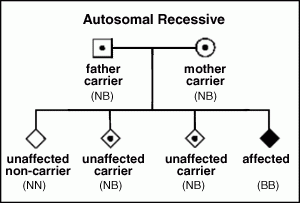
Pedigree-style diagram illustrating autosomal recessive inheritance when both parents are carriers. It shows the expected offspring proportions (unaffected, carrier, affected), which is the genetic rationale for carrier identification in family planning. Source
This is why it is often discussed before pregnancy or early in family planning.
Pre-implantation genetic diagnosis
Another important use of genetic screening is pre-implantation genetic diagnosis, usually called PGD.
Pre-implantation genetic diagnosis: Testing embryos produced by IVF for a specific genetic condition before implantation in the uterus.
PGD is used when there is a known risk that a child could inherit a particular genetic disorder. Eggs are fertilized outside the body during in vitro fertilization (IVF), and the resulting embryos are allowed to develop for a short time. Cells from an embryo can then be tested for the mutation being investigated.
The main use of PGD is to identify which embryos do not have the genetic condition being tested for, so that an unaffected embryo can be selected for implantation.
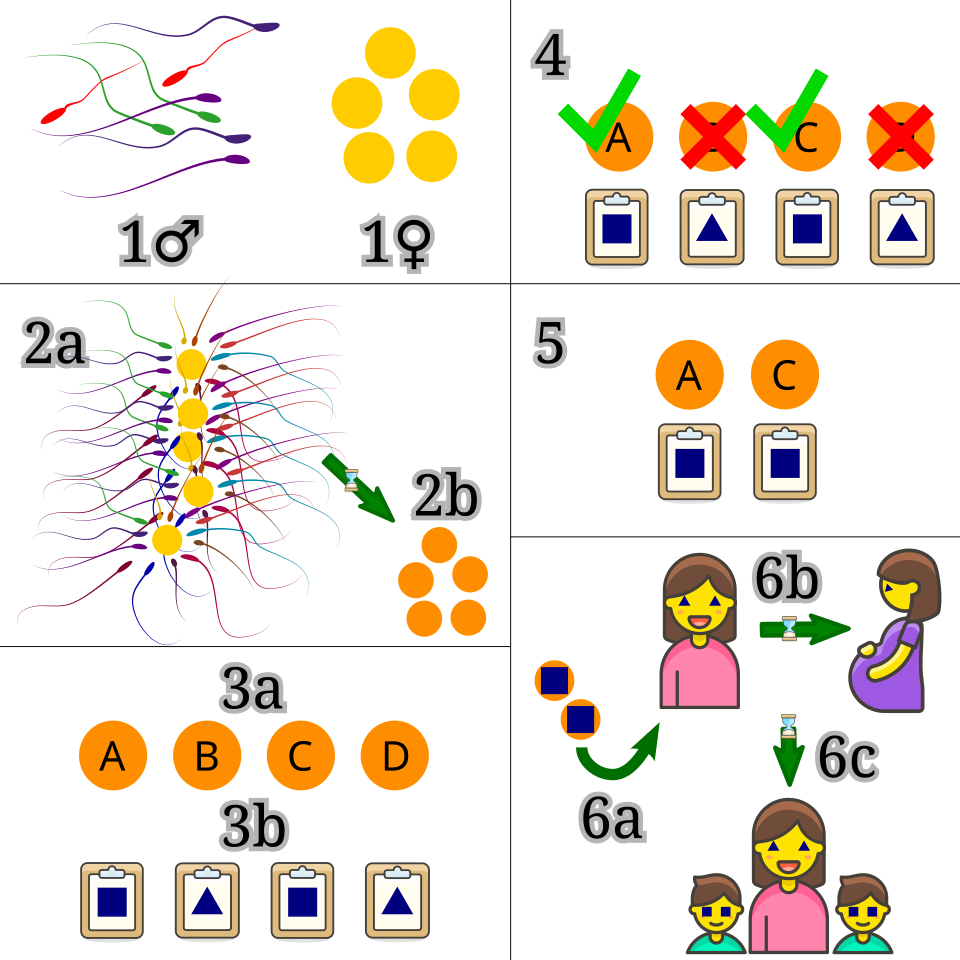
Flow diagram summarizing pre-implantation genetic diagnosis (PGD) alongside IVF: embryos are created in vitro, genetically tested, and then selected for implantation based on the result. This visual reinforces that screening occurs before pregnancy is established in the uterus. Source
This means screening takes place before a pregnancy is established in the uterus. PGD is therefore different from prenatal tests such as amniocentesis and chorionic villus sampling, which are carried out after pregnancy has begun.
PGD is generally used for known inherited conditions rather than for a broad search of every possible mutation. The laboratory must know what it is testing for, so PGD is most effective when the disease-causing allele in a family has already been identified.
Prenatal testing during pregnancy
Genetic screening can also be used during pregnancy to determine whether a fetus has a genetic condition. Two important methods are amniocentesis and chorionic villus sampling. Both provide fetal genetic material for analysis, but they differ in the sample used and the stage of pregnancy at which they are usually carried out.
Amniocentesis
One prenatal method is amniocentesis.
Amniocentesis: A prenatal test in which a sample of amniotic fluid is taken and fetal cells in the fluid are analyzed for genetic conditions.
Amniotic fluid surrounds the developing fetus. This fluid contains fetal cells, which can be collected and tested. The use of amniocentesis is to diagnose whether the fetus has a specific inherited condition or other genetic abnormality. It is usually carried out later in pregnancy than chorionic villus sampling.
Because amniocentesis uses fetal cells taken from the fluid around the fetus, it can provide direct genetic information about the pregnancy. It is commonly used when there is an increased chance of a genetic disorder, such as when screening or family history suggests a higher risk.
Chorionic villus sampling
Another prenatal method is chorionic villus sampling, often abbreviated to CVS.
Chorionic villus sampling: A prenatal test in which a sample of placental tissue is taken and analyzed for genetic conditions.
The chorionic villi are tiny projections in the placenta.
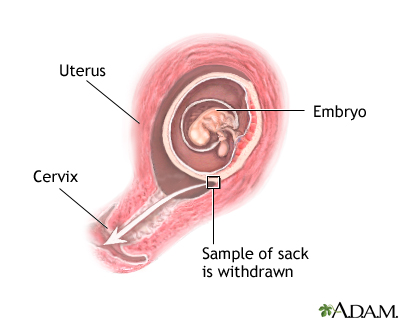
Diagram of chorionic villus sampling (CVS) showing how placental (chorionic villus) tissue is accessed for genetic analysis. It helps distinguish CVS from amniocentesis by emphasizing that the sampled material is placental tissue rather than amniotic fluid. Source
Since placental cells usually have the same genetic makeup as the fetus, they can be tested for inherited conditions. The main use of CVS is the same as amniocentesis: to determine whether a fetus has a particular genetic condition.
A key feature of CVS is that it can usually be carried out earlier in pregnancy than amniocentesis. This means information can be obtained sooner. Like amniocentesis, it is used when there is a known or suspected genetic risk and when a prenatal diagnosis is needed.
Choosing the appropriate method
These forms of genetic screening are used at different points in reproduction and pregnancy:
Carrier identification tests adults to see whether they can pass on a recessive allele.
PGD tests embryos created by IVF before implantation.
CVS tests placental tissue during pregnancy, usually earlier.
Amniocentesis tests amniotic fluid during pregnancy, usually later.
Together, these methods allow genetic screening to be used before conception planning, before implantation, and during pregnancy, depending on whether the aim is to identify carrier status or diagnose the genetic status of an embryo or fetus.
Practice Questions
State two uses of genetic screening in reproduction and pregnancy. (2 marks)
1 mark for identifying any valid use, such as carrier identification
1 mark for identifying a second valid use, such as pre-implantation genetic diagnosis, amniocentesis, or chorionic villus sampling
Explain how pre-implantation genetic diagnosis, amniocentesis, and chorionic villus sampling are used to detect genetic conditions. Your answer should include when each method is used. (6 marks)
1 mark: PGD is used with IVF / embryos are tested before implantation
1 mark: PGD is used to identify embryos without a specific mutation or genetic condition
1 mark: amniocentesis involves sampling amniotic fluid
1 mark: amniotic fluid contains fetal cells that can be genetically analyzed
1 mark: CVS involves sampling placental tissue / chorionic villi
1 mark: CVS is usually used earlier in pregnancy than amniocentesis
FAQ
PGD requires embryos to be formed outside the body so they can be tested before implantation.
In a natural conception, the embryo develops inside the uterus, so it cannot be screened at that stage in the same controlled way. IVF allows:
fertilization in the laboratory
short-term embryo growth
removal of cells for testing
selection of an embryo for transfer
Without IVF, PGD cannot be carried out.
No. Most genetic screening is targeted, meaning the lab looks for a specific mutation, gene, or genetic abnormality.
This means screening works best when:
the disorder is already known
the family mutation has been identified
the test has been designed for that condition
A negative result does not always rule out every possible genetic disorder. It usually means the tested condition was not found.
CVS uses placental tissue, which can be sampled earlier in pregnancy than amniotic fluid is usually sampled for amniocentesis.
This earlier timing can be helpful because:
information is available sooner
follow-up decisions can be made earlier
less waiting may reduce uncertainty for parents
The difference is mainly due to which tissue is being collected and when that sample can be safely obtained.
The lab may first identify the exact mutation present in an affected family member.
Once that is known, relatives can be tested specifically for the same mutation. If many mutations are possible, testing may involve:
a panel of common mutations
full gene sequencing
follow-up testing to confirm uncertain results
The approach depends on the disorder and how much is already known about the family history.
An unclear result means the test did not give a definite answer. This can happen if:
there was not enough usable DNA
the result is technically borderline
an unusual genetic variant was found
In this situation, the next step may include:
repeating the test
testing another sample
using a different method
discussing the result with a genetics specialist
An inconclusive result does not automatically mean a condition is present. It means more evidence is needed.

