

Edexcel Syllabus focus:
'Know the meanings of gene, allele, genotype, phenotype, recessive, dominant, incomplete dominance, homozygote and heterozygote.'
Understanding these core genetic terms is essential because later inheritance questions depend on using them precisely. They describe what is inherited, how versions of genes differ, and how those differences appear in organisms.
Genes and alleles
In genetics, the basic unit discussed is the gene.
Gene: A length of DNA that affects a characteristic by coding for a product.
Genes are inherited from parents and help determine biological characteristics. A single characteristic can be associated with different forms of the same gene, and these alternative forms are called alleles.
Allele: One of the different versions of the same gene.
For many genes in diploid organisms, an individual has two alleles, one inherited from each parent. These alleles may be the same or different. That difference is important because it helps explain why some inherited characteristics are expressed in different ways.
Genotype and phenotype
When biologists describe the actual allele combination present in an organism, they are referring to its genotype.
Genotype: The genetic makeup of an organism, often referring to the alleles it possesses for a gene.
A genotype tells you what alleles are present, not what the organism necessarily looks like. In exam questions, genotypes are often represented using symbols for alleles.
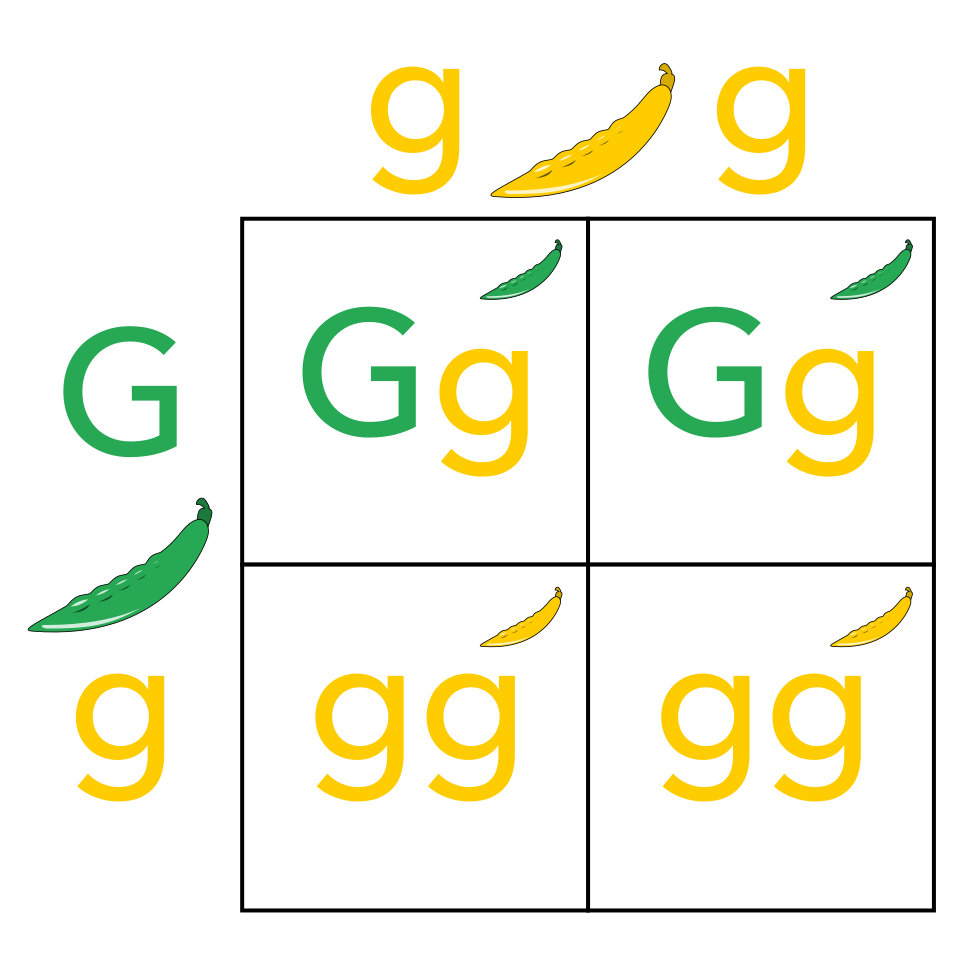
A labeled Punnett square for a monohybrid cross, using uppercase and lowercase letters to represent dominant and recessive alleles. The four boxes show the possible offspring genotypes formed by combining parental gametes, making genotype ratios (and then phenotype predictions) explicit. This is the standard diagram used to connect alleles to genotype outcomes under complete dominance. Source
The genotype is therefore the genetic information behind a characteristic.
The visible or measurable result of that genetic information is the phenotype.
Phenotype: The observable characteristics of an organism.
Phenotype includes features such as color, shape, or any characteristic that can be detected. A phenotype is often influenced by genotype, but environmental factors can also play a role. This means phenotype is the outcome you observe, whereas genotype is the allele combination that helps produce it.
Genotype and phenotype are not the same
Students often confuse these two terms, so the distinction must be clear:
Genotype refers to the alleles present.
Phenotype refers to the observed characteristic.
Two organisms can have different genotypes but the same phenotype if one allele masks the effect of another.
In other cases, a change in genotype leads directly to a different phenotype.
Dominant, recessive, and incomplete dominance
When two different alleles are present together, one allele may determine the phenotype. This allele is described as dominant.
Dominant: An allele that is expressed in the phenotype when present, even if only one copy is present.
A dominant allele masks the effect of the other allele in a heterozygote. However, dominant does not mean stronger, better, or more common in a population. It only describes how the allele affects phenotype.
An allele that is hidden when a dominant allele is present is called recessive.
Recessive: An allele that is expressed in the phenotype only when two copies are present, or when no dominant allele is present.
A recessive allele can still be part of the genotype even when it is not visible in the phenotype. This is why an organism may carry a recessive allele without showing the recessive characteristic.
Not all allele pairs show a simple dominant-recessive relationship.
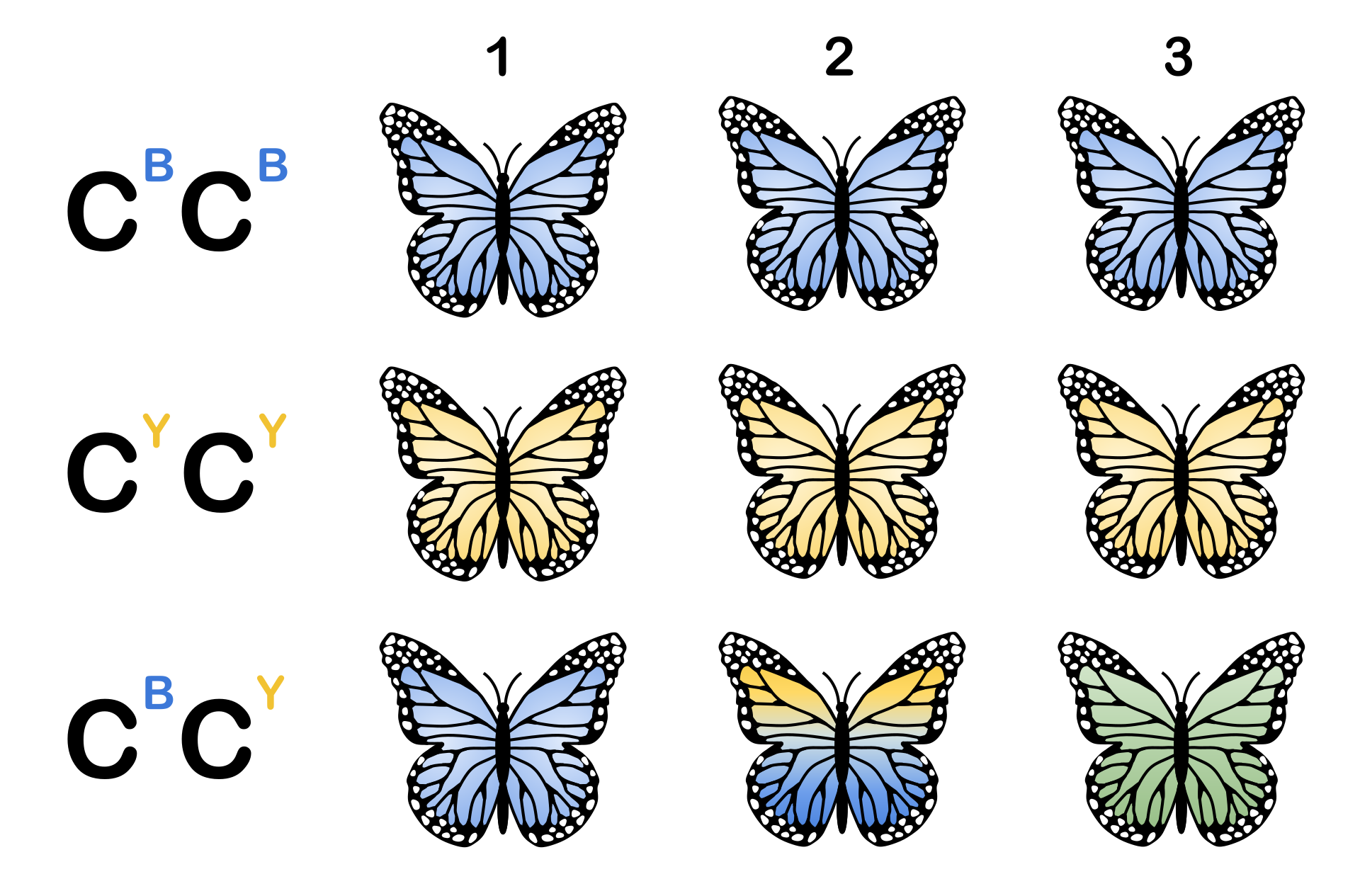
Diagram contrasting complete dominance with other allele-interaction patterns, including an incomplete-dominance example where the heterozygote shows an intermediate phenotype. By placing the three patterns side-by-side, it highlights that “dominant vs recessive” is not universal across all genes. This supports exam explanations of why some heterozygotes do not match either homozygous phenotype. Source
Some show incomplete dominance.
Incomplete dominance: A pattern of inheritance in which neither allele is fully dominant, so the heterozygote has an intermediate phenotype.
In incomplete dominance, one allele does not completely mask the other. Instead, the heterozygous phenotype is intermediate between the two homozygous phenotypes. This makes incomplete dominance different from complete dominance, where one allele fully determines the phenotype in a heterozygote.
Homozygotes and heterozygotes
To describe whether the two alleles are identical or different, geneticists use the terms homozygote and heterozygote.
An organism with two identical alleles is a homozygote.
Homozygote: An organism that has two identical alleles for a gene.
A homozygote may carry two dominant alleles or two recessive alleles. In a complete dominance relationship, these two homozygous genotypes usually produce different phenotypes.
An organism with two different alleles is a heterozygote.
Heterozygote: An organism that has two different alleles for a gene.
In complete dominance, a heterozygote shows the dominant phenotype. In incomplete dominance, a heterozygote shows an intermediate phenotype instead. So, heterozygote describes the allele combination, while the phenotype depends on how those alleles interact.
How the terms connect
These key terms fit together in a logical sequence:
A gene influences a characteristic.
An allele is a version of that gene.
The pair of alleles present makes up the genotype.
The observable result is the phenotype.
Dominant and recessive describe how alleles affect phenotype.
Incomplete dominance describes a case where neither allele fully masks the other.
A homozygote has two same alleles.
A heterozygote has two different alleles.
In exam answers, accuracy matters. Genotype must not be confused with phenotype, and dominant must not be used to mean common. These words each have a precise genetic meaning.
Practice Questions
Define the terms allele and phenotype. [2 marks]
Allele: an alternative version of a gene / one of the different forms of the same gene. (1)
Phenotype: the observable characteristics of an organism. (1)
A gene controls flower color in a plant. The two alleles are and . Plants with genotype have red flowers, plants with genotype have white flowers, and plants with genotype have pink flowers.
Using this example, explain the meanings of genotype, phenotype, homozygote, heterozygote, and incomplete dominance. [6 marks]
Award 1 mark for each correct point, up to 6 marks:
Genotype means the allele combination / genetic makeup for the gene.
Example of genotype given, such as , , or .
Phenotype means the observable characteristic, here flower color.
Homozygote means having two identical alleles, such as or .
Heterozygote means having two different alleles, such as .
Incomplete dominance means neither allele is fully dominant, so the heterozygote has an intermediate phenotype; here, pink is intermediate between red and white.
FAQ
This happens when one allele is dominant over another.
For example, in complete dominance, both a homozygous dominant organism and a heterozygote can show the same phenotype because the dominant allele masks the recessive one. The outward characteristic is the same, but the allele combinations are different.
Recessive only describes how an allele is expressed in a heterozygote. It does not describe how common it is or whether it is beneficial.
A recessive allele can:
be common in a population
have no harmful effect
even be helpful in some environments
Its frequency depends on inheritance, selection, mutation, and chance, not on the fact that it is recessive.
Yes. Genotype is usually stable, but phenotype can change because gene expression can vary over time.
Changes in phenotype may be influenced by:
age
diet
disease
temperature
hormones
exercise
For example, body mass, skin condition, and some enzyme levels can change without any change in the DNA sequence.
They compare the phenotype of the heterozygote with the phenotypes of both homozygotes.
If the heterozygote is clearly intermediate rather than matching one homozygote, that supports incomplete dominance. Scientists usually confirm this by breeding organisms with known genotypes and checking whether the offspring consistently show that intermediate phenotype.
Yes. These terms apply to one gene at a time.
An organism might have:
two identical alleles for one gene, making it a homozygote for that gene
two different alleles for another gene, making it a heterozygote for that gene
So a full genotype across many genes can include both homozygous and heterozygous gene pairs at the same time.

