

CIE Syllabus focus:
'Explain the general increase in first ionisation energy across a period and the decrease down a group in terms of nuclear charge, shielding and atomic radius.'
First ionization energy trends show how changes in atomic structure control the energy needed to remove an outer electron.
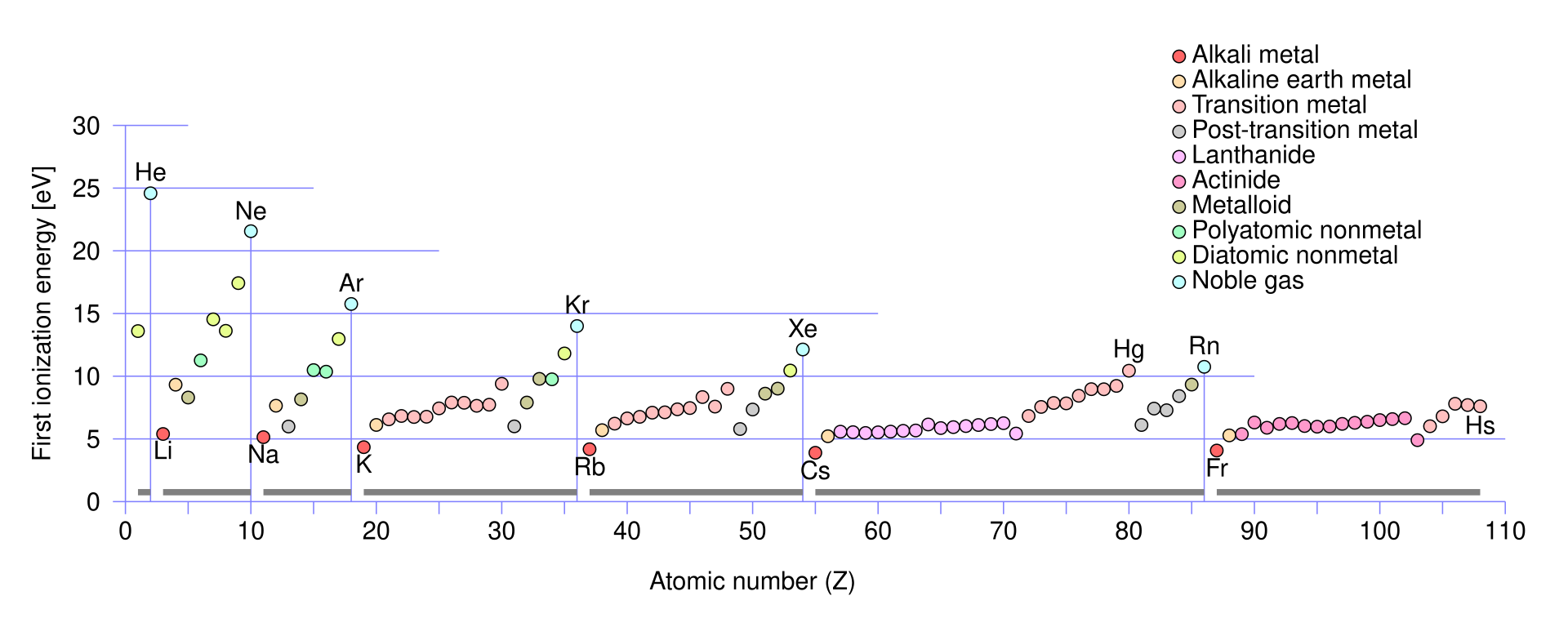
Vector graph of first ionization energy versus atomic number emphasizes the periodic repetition caused by electron-shell structure. The rising sections within each period reflect increasing attraction for the outer electron as nuclear charge increases, while the sharp drops mark the start of a new period where the outer electron is in a new shell farther from the nucleus. Source
Across a period the trend rises overall, while down a group it falls.
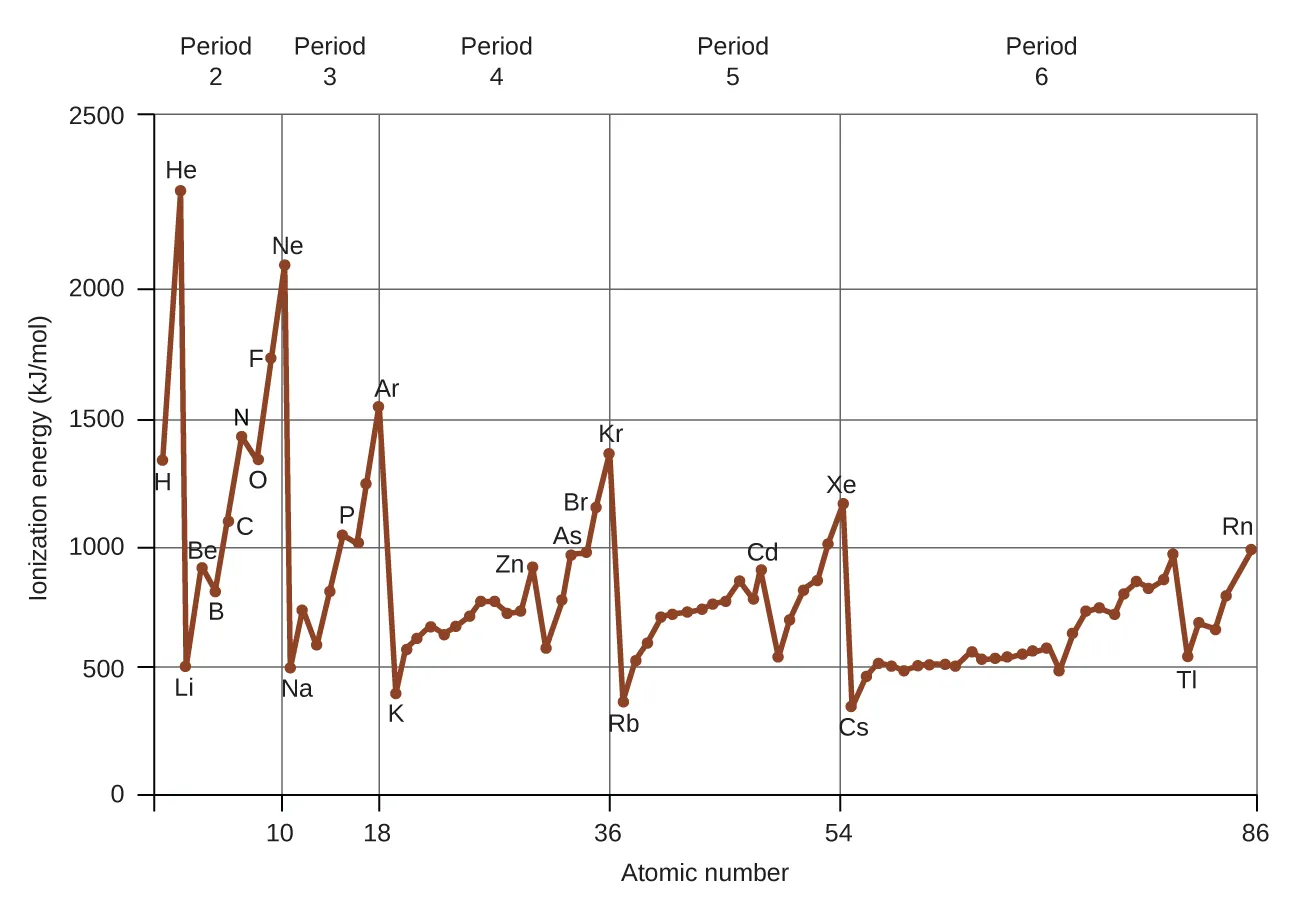
First ionization energy plotted against atomic number (elements 1–86) shows the repeating sawtooth pattern across periods: values rise toward the noble gases (peaks) and drop sharply at the start of the next period (alkali metals). This directly visualizes why the trend is described as increasing across a period overall and decreasing down a group overall, with predictable periodic resets when a new outer shell begins. Source
Understanding first ionization energy
First ionization energy compares how strongly an atom holds its outermost electron. A high value means the electron is strongly attracted to the nucleus, while a low value means it is easier to remove.
First ionization energy: The energy required to remove one electron from each atom in one mole of gaseous atoms to form one mole of gaseous positive ions.
Three structural ideas explain the trend: nuclear charge, shielding, and atomic radius.
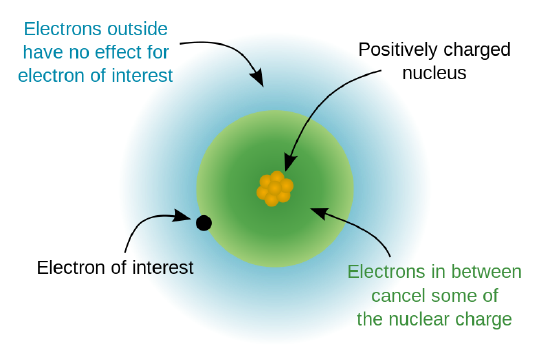
Diagram illustrating effective nuclear charge () and shielding: inner (core) electrons partially block the full nuclear attraction experienced by a valence electron. It provides a concrete visual for why increased shielding reduces the nucleus–electron attraction, lowering first ionization energy—especially down a group where additional shells add major shielding. Source
Shielding: The reduction in attraction between the nucleus and an outer electron caused by repulsion from inner-shell electrons.
These factors determine the strength of attraction between the positive nucleus and the electron being removed.
A useful way to think about the trend is that first ionization energy increases when this attraction becomes stronger and decreases when it becomes weaker.
Why first ionization energy generally increases across a period
When moving across a period from left to right, first ionization energy generally increases. The atom becomes less willing to lose an electron because the outer electron is held more strongly.
Nuclear charge
Each successive element has one more proton, so the nuclear charge increases. The nucleus pulls more strongly on the outer electron.
Shielding
Across a period, the additional electrons usually enter the same main shell. The number of inner shells stays the same, so shielding does not increase very much. Any extra shielding from electrons in the same shell is small compared with the increase in nuclear charge.
Atomic radius
Because the nuclear charge increases while shielding changes only slightly, the outer electrons are pulled closer to the nucleus. This means the atomic radius decreases across the period. A smaller radius means the outer electron is nearer to the nucleus and experiences a stronger attraction.
Overall effect
The increasing nuclear charge is the dominant change. Since shielding is roughly constant and atomic radius decreases, more energy is needed to remove the first electron. That is why the first ionization energy rises across a period.
Why first ionization energy generally decreases down a group
When moving down a group, first ionization energy generally decreases. Although the nucleus contains more protons, the outer electron is easier to remove.
Nuclear charge
The nuclear charge does increase down the group because proton number increases. On its own, this would tend to increase first ionization energy.
Shielding
However, each element down the group has an extra occupied shell of electrons. Inner electrons shield the outer electron from the full attraction of the nucleus. The shielding effect therefore increases significantly down a group.
Atomic radius
The outer electron is also in a shell that is farther from the nucleus. This means the atomic radius increases down the group. Because the electron is farther away, the electrostatic attraction between the nucleus and that electron is weaker.
Overall effect
The increased shielding and larger atomic radius outweigh the increase in nuclear charge. As a result, the outer electron experiences less attraction to the nucleus, so less energy is required to remove it.
Linking the factors together
A strong explanation does not treat the three factors as separate facts. It shows how they combine to change the attraction between the nucleus and the outer electron.
Across a period: higher nuclear charge, similar shielding, smaller atomic radius, so attraction increases and first ionization energy increases.
Down a group: higher nuclear charge, much greater shielding, larger atomic radius, so attraction decreases and first ionization energy decreases.
In both cases, the key idea is the balance between the positive pull of the nucleus and the extent to which that pull is reduced by shielding and distance.
Writing precise explanations
To explain the trend clearly, use cause-and-effect language:
state whether nuclear charge increases
state whether shielding stays similar or increases
state whether atomic radius decreases or increases
link these changes to the strength of attraction for the outer electron
finish by stating whether more or less energy is needed to remove that electron
Avoid vague statements such as “the atom is bigger” or “the electron is harder to remove” without explaining why. The key marks usually come from linking structure to attraction and then to the change in first ionization energy.
Practice Questions
State and explain the general trend in first ionization energy across Period 3.
[2 marks]
First ionization energy generally increases across Period 3. [1]
Nuclear charge increases while shielding stays about the same, so atomic radius decreases and the outer electron is more strongly attracted to the nucleus. [1]
The first ionization energy generally increases across Period 3 and decreases down Group 2.
Explain both trends in terms of nuclear charge, shielding, and atomic radius.
[6 marks]
Across Period 3, nuclear charge increases. [1]
Across Period 3, shielding stays about the same because electrons are added to the same main shell. [1]
Across Period 3, atomic radius decreases, so the outer electron is more strongly attracted and more energy is needed to remove it. [1]
Down Group 2, extra shells are added, so shielding increases. [1]
Down Group 2, atomic radius increases, so the outer electron is farther from the nucleus. [1]
Increased shielding and larger atomic radius outweigh the increase in nuclear charge, so the attraction is weaker and less energy is needed to remove the electron. [1]
FAQ
The overall pattern is clear, but the graph is not completely smooth. Some neighboring elements do not follow the expected step-by-step increase.
These small irregularities happen because electron arrangement matters as well as nuclear charge, especially when a new subshell starts filling or when electrons pair up in the same orbital.
Noble gases are near the end of each period, where nuclear charge is high and atomic radius is relatively small. Their outer electrons are therefore strongly attracted to the nucleus.
Their full outer shell also makes electron removal less favorable, so the energy needed to remove the first electron is usually especially high.
At the start of a new period, the outer electron enters a higher shell farther from the nucleus. This causes a large drop in first ionization energy compared with the noble gas before it.
Across the rest of the period, first ionization energy rises again overall as nuclear charge increases. This repeating drop-and-rise pattern creates the saw-tooth shape.
Each step down a group adds another shell, but the effect of that extra shell is not identical every time. Shielding and distance increase, but not in perfectly equal ways from one element to the next.
As a result, the drop in first ionization energy is usually regular in direction, but not perfectly regular in size.
Yes. More protons increase nuclear charge, but that is only one factor. If the outer electron is much farther from the nucleus or much more shielded, it can still be easier to remove.
That is why an element lower in a group can have a lower first ionization energy than an element above it, even though it has more protons.

