

CIE Syllabus focus:
'Define first ionisation energy and successive ionisation energies, including the states and species involved in each process.'
These notes define first and successive ionization energies precisely, show how to write the associated equations, and emphasize the species, charges, and state symbols that must appear in accurate exam answers.
First ionization energy
The first ionization energy is the starting point for all later ionization definitions. It describes the removal of the first electron from each atom of an element under carefully stated conditions.
First ionization energy: The energy required to remove one mole of electrons from one mole of gaseous atoms to form one mole of gaseous 1+ ions.
This definition must be learned accurately.
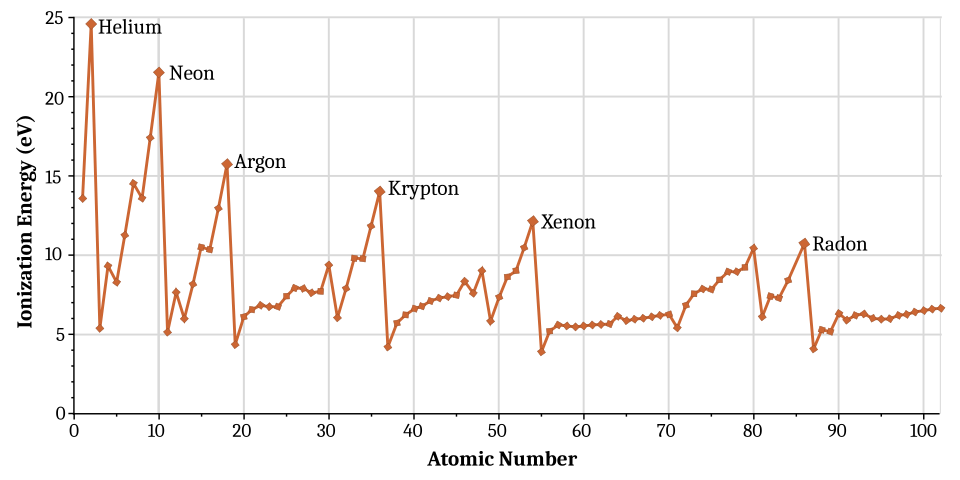
Plot of first ionization energies (neutral atoms) across the elements, showing the repeating periodic pattern with peaks at noble gases and troughs at alkali metals. It reinforces that ionization energy is a measurable molar quantity and that values change systematically with electron structure. Source
One mole shows that ionization energy is a molar quantity, usually expressed in . Gaseous atoms means separate atoms in the gas phase, not atoms in a solid, liquid, or solution. 1+ ions shows that only one electron is removed from each atom in this first stage.
The process can be shown by a symbolic equation.
= one gaseous atom of element
= one gaseous ion with a charge of
= one electron
In this equation, the atom becomes a positive ion because it loses a negatively charged electron. The proton number stays the same; only the number of electrons changes. Ionization means the electron is removed completely from the atom, not just moved to a higher energy level.
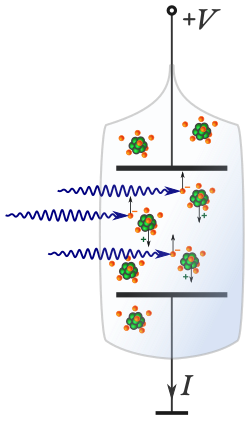
Schematic of photoionization used to measure ionization energy in the gas phase. The diagram highlights that a beam with sufficient photon energy ejects an electron, leaving a positively charged ion, directly matching the process . Source
Successive ionization energies
After the first electron has been removed, more electrons can be removed in later stages. These are called successive ionization energies, and each stage refers to a separate electron-removal process.
Successive ionization energies: The energies required to remove electrons one at a time from one mole of gaseous ions to form one mole of gaseous ions with a charge one higher.
The second ionization energy starts with one mole of gaseous ions and forms one mole of gaseous ions. The third ionization energy starts with one mole of gaseous ions and forms one mole of gaseous ions. This pattern continues step by step.
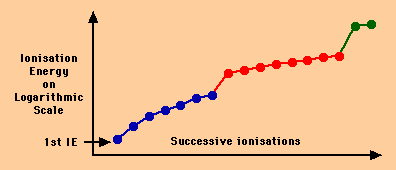
Graph of successive ionisation energies (example: chlorine) with clear stepwise increases and major jumps when electron removal moves from an outer shell to an inner shell. This visual makes it explicit that each ionization stage removes exactly one electron and that the starting species for each stage is the ion formed previously. Source
The starting species for each stage is always the ion produced in the previous stage.
A general way to represent a later ionization step is shown below.
= ionization number
= gaseous ion before electron removal
= gaseous ion after electron removal
= one electron
This general form shows an important pattern:
before ionization, the ion has a charge of
after ionization, the ion has a charge of
exactly one electron is removed in each stage
Each successive ionization energy refers to removing a single electron from each particle present. It does not mean removing several electrons at once from one atom. If several electrons are removed overall, chemists describe them as separate first, second, third, and later processes.
States and species that must be included
For this subtopic, the state symbols and species are as important as the words "ionization energy." Missing them often turns a correct idea into an incomplete definition.
The first ionization energy always starts from gaseous atoms, written as .
A successive ionization energy starts from gaseous positive ions, such as or .
The product ion always has a charge one higher than the starting ion.
The removed particle is an electron, written as .
The definitions refer to one mole of starting particles and one mole of electrons removed.
It is also important to identify the correct chemical species. A neutral atom has equal numbers of protons and electrons. After ionization, the number of protons is unchanged, but the number of electrons is lower, so the particle is a cation. This is why ionization equations always show a positive ion on the product side.
Common exam wording and common errors
When defining ionization energies, short answers are often not enough. A statement such as "energy needed to remove an electron from an atom" is incomplete because it omits key conditions.
To make a definition secure, include:
energy required
one mole of electrons
one mole of gaseous atoms for the first ionization energy, or one mole of gaseous ions for successive ionization energies
one mole of gaseous positive ions formed
Common mistakes include:
starting the first ionization energy from a solid or aqueous species instead of a gas
forgetting that successive ionization energies start from ions, not neutral atoms
missing the idea of one electron per stage
describing the process as if energy is released rather than required
In exam questions, the safest approach is to state the full definition and, when asked, write the symbolic equation with the correct charges and state symbols.
Practice Questions
State the definition of the first ionization energy of an element. [2 marks]
1 mark for: removing one mole of electrons from one mole of gaseous atoms
1 mark for: forming one mole of gaseous 1+ ions / gaseous positive ions
An element forms gaseous ions.
(a) Write equations for the first and second ionization energies of . [2 marks]
(b) Explain how the starting species and product species differ between the first and second ionization energies. [3 marks]
(a)
1 mark for
1 mark for
(b)
1 mark for: the first ionization energy starts from neutral gaseous atoms
1 mark for: the second ionization energy starts from gaseous ions formed after the first ionization
1 mark for: the product ion in the second ionization has a charge one higher, so is formed / one electron is removed in each stage
FAQ
Chemists usually measure energy changes for very large numbers of particles, not for one atom at a time.
Using per mole:
matches laboratory-scale measurements
makes values easier to compare between substances
links microscopic particle behavior to macroscopic quantities
A mole contains Avogadro’s constant of particles, so $kJ\ mol^{-1}$ is a practical unit for experimental chemistry.
After each electron is removed, the ion becomes more positively charged.
That means:
the remaining electrons are attracted more strongly to the nucleus
less electron-electron repulsion remains
more energy is needed to remove the next electron
So the second ionization energy is usually larger than the first, the third is usually larger than the second, and so on.
Using gaseous species makes the definition precise and fair.
If solids or liquids were used, the measured energy would also include other changes, such as:
melting
boiling
separating particles from one another
By using gaseous atoms or gaseous ions, the value refers only to removing an electron from an isolated particle.
In A-Level Chemistry, the term first ionization energy is reserved for removing an electron from a neutral gaseous atom.
If you remove an electron from a positive ion, it is named by its place in the sequence from the neutral atom:
from $X_{(g)}$ to $X^+_{(g)}$ is first ionization
from $X^+{(g)}$ to $X^{2+}{(g)}$ is second ionization
So a positive ion does not get a new “first” ionization energy in this naming system.
At this level, the two terms are often treated as effectively the same in meaning and use.
More precisely, ionization enthalpy is the thermodynamic enthalpy change for the process at constant pressure. Ionization energy is the simpler course term.
In exam practice for this course, the important point is the correct process:
gaseous particles
one electron removed
energy required per mole


