

CIE Syllabus focus:
'Predict electronic configurations of s- and p-block ions up to atomic number 36 from the atomic number and ionic charge, using 1s notation and electrons-in-boxes notation.'
Electronic configurations of ions are predicted by starting with the neutral atom and then adding or removing electrons to match the charge. The key skill is deciding exactly which electrons are gained or lost.
Electronic configuration: The arrangement of electrons in an atom or ion in shells, subshells, and orbitals.
This skill applies to individual ions such as or , not to whole compounds.
Starting from the neutral atom
To find the electronic configuration of an ion, first work out the neutral atom from its atomic number. A neutral atom has the same number of electrons as its atomic number. Only after the neutral atom has been written should the ionic charge be applied.
For elements up to atomic number 36, electrons fill in the order:
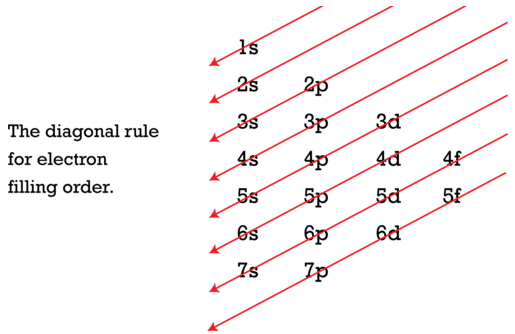
Aufbau (diagonal rule) filling-order diagram showing the sequence of subshells (e.g., ). This provides a visual method for remembering why is written before in full notation for elements up to . Source
The maximum numbers of electrons you need here are:
s subshell: 2 electrons
p subshell: 6 electrons
d subshell: 10 electrons
Using full 1s notation
In 1s notation, each occupied subshell is written with a superscript showing how many electrons it contains. For ion questions on this topic, full notation is especially useful because it makes electron gain or loss easy to track.
A full configuration must:
follow the correct filling order
show the correct number of electrons
end at the correct subshell for that species
For example, a full configuration might look like . For ions involving period 4 s- and p-block elements, the configuration may also include and electrons.
Why period 4 ions need extra care
For elements from potassium to krypton, the full configuration no longer ends at . Period 4 s- and p-block ions may contain a filled subshell even though the ion itself is not a d-block species. This means the written answer can be longer than students expect.
A correct ion configuration for these elements may include and electrons around a filled subshell. If is missing from a full 1s answer, the electron total will be wrong even if the final shell looks correct.
Turning the atom into an ion
The ionic charge tells you whether electrons have been lost or gained.
Ionic charge: The overall charge on an ion, caused by losing electrons to form a positive ion or gaining electrons to form a negative ion.
A positive charge means electrons have been removed. A negative charge means electrons have been added. The number in the charge tells you how many electrons have changed.
A reliable method
When a question gives an atomic number and a charge, follow the same routine every time:
identify the neutral atom
write the full 1s configuration
change the electron total using the charge
alter only the electrons in the outer region of the configuration
recount electrons in the final ion
A ion has three fewer electrons than the atom. A ion has two more electrons than the atom. Do not change the written subshell order just because the species is charged.
Positive ions
A positive ion, or cation, forms when electrons are removed from the neutral atom. For s- and p-block ions, remove electrons from the outermost occupied shell first. This is one of the most important rules in this topic.
Key points:
subtract the number of electrons shown by the positive charge
remove electrons from the highest principal energy level first
do not remove electrons from an inner shell while outer-shell electrons are still present
This matters especially in period 4 p-block elements. Their neutral atoms contain electrons in , , and . When forming a positive ion, electrons are removed from the subshell first, then , before any electrons would be removed from . That is because the outer shell is , not .
For example:
has lost three electrons from the neutral aluminum atom
has lost both electrons
has lost its single electron
Negative ions
A negative ion, or anion, forms when electrons are added to the neutral atom. Added electrons go into the next available space in the partially filled outer subshell.
Useful patterns:
group 17 atoms often gain 1 electron
group 16 atoms often gain 2 electrons
group 15 atoms often gain 3 electrons
When adding electrons:
keep the filling order unchanged
place the added electrons into the existing outer subshell before moving elsewhere
check that the final total number of electrons matches the atomic number plus the magnitude of the negative charge
Common examples include , , , and . Many negative ions end up with a full outer shell, which is why their final configuration often matches that of a nearby noble gas.
Electrons-in-boxes notation
Electrons-in-boxes notation shows orbitals as boxes and electrons as arrows.
Electrons-in-boxes notation: A way of representing orbitals using boxes, with electrons shown as arrows to indicate how they are arranged within a subshell.
This notation is useful because it shows not just how many electrons are present, but also how they are distributed between orbitals. In an orbital, a maximum of two electrons can be shown, and they must have opposite spins.
For the subshells you need here:
an s subshell has one box
a p subshell has three boxes
a d subshell has five boxes
A full subshell is shown as:
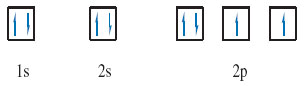
Orbital (electron-in-box) diagrams illustrating boxes as orbitals and arrows as electron spins, including filling patterns that follow Hund’s rule. The diagrams make it clear why a subshell uses three adjacent boxes and how electrons occupy each box singly before pairing. This directly supports drawing ions in box notation by adjusting electron number while keeping subshell structure consistent. Source
[↑↓] [↑↓] [↑↓]
A full subshell is shown as:
[↑↓]
When drawing ions in box notation:
start from the neutral atom if needed
adjust the electron number for the charge
fill or empty the boxes in the correct outer subshell
make sure the final number of arrows equals the number of electrons in the ion
Common exam pitfalls
Several mistakes appear often in ion configuration questions.
Removing electrons from the wrong subshell: for positive ions, students often remove from before or in period 4 p-block species.
Forgetting in period 4 full configurations: this gives the wrong total number of electrons.
Using the atomic number incorrectly: remember that the atomic number identifies the neutral atom first.
Forgetting the charge: always check whether electrons should be added or removed.
Giving an atom instead of an ion: the final electron total must match the ion, not the neutral element.
Mixing notations: if the question asks for 1s notation, give the full subshell configuration; if it asks for electrons-in-boxes notation, show boxes and arrows clearly.
A strong final check is to count the electrons in your completed configuration. If the ion is , the total should be two fewer than the atomic number. If the ion is , the total should be one more than the atomic number.
Practice Questions
Write the full 1s electronic configuration of the sulfide ion, . (2 marks)
1 mark: recognizes that sulfur gains 2 electrons, giving 18 electrons in total
1 mark:
Bromine has atomic number 35.
(a) Write the full 1s electronic configuration of .
(b) Draw the electrons-in-boxes notation for the subshell in .
(c) Write the full 1s electronic configuration of and state which subshell loses an electron first when the ion forms.
(6 marks)
(a)
1 mark: correct configuration up to
1 mark: includes
1 mark: correct ending
(b)
1 mark: [↑↓] [↑↓] [↑↓]
(c)
1 mark:
1 mark: electron removed from the subshell
FAQ
Full notation makes every electron visible, so it is easier to see exactly where electrons were added or removed.
This is especially useful for period 4 p-block ions, where $4s$, $3d$, and $4p$ electrons can be hidden by shorthand.
Yes. These are called isoelectronic species.
For example, $Na^+$, $Mg^{2+}$, and $Al^{3+}$ all match neon, while $Cl^-$, $K^+$, and $Ca^{2+}$ all match argon.
Usually, only the orbitals relevant to the configuration or the named subshell need to be shown clearly.
If the question asks for the whole ion, include the occupied subshells in order. Empty boxes can be added for clarity, but they are not usually necessary unless they help show where electrons were removed.
Place one electron in each of the three $p$ orbitals before pairing them.
So a $p^4$ arrangement is [↑↓] [↑] [↑], and a $p^5$ arrangement is [↑↓] [↑↓] [↑]. This helps avoid incorrect pairing patterns in box diagrams.
The block of an element is based on the subshell being filled in the neutral atom.
For bromine, selenium, and similar elements, that final filling is in $4p$, so they are p-block. A filled $3d^{10}$ subshell is still present underneath and remains part of the ion’s full electronic configuration.
