

CIE Syllabus focus:
'Explain how an element's electronic configuration, particularly its outer-shell electrons, determines its chemical properties and position in the Periodic Table.'
An element’s electronic configuration does more than describe its electrons: it helps explain where the element is placed in the Periodic Table and why it reacts in a particular way.
Electronic configuration and reactivity
An atom’s electronic configuration shows how its electrons are arranged around the nucleus.
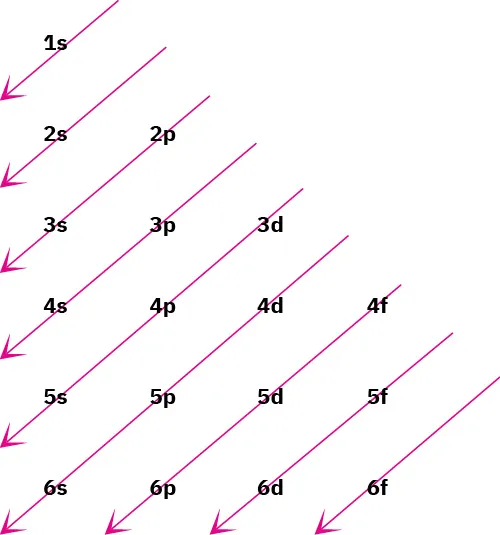
An orbital-filling (Aufbau) diagram shows the order in which atomic orbitals are filled as electrons are added (e.g., ). This helps students translate from the idea of “arranged in shells, subshells, and orbitals” to the actual sequence used to build electron configurations. It also clarifies why configurations are written in blocks (s, p, d, f) rather than only as simple shell counts. Source
This is important because chemical reactions involve electrons, and the arrangement of those electrons affects how easily an atom can react.
Electronic configuration: The arrangement of an atom’s electrons in shells, subshells, and orbitals.
Not all electrons influence chemical behavior equally. The most important electrons for ordinary chemistry are the outer-shell electrons.
Outer-shell electrons: The electrons in the highest occupied energy level of an atom; these are the electrons most directly involved in bonding and chemical reactions.
Inner electrons are much closer to the nucleus and are held more strongly. They mainly contribute to shielding and do not usually take part directly in reactions. As a result, two elements can have very different total numbers of electrons but still show similar chemical properties if they have the same outer-shell arrangement.
Why outer-shell electrons matter
Chemical reactions usually involve atoms losing, gaining, or sharing outer-shell electrons. This means the number of electrons in the outer shell is a key factor in determining what an atom is likely to do.
Atoms with only one or two outer-shell electrons often lose them relatively easily. This is typical of many metals. By contrast, atoms with nearly full outer shells often gain electrons or share electrons in covalent bonds. This is more typical of nonmetals.
A full outer shell is associated with increased stability, so atoms often react in ways that move them toward a more stable electron arrangement. Because of this:
the number of outer-shell electrons affects the type of ion an element tends to form
it affects whether an element is more likely to show metallic or nonmetallic behavior
it influences the number of bonds an atom commonly forms
So, electronic configuration is directly linked to chemical properties because it controls the behavior of the electrons that actually take part in reactions.
Electronic configuration and group position
For the main-group elements, an element’s position in a group is closely related to the number of outer-shell electrons it has.
Elements in the same group have the same number of outer-shell electrons. This is why elements in a group tend to have similar chemical properties. They react in similar ways because they undergo similar electron changes.
For example:
Group 1 elements have one outer-shell electron
they tend to lose one electron
they commonly form ions with charge
Group 2 elements have two outer-shell electrons
they tend to lose two electrons
they commonly form ions with charge
Group 17 elements have seven outer-shell electrons
they tend to gain one electron or share one electron
they commonly form ions with charge
Group 18 elements have full outer shells
they are much less reactive than most other elements
This repeated pattern of outer-shell electrons explains the repeated pattern of chemical properties down a group. The atoms get larger as you move down, but the same outer-shell pattern remains, so the overall type of chemistry stays similar.
Electronic configuration and period position
An element’s position in a period depends on the highest occupied shell in its electronic configuration. The number of occupied shells tells you which period the element belongs to.
elements in Period 2 have electrons in two occupied shells
elements in Period 3 have electrons in three occupied shells
elements in Period 4 have electrons in four occupied shells
This means electronic configuration determines horizontal position in the Periodic Table as well as vertical position.
Elements across the same period have the same number of occupied shells, but their outer-shell electron numbers increase by one from left to right.
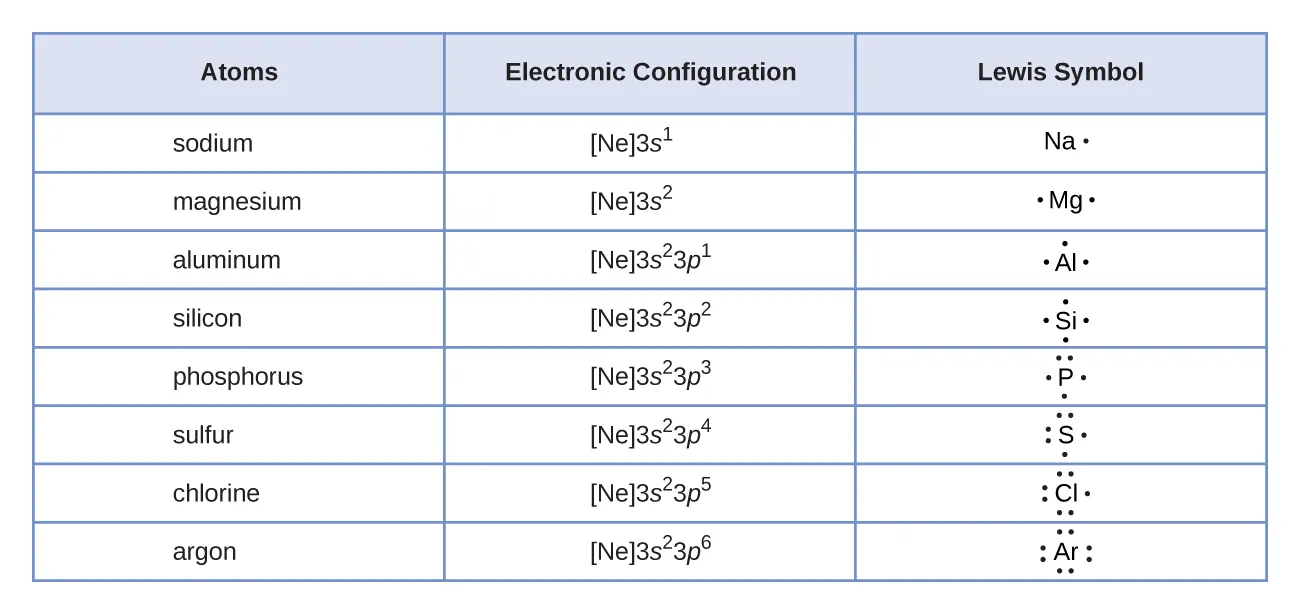
Lewis symbols for Period 3 elements (Na to Ar) show the number of valence electrons as dots around the element symbol. The pattern makes the left-to-right increase in outer-shell electrons visually explicit, reinforcing why metallic behavior tends to decrease and nonmetallic behavior tends to increase across a period. It also connects outer-shell electron count to typical bonding capacity (how many electrons are needed to reach a stable octet). Source
As the outer shell fills, chemical properties change. Early in a period, elements are more likely to lose electrons and behave as metals. Later in the period, elements are more likely to gain or share electrons and behave as nonmetals.
Predicting chemical properties from configuration
Once you know an element’s electronic configuration, you can make useful predictions about its chemistry.
You can often predict:
its group from the number of outer-shell electrons
its period from the number of occupied shells
whether it is likely to lose, gain, or share electrons
the charge of ion it is likely to form
whether it is likely to have chemical properties similar to other elements in the same group
For example, an atom with one outer-shell electron will usually react very differently from an atom with seven outer-shell electrons. The first is more likely to lose an electron, while the second is more likely to gain one or share one in bonding. That difference comes directly from electronic configuration.
Using the idea in explanations
In exam answers, the strongest explanations usually connect three points clearly:
the electronic configuration
the number of outer-shell electrons
the resulting chemical behavior and Periodic Table position
A statement such as “these elements have similar chemical properties because they have the same number of outer-shell electrons” is often the key link. Likewise, stating that an element is in a certain period because it has that number of occupied shells shows how electronic configuration determines its position in the Periodic Table.
Practice Questions
Explain why sodium and potassium have similar chemical properties. (2 marks)
Both have one electron in their outer shell / the same outer-shell electronic configuration. (1)
Both tend to lose one electron / form ions with charge / therefore react in similar ways. (1)
Element A has electronic configuration .
Element B has electronic configuration .
(a) State the period and group of element A and of element B. (4 marks)
(b) Use the electronic configurations to explain why the chemical properties of A and B are different. (2 marks)
(a)
A is in Period 3. (1)
A is in Group 2. (1)
B is in Period 3. (1)
B is in Group 17. (1)
(b)
A has two outer-shell electrons and tends to lose two electrons / form ions with charge . (1)
B has seven outer-shell electrons and tends to gain one electron or share one electron / form ions with charge . (1)
Accept equivalent wording that links outer-shell electrons to different chemical behavior.
FAQ
Helium has the electronic configuration $1s^2$, so its first shell is full.
The first shell can only hold two electrons, not eight. That means helium already has a complete outer shell, making it very unreactive, so it is placed with the noble gases in Group 18.
Hydrogen has one electron, so its configuration suggests a Group 1 position.
However, hydrogen is a nonmetal, has no inner shell, and often forms covalent bonds rather than behaving like an alkali metal. It can lose its electron, but it can also share it, so its chemistry is unusual compared with the rest of Group 1.
Not as neatly.
In transition metals, electrons from the $d$ subshell can also affect chemical behavior. Because the energies of the $s$ and $d$ subshells are close, these elements often show variable oxidation states, so their chemistry cannot always be predicted just by counting outer-shell electrons in the simplest way.
A full outer shell is a useful idea, but atoms do not always reach it by forming ions.
If two atoms attract electrons with similar strength, complete electron transfer may be unfavorable. In that case, sharing electrons in a covalent bond can give both atoms access to a more stable arrangement without producing separate ions.
Having the same electronic configuration does not make two ions identical.
For example, $Na^+$ and $Mg^{2+}$ both have the same electron arrangement as neon, but they have different nuclear charges and different ionic charges. This changes how strongly they attract other ions or molecules, so their chemical behavior is not the same.
