

CIE Syllabus focus:
'Classify elements as s-, p- or d-block elements from the subshell being filled and their positions in the Periodic Table.'
The block structure of the Periodic Table links electron arrangement to element classification. To answer exam questions accurately, you must identify the subshell being filled and connect it to the element’s position.
Understanding blocks
The Periodic Table is divided into blocks.
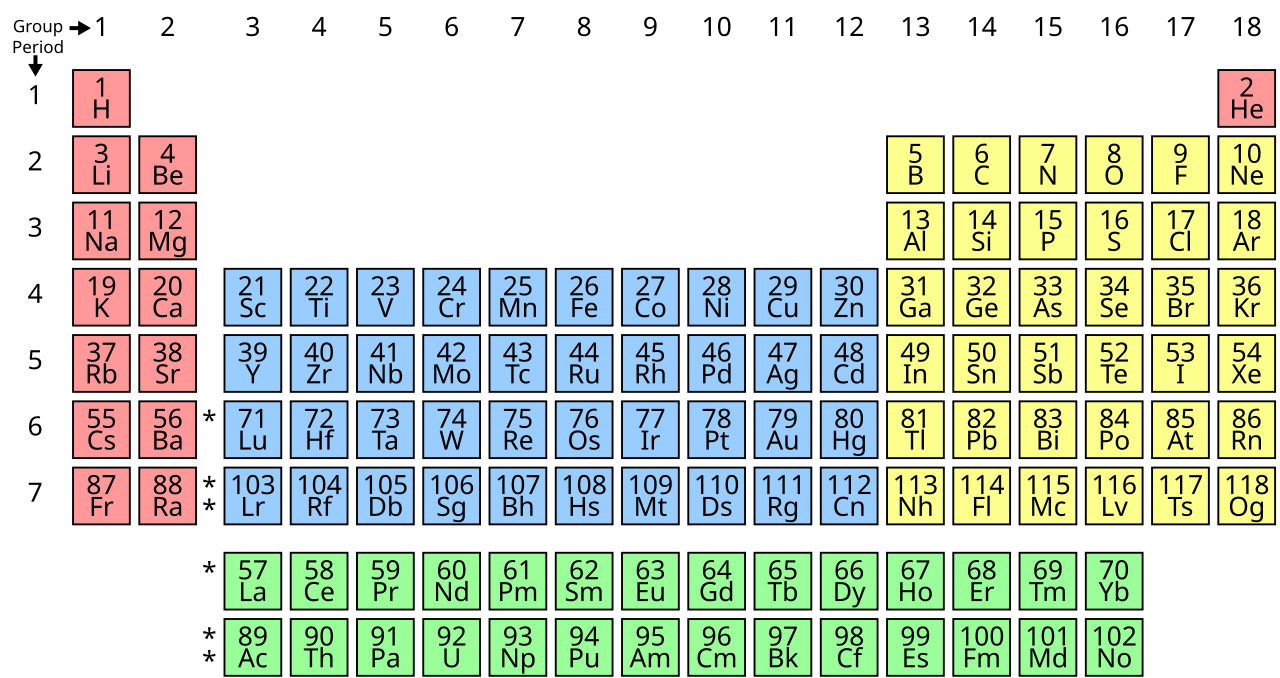
Periodic table shaded by block (s, d, p), making the block boundaries and relative widths immediately visible. This reinforces that blocks are defined by the subshell being filled as atomic number increases across a period, not by metallic/nonmetallic character. Source
These blocks are named after the type of subshell that is being filled as atomic number increases across a period. This means block classification comes from electronic structure, not just from whether an element is a metal or nonmetal.
Block: A section of the Periodic Table in which the electron being added enters the same type of subshell.
Because different subshells hold different numbers of electrons, each block has a characteristic width. An s subshell holds 2 electrons, a p subshell holds 6 electrons, and a d subshell holds 10 electrons. This is why the blocks have different numbers of columns in the Periodic Table.
The s-block
The s-block is found on the left-hand side of the Periodic Table. It contains the first two columns, because an s subshell can contain a maximum of 2 electrons.
Elements are classified as s-block elements when the subshell being filled is an s subshell. In electron configurations, the final electron enters an s orbital. Typical examples include:
Li:
1s2 2s1Mg:
1s2 2s2 2p6 3s2Ca:
1s2 2s2 2p6 3s2 3p6 4s2
These elements lie in Groups 1 and 2. Their position matches the fact that the outer electrons are entering an s subshell. When a question asks you to classify an element in the first two columns, the answer will usually be s-block.
The p-block
The p-block is found on the right-hand side of the Periodic Table. It contains six columns, which matches the maximum of 6 electrons in a p subshell.
An element is p-block when the subshell being filled is a p subshell. This means the final electron enters p rather than s or d. Examples include:
B:
1s2 2s2 2p1S:
1s2 2s2 2p6 3s2 3p4Cl:
1s2 2s2 2p6 3s2 3p5
These elements occupy Groups 13 to 18 of the Periodic Table. The p-block begins in Period 2, since there is no 1p subshell. Across a period, once the s subshell has been filled, electrons begin to fill the p subshell, so the Periodic Table moves from the left-hand s-block to the right-hand p-block.
The d-block
The d-block is located in the middle of the Periodic Table, between the s-block and the p-block. It is 10 columns wide, because a d subshell can hold up to 10 electrons.
An element is d-block when the subshell being filled is a d subshell. This is an important idea, because the electron configuration may still include an s subshell outside it. For example:
Sc:
1s2 2s2 2p6 3s2 3p6 4s2 3d1Fe:
1s2 2s2 2p6 3s2 3p6 4s2 3d6Zn:
1s2 2s2 2p6 3s2 3p6 4s2 3d10
Although these configurations contain 4s electrons, the block is decided by the fact that the 3d subshell is being filled across this section of the table.
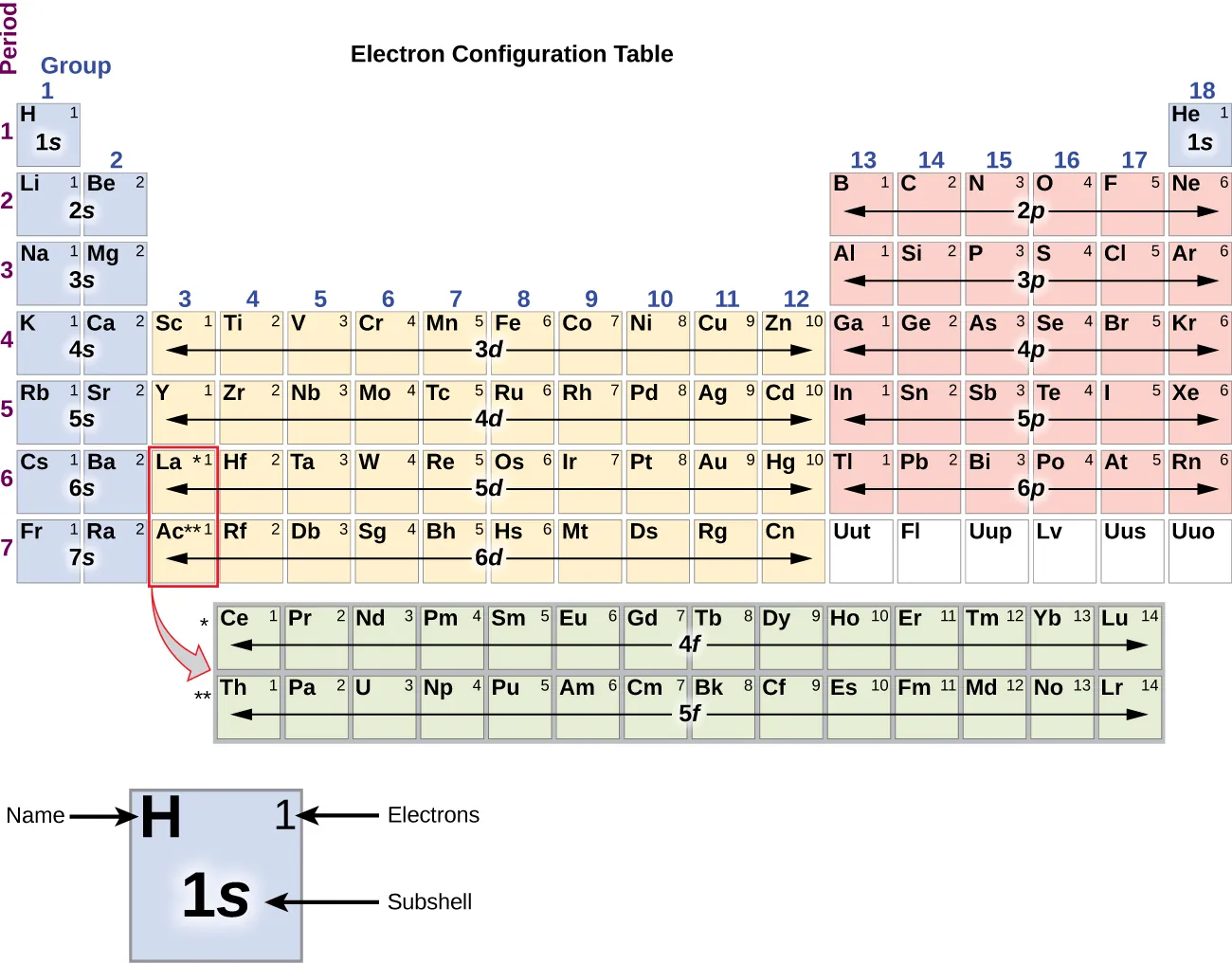
Periodic table annotated with the subshell labels (e.g., 4s, 3d, 4p) across each period, showing where electrons are being added in each region. This makes it clear why elements like Sc–Zn are classified as d-block even though their configurations include 4s electrons: the differentiating electrons are entering the 3d subshell. Source
This is why these elements are classified as d-block, not s-block.
The d-block first appears in Period 4. After calcium, the next electrons begin to enter the 3d subshell, so the central block starts. When the 3d subshell becomes full, the next electron enters a p subshell, and the table moves into the p-block again.
Using position and electronic configuration together
In exam questions, you may be given either an electron configuration or an element’s position in the Periodic Table. You should be able to use either type of information.
A reliable method is:
identify the subshell receiving the final electron
match that subshell to the block name
check that the position fits the correct region of the Periodic Table
For example, an element ending in ns1 or ns2 will usually be s-block. An element ending in np1 to np6 will be p-block. An element in the central section where electrons are entering d orbitals will be d-block.
Position is especially helpful when you do not need to write the full configuration. The first two columns are s-block, the central ten columns are d-block, and the right-hand six columns are p-block. This layout reflects the order in which subshells are filled across each period.
Common errors to avoid
A frequent mistake is choosing the block from the highest shell number rather than the subshell being filled. For d-block elements such as iron, students sometimes see 4s and incorrectly say s-block. The correct classification is d-block because the extra electrons across that region are entering 3d.
Another common mistake is assuming that block and group mean exactly the same thing. Group number helps with position, but block classification is specifically about the type of subshell being filled.
Also avoid deciding the block from the total number of outer electrons alone. For example, boron has only one electron in its p subshell, but it is still p-block because that electron enters p, not s. This focus on the subshell being filled is the key idea that links electronic structure to the layout of the Periodic Table.
Practice Questions
State the block to which aluminum belongs and explain your answer using its electron configuration. (2 marks)
p-block (1)
The final electron enters a p subshell / the configuration ends in 3p1 (1)
An element X has the electron configuration 1s2 2s2 2p6 3s2 3p6 4s2 3d5.
(a) State the block of element X. (1)
(b) Explain, using the electron configuration, why X belongs to this block. (2)
(c) Describe where this block is found in the Periodic Table. (1)
(d) Another element Y has the electron configuration 1s2 2s2 2p6 3s2 3p1. State the block of Y. (1)
(5 marks)
(a)
d-block (1)
(b)
States that the 3d subshell is being filled (1)
States that block classification depends on the subshell being filled, not just the presence of 4s electrons (1)
(c)
Middle / central section of the Periodic Table, between the s-block and p-block (1)
(d)
p-block (1)
FAQ
Helium is a special case.
By electron configuration, helium has its electrons in an s subshell, so it can be described as s-block. However, it is placed with the noble gases because its outer shell is full and its chemical behavior is much closer to Group 18 than to Group 2.
This is a reminder that block classification and group placement do not always tell you exactly the same thing.
Hydrogen has the configuration 1s1, so it fits the pattern of an s-block element.
However, its chemistry is unusual:
it is a nonmetal
it can lose an electron like Group 1 elements
it can also gain or share electrons in ways unlike alkali metals
Because of this, hydrogen is often shown above Group 1, but many chemists treat it as a unique element rather than a perfect match for that group.
Both scandium and zinc sit in the region of the Periodic Table associated with d-subshell filling.
Scandium begins the 3d series, while zinc ends it. That means both belong to the d-block when classification is based on position and the subshell pattern of the neutral atoms.
In more advanced chemistry, zinc is sometimes treated as a special case for other definitions, but for block classification it still belongs to the d-block.
An element’s block is based on the neutral atom.
This matters because ions can lose electrons in a different order from the way electrons were added during filling. For example, some d-block elements lose s electrons before d electrons when they form ions.
Even so, the element keeps the same block label, because the block comes from the electron arrangement and position of the uncharged atom in the Periodic Table.
They are usually placed below the main table to keep the diagram compact and readable.
These elements belong to the f-block, where electrons are added to an f subshell. If they were inserted into the main body in full, the Periodic Table would be much wider.
So, their separate position is mainly a layout choice. It does not mean they are less important; it simply makes the table easier to display.

