

CIE Syllabus focus:
'Predict electronic configurations of atoms up to atomic number 36 using 1s notation and electrons-in-boxes notation.'
Electronic configurations show how electrons are arranged in atoms. For this topic, you need to write accurate configurations for neutral atoms up to krypton using both full 1s notation and electrons-in-boxes diagrams.
What electronic configurations show
An electronic configuration tells you how the electrons in an atom are arranged. For a neutral atom, the number of electrons is the same as the atomic number, so the atomic number tells you how many electrons must be placed.
Electronic configuration: The arrangement of electrons in an atom in shells, subshells, and orbitals.
In 1s notation, each part of the configuration gives specific information:
the number shows the main energy level
the letter shows the subshell: s, p, or d
the superscript shows the number of electrons in that subshell
For example, means:
energy level 3
a p subshell
4 electrons in that subshell
A full electronic configuration must include all electrons in the atom, written in the correct order. For atoms with atomic numbers up to 36, the final subshell written is no higher than 4p.
Order in which subshells fill
Electrons fill the available subshells in order of increasing energy. For the first 36 elements, the order you need is:
This order must be learned accurately, because it is the basis of every configuration in this range.
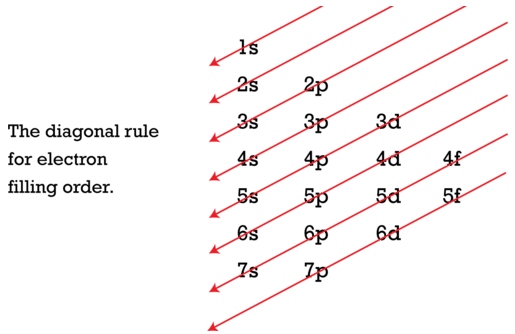
Diagonal (Aufbau) filling diagram showing how subshells are filled in order of increasing energy. Following the arrows gives the sequence used in full configurations (e.g., …). This is especially useful for remembering why is written before for neutral atoms up to . Source
Each subshell has a maximum capacity:
s holds 2 electrons
p holds 6 electrons
d holds 10 electrons
These capacities depend on how many orbitals are present in each subshell.
Orbital: A region of space that can hold up to two electrons with opposite spins.
In full 1s notation, orbitals are not shown separately, but they are still important. An s subshell contains 1 orbital, a p subshell contains 3 orbitals, and a d subshell contains 5 orbitals.
A common difficulty is the position of 4s and 3d. For neutral atoms up to atomic number 36, 4s fills before 3d. This means potassium is , and calcium is .
Useful checkpoint configurations
Some full configurations are especially useful as reference points:
helium:
neon:
argon:
krypton:
If your configuration does not build correctly from these patterns, it should be checked.
Electrons-in-boxes notation
Electrons-in-boxes notation shows orbitals more clearly than 1s notation. Each box represents one orbital, and each arrow represents one electron.
This notation helps you see how electrons are arranged within a subshell, especially in p and d subshells.
The rules are:
each box can hold a maximum of two electrons
two electrons in the same box must have opposite spins
when orbitals have the same energy, electrons go into separate boxes first before any pairing happens
So:
a p subshell with 3 electrons is shown as [↑] [↑] [↑]
a p subshell with 4 electrons is shown as [↑↓] [↑] [↑]
For box diagrams:
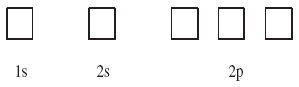
Orbital box template for , , and , showing how each orbital is represented as a box and each electron as an arrow. The diagram makes it explicit that an subshell has one orbital (one box), while a subshell has three orbitals (three boxes). This provides a visual bridge from subshell notation to electrons-in-boxes diagrams with correct spin pairing. Source
an s subshell has 1 box
a p subshell has 3 boxes
a d subshell has 5 boxes
This makes it easier to represent atoms such as nitrogen, phosphorus, or the first-row d-block atoms, where several electrons occupy equal-energy orbitals.
Writing configurations for atoms up to atomic number 36
To write a configuration correctly:
start with the atomic number
place that number of electrons into subshells using the correct filling order
do not exceed the maximum capacity of any subshell
check that the total number of electrons written equals the atomic number
For atoms up to 20, configurations build from to . After calcium, the next electrons go into 3d, so scandium begins the 3d series. After is reached, the next electrons enter 4p, finishing at krypton.
Important exceptions
Most atoms up to 36 follow the standard filling order exactly, but two important neutral atoms must be learned as exceptions:
chromium:
copper:
These configurations are more stable than the expected alternatives because a half-filled or fully filled d subshell is especially favorable.
Common mistakes to avoid
using shell patterns such as 2,8,8,2 when the question asks for full 1s notation
writing 3d before 4s for neutral atoms in this range
forgetting that p subshells have three orbitals and d subshells have five
pairing electrons too early in box diagrams
giving chromium as or copper as
forgetting to add the superscripts to the correct total number of electrons
Accuracy matters because one misplaced electron gives the wrong atom.
Practice Questions
Calcium has atomic number 20.
Write the full electronic configuration of a calcium atom in 1s notation. (2 marks)
(1)
correctly added, giving (1)
Vanadium has atomic number 23.
(a) Write the full electronic configuration of a vanadium atom in 1s notation. (2 marks)
(b) Draw the electrons-in-boxes notation for the and subshells of vanadium. (2 marks)
(c) State the number of unpaired electrons in a vanadium atom. (1 mark)
(a)
correct arrangement up to argon, (1)
correct ending , giving full configuration (1)
(b)
: [↑↓] (1)
: [↑] [↑] [↑] [ ] [ ] (or equivalent with three single electrons in separate boxes) (1)
(c)
3 (1)
FAQ
Yes. Noble gas shorthand is a helpful checking tool because it reduces long configurations to a shorter form, such as $[Ar]\ 4s^2\ 3d^6$.
However, if a question specifically asks for full 1s notation, you should expand the shorthand fully before giving your final answer.
Empty boxes show that a subshell contains more orbitals than are currently occupied.
This matters because:
it shows how many orbitals are available
it makes unpaired electrons easier to see
it helps you apply the rule that electrons occupy equal-energy orbitals singly before pairing
Without empty boxes, the structure of the subshell is hidden.
This happens because the relative energies of $3d$ and $4s$ can be very close, and the ordering can change depending on the atom or ion being discussed.
For neutral atoms up to atomic number 36 in this course, the safe rule is:
fill $4s$ before $3d$
So for Edexcel exam questions on neutral atoms, follow the course filling order unless you are dealing with a known exception such as chromium or copper.
No. An electronic configuration does not give an exact position for any electron.
Instead, it tells you:
which energy levels are occupied
which subshells contain electrons
how electrons are distributed among orbitals
It is a model of electron arrangement, not a map of fixed particle locations.
If superscripts are unavailable, clarity is the main goal.
Good alternatives include:
$1s^2\ 2s^2\ 2p^6$
1s2 2s2 2p6
1s^2 2s^2 2p^6
Avoid formats that make the numbers look like atomic numbers or separate terms. Keep spaces between subshells so the configuration is easy to read and mark.
