

CIE Syllabus focus:
'Understand periodicity as a repeating pattern of physical and chemical properties across different periods of the Periodic Table.'
Periodicity explains why the Periodic Table is more than a list of elements: as atomic number increases, patterns in structure and properties appear, end, and then recur in the next period.
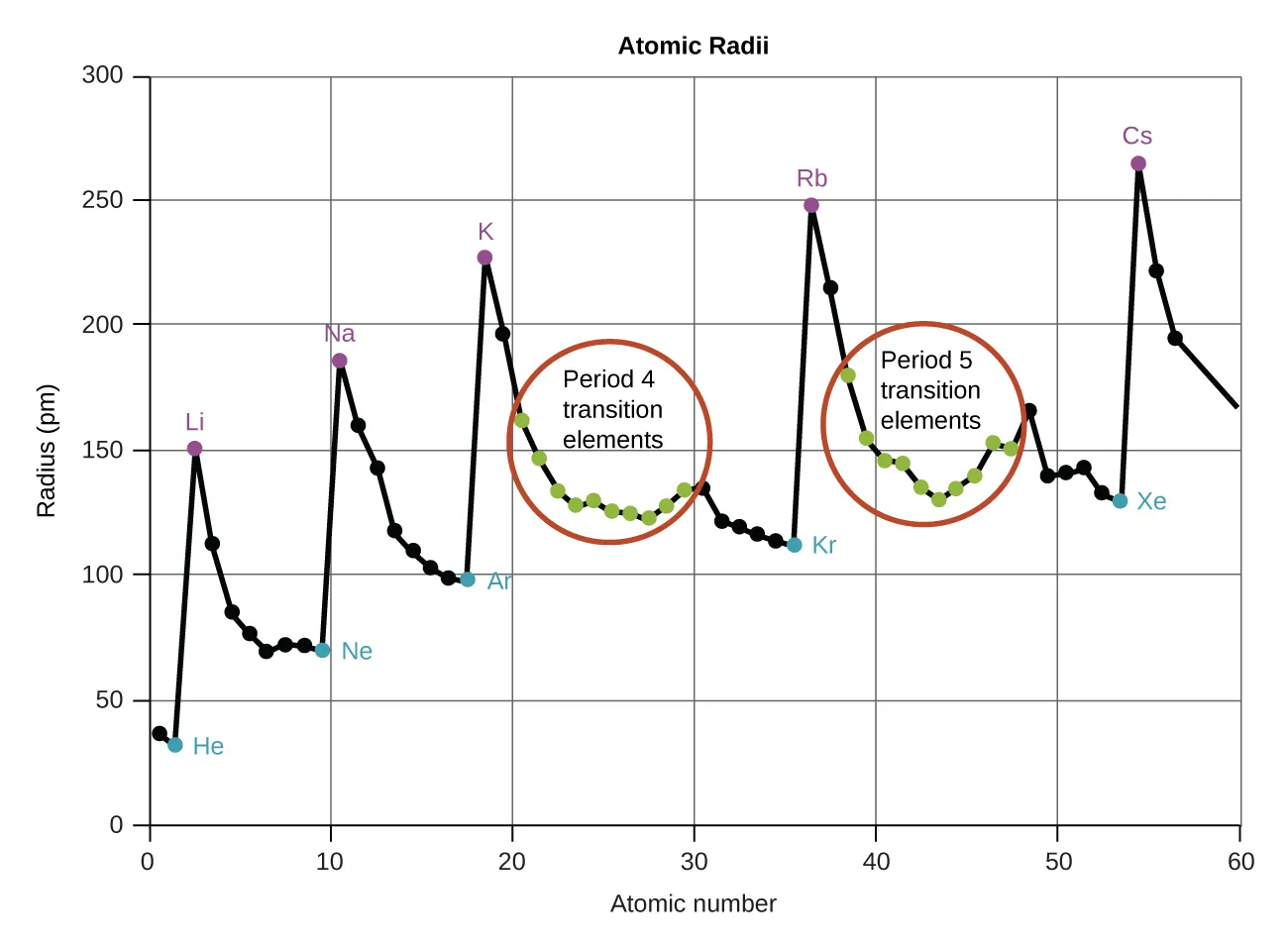
Graph of atomic radius against atomic number showing a repeating sawtooth pattern across successive periods. Peaks occur at the start of each period (alkali metals) and minima near the end (noble gases), illustrating how size trends recur even though absolute values shift for later periods. Source
What periodicity means
Periodicity is the regular recurrence of similar properties when elements are arranged in order of increasing atomic number. The Periodic Table is called periodic because the behavior of the elements follows repeating patterns rather than changing randomly.
Periodicity: A repeating pattern of physical and chemical properties shown by elements when they are arranged in order of increasing atomic number.
This idea applies to both physical properties and chemical properties. Physical properties are features that can be observed or measured without making a new substance, such as conductivity or melting temperature. Chemical properties describe how a substance reacts, such as the kinds of ions or compounds it forms.
Why the pattern repeats
The underlying cause of periodicity is electronic structure, especially the arrangement of outer-shell electrons. As proton number increases, electrons are added in a predictable sequence. When one outer shell becomes full, a new shell begins to fill, starting a new period.
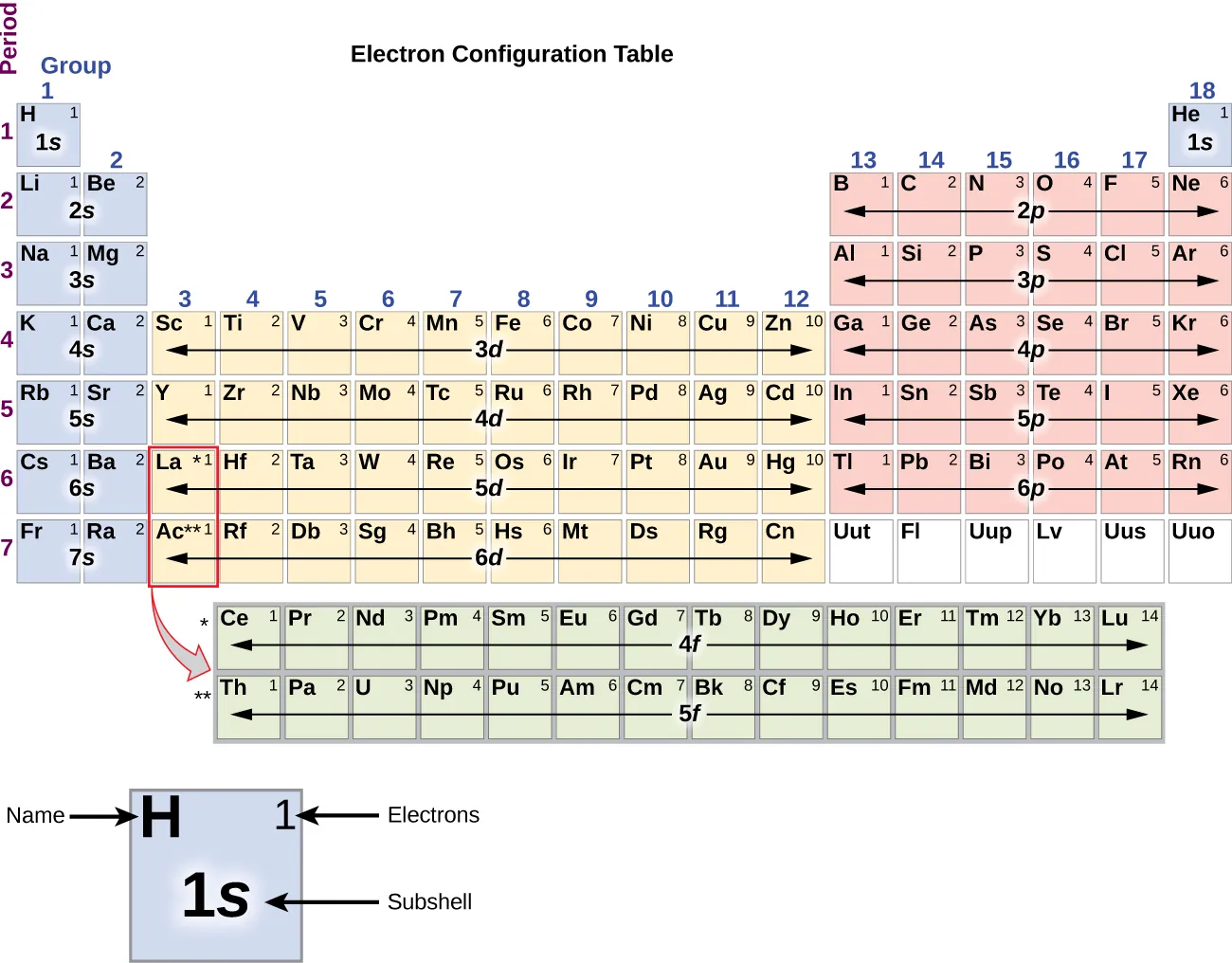
Electron-configuration periodic table showing the order in which subshells fill (s-, p-, d-, and f-blocks) and how this aligns with periods and groups. It makes clear why valence-shell structure repeats at the start of each new period, producing recurring chemical behavior for elements in the same group. Source
This means that:
the number of outer electrons increases step by step across a period
similar outer-electron arrangements reappear in the next period
similar outer-electron arrangements lead to similar properties
A repeated outer-electron pattern gives a repeated property pattern. Elements in equivalent positions in different periods therefore often show related behavior.
Period: A horizontal row in the Periodic Table in which the outer electrons occupy the same main shell.
Elements in the same group are especially important when identifying periodicity. They have the same number of outer electrons, so they often:
form ions with the same charge
make similar types of compounds
react in comparable ways
Same group, different period
Group 1 elements in different periods each have one outer electron, so they tend to lose one electron and show related chemistry. Group 17 elements each have seven outer electrons, so they often gain one electron or share one electron in covalent bonding. Group 18 elements have full outer shells, making them much less reactive than the elements just before them.
This is a direct expression of periodicity: once a new period starts, the sequence of outer-electron arrangements begins again, so families of elements reappear with similar chemical behavior.
Periodicity across different periods
The specification emphasizes repeating patterns across different periods, not just changes within one row. For example, the first element in one period and the first element in the next period occupy similar positions and often share important features. The same is true for elements near the middle or end of a period.
Comparing Period 2 and Period 3 shows this clearly:
each begins with a reactive metal on the left
metallic character decreases across the period
nonmetallic character becomes more important toward the right
each ends with a very unreactive noble gas
Periodic does not mean identical
The exact values of properties do not repeat perfectly. An element in Period 3 is not identical to the element above it in Period 2. Period 3 atoms are larger and have more occupied shells, so the attraction between the nucleus and outer electrons is not exactly the same.
Because of this, periodicity means a repeated pattern of change, not an exact numerical repetition. Similar elements often have related properties, but the strength or numerical value of those properties can still differ.
Physical and chemical patterns you should recognize
You do not need to treat periodicity as a memorized slogan.
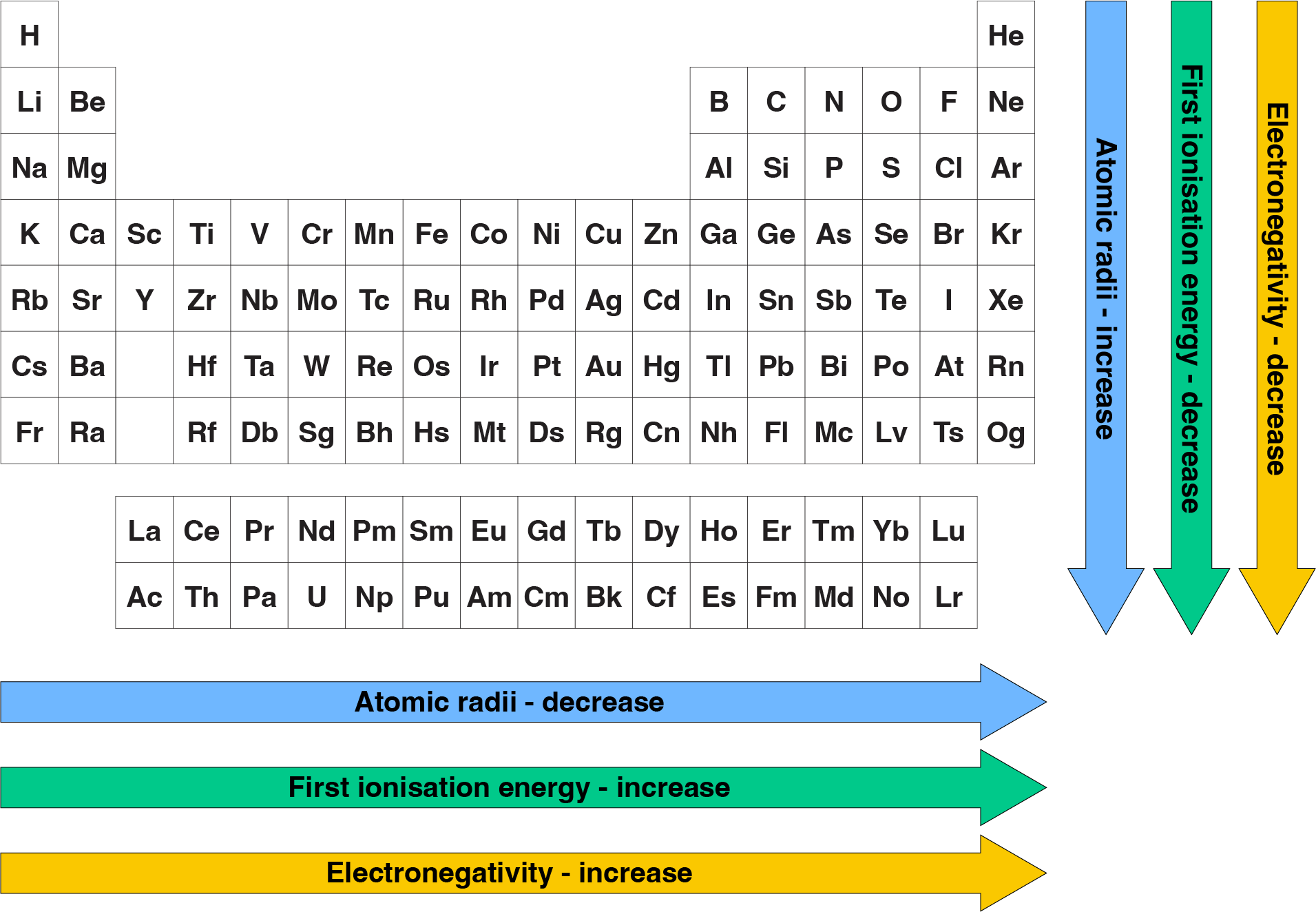
Periodic-table trend map summarizing the directions of change for atomic radius, first ionisation energy, and electronegativity. The arrows emphasize that these properties show systematic, repeatable patterns across periods and down groups, which is the practical meaning of periodicity in prediction. Source
Instead, recognize the kinds of properties that can show repeated patterns from one period to the next.
Physical properties
Examples of physical properties that may display periodicity include:
atomic size
melting temperature
boiling temperature
electrical conductivity
The important point is that the values themselves may differ from period to period, but the sequence or general pattern can recur.
Chemical properties
Examples of chemical properties that may display periodicity include:
typical reactivity
the charge on common ions
whether an element behaves mainly as a metal or nonmetal
the kinds of compounds it usually forms
Chemical periodicity is especially strong because chemical reactions involve outer electrons. If two elements have the same number of outer electrons, they often show similar bonding and reaction patterns.
Using position in the Periodic Table
Periodicity allows chemists to connect an element's position to its likely behavior. This makes the Periodic Table predictive rather than descriptive only.
A useful approach is to ask:
which period is the element in
which group is it in
how many outer electrons does that suggest
what similar elements are found in the same group in other periods
By answering these questions, you can often predict broad features of an element without knowing every detail about it. For instance, elements in the same group can often be treated as a chemical family because periodicity links their structures and properties.
Why periodicity is important in chemistry
Periodicity is one of the main reasons the Periodic Table is such a powerful scientific model. It organizes a very large number of elements into a small number of repeating patterns.
It also shows that the table is based on structure, not just appearance. The repeating arrangement of electrons produces repeating physical and chemical properties, allowing chemists to compare known elements with less familiar ones and predict likely behavior from position alone.
Practice Questions
Define periodicity in the context of the Periodic Table. (2 marks)
states that it is a repeating pattern or regular recurrence [1]
states that the pattern is in physical and chemical properties when elements are arranged by increasing atomic number or across periods [1]
Explain why elements in the same group but in different periods often have similar chemical properties. In your answer, refer to the idea of periodicity. (5 marks)
periodicity is a repeating pattern of physical and chemical properties [1]
elements are arranged in order of increasing atomic number [1]
outer-shell electron arrangements repeat from one period to the next [1]
elements in the same group have the same number of outer-shell electrons [1]
chemical properties depend on outer-shell electrons, so same-group elements react similarly or form similar ions/compounds [1]
FAQ
Chemists could still observe repeating patterns in properties such as:
formulas of compounds
reactivity
densities
melting behavior
This allowed early periodic tables to group similar elements together and even predict missing elements before they were discovered. Periodicity was first recognized from patterns in observed behavior, and only later explained by electronic structure.
The pattern repeats because outer-electron arrangements recur, but the number of elements in each period depends on how many electrons can fit into the available orbitals for that stage of filling.
So:
Period 1 is short
Periods 2 and 3 are longer
later periods are longer still
The repeating pattern is therefore structural, not based on every period containing the same number of elements.
Hydrogen has one electron, so it matches Group 1 in a simple electronic sense. However, its chemistry is unusual.
For example:
it is a nonmetal
it forms covalent bonds easily
it can form both positive and negative ions in different contexts
So hydrogen shows that periodicity is very useful, but not every element fits perfectly into a simple family pattern.
Main-group elements show a closer link between group position and the number of outer electrons, so their chemistry often repeats more obviously from one period to the next.
Transition metals are less straightforward because:
electrons are filling more complex subshells
oxidation states can vary
their chemical behavior is often less uniform across a row
This can make the broad idea of periodicity less visually obvious, even though periodic organization still applies.
If an element is in a known group, periodicity helps you predict its usual valency or common ion charge. That gives a strong clue about the formulas of its compounds.
For example:
Group 1 elements often form chlorides like $MCl$
Group 2 elements often form oxides like $MO$
Group 13 elements often form oxides like $M_2O_3$
This method is not perfect for every element, but it is very useful for spotting likely compound formulas quickly.
