

CIE Syllabus focus:
'Understand ion formation in terms of electron loss or gain, and draw electronic configuration diagrams of cations and anions using dot-and-cross diagrams.'
These notes explain how atoms become charged particles by losing or gaining electrons, and how to represent those changes clearly using electronic configurations and dot-and-cross diagrams.
Ion formation
Atoms are neutral because they contain equal numbers of protons and electrons. During chemical change, the number of protons in the nucleus stays the same, but electrons can be transferred. If electrons are lost or gained, the atom becomes an ion.
Ion: A charged particle formed when an atom gains or loses one or more electrons.
An atom that loses electrons forms a positive ion, also called a cation. This is because it then has more protons than electrons. An atom that gains electrons forms a negative ion, also called an anion, because it then has more electrons than protons.
For the elements usually met at this level, ions form so that the outer shell becomes full. This often gives the ion the same electronic configuration as the nearest noble gas. The important point is that only electrons are transferred; the identity of the element does not change.
Common patterns include:
Group 1 atoms lose 1 electron to form 1+ ions.
Group 2 atoms lose 2 electrons to form 2+ ions.
Group 6 atoms gain 2 electrons to form 2− ions.
Group 7 atoms gain 1 electron to form 1− ions.
For example:
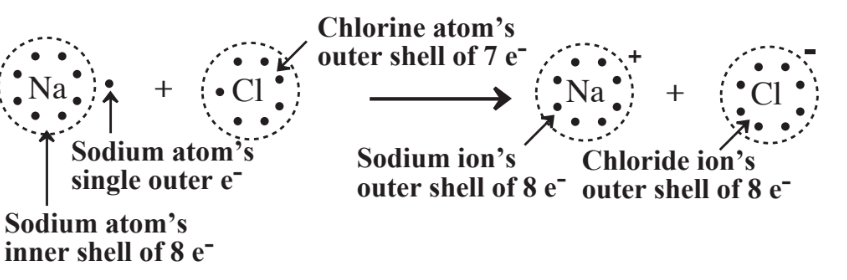
Electron-transfer diagram for the formation of NaCl, showing a sodium atom losing one electron to become and a chlorine atom gaining that electron to become . This makes the link between electron transfer and ion charge explicit, supporting the octet/noble-gas-configuration explanation. Source
sodium: 2,8,1 becomes Na+ with configuration 2,8
magnesium: 2,8,2 becomes Mg2+ with configuration 2,8
chlorine: 2,8,7 becomes Cl− with configuration 2,8,8
oxygen: 2,6 becomes O2− with configuration 2,8
Why the charge appears
The charge on an ion depends on the balance between protons and electrons. Losing electrons leaves an overall positive charge. Gaining electrons produces an overall negative charge. A 2+ ion has lost two electrons, while a 3− ion has gained three electrons.
This means you should always connect the charge to the number of electrons transferred, not to the number of shells or the position of the atom alone.
Electronic configurations of ions
When writing the electronic configuration of an ion, start with the neutral atom and then change the number of outer-shell electrons.
A reliable method is:
write the electronic configuration of the neutral atom
decide whether electrons are lost or gained
remove electrons from, or add electrons to, the outer shell
write the final electronic configuration of the ion
add the ion charge to the formula
For cations, the outer shell may disappear completely after electrons are lost. Sodium is a good example: the neutral atom is 2,8,1, but Na+ is 2,8 because the third shell no longer contains any electrons.
For anions, electrons are added to the existing outer shell until it is full. Chlorine changes from 2,8,7 to Cl− with 2,8,8. The nucleus is still chlorine because the proton number has not changed.
What exam questions are testing
Questions on ion formation usually check whether you can do two linked things:
identify whether electrons are lost or gained
write the correct electronic configuration after the change
Examiners often include ions with charges greater than 1. You should be comfortable with ions such as Mg2+, O2−, Al3+, and N3−, where more than one electron is transferred.
Dot-and-cross diagrams
A dot-and-cross diagram helps show where electrons came from when ions are formed.
Dot-and-cross diagram: A diagram that shows outer-shell electrons using different symbols to indicate which atom the electrons originally came from.
Dots and crosses do not represent different kinds of electrons. They are simply a way of tracking electron transfer. One atom’s electrons may be drawn as dots and the other atom’s as crosses.
When drawing ions in this style:
put each ion in square brackets
write the charge outside the bracket, usually at the top right
show the correct number of electrons in the outer shell
for anions, include the gained electrons using the symbol from the atom that supplied them
for cations, show the electron arrangement after electrons have been removed
In a sodium chloride diagram, Na+ is shown in brackets with a + charge and no electron in its former third shell. Cl− is shown in brackets with a − charge and eight outer-shell electrons. Seven belong to chlorine originally, and the eighth comes from sodium, so one symbol is different.
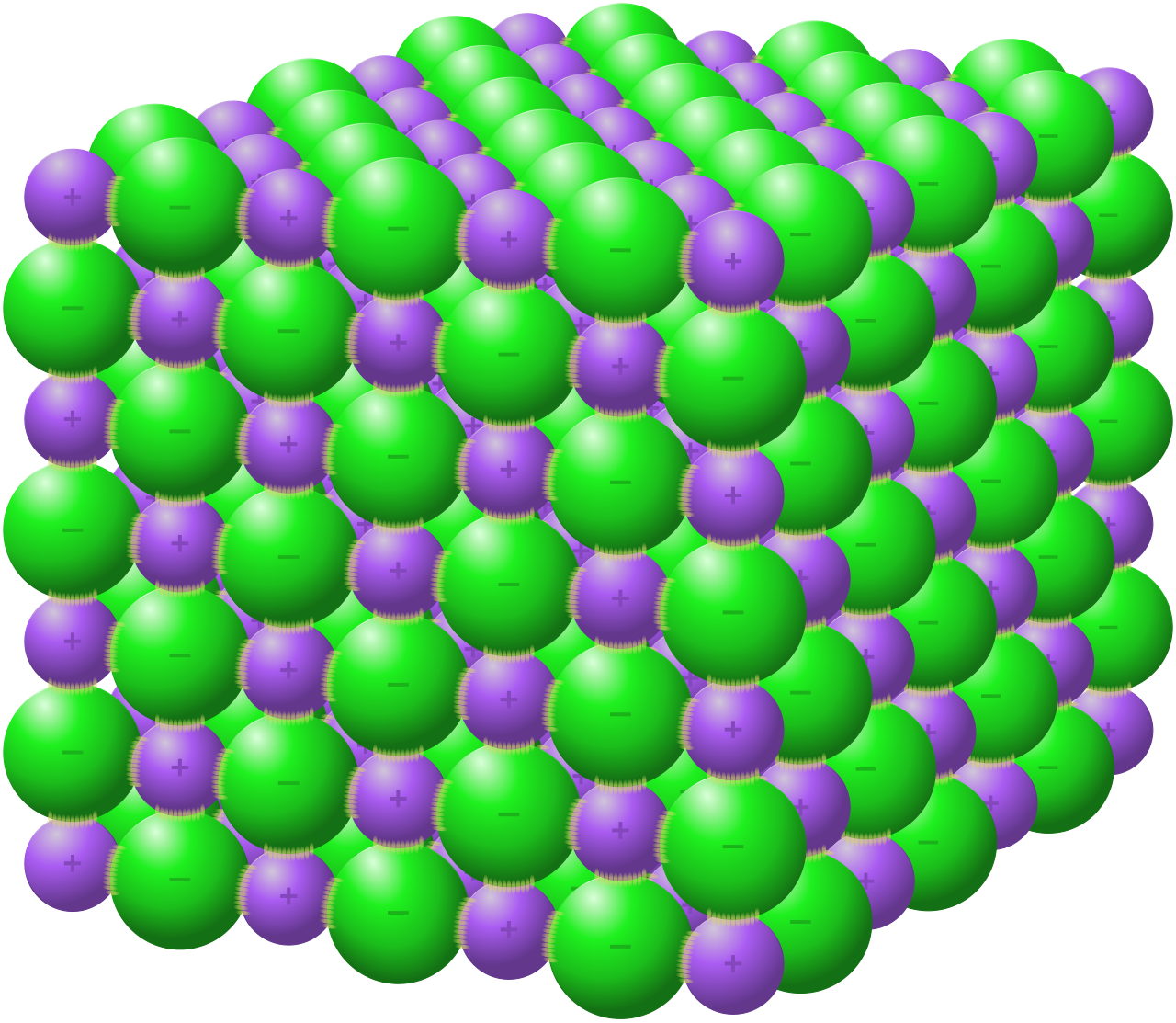
Schematic of the sodium chloride crystal lattice, showing alternating and ions arranged in a regular 3D structure. This reinforces that ionic bonding produces an extended lattice of repeating ions rather than discrete NaCl molecules. Source
In a magnesium oxide diagram, Mg2+ has lost two electrons and is shown as 2,8 inside brackets with a 2+ charge. O2− has gained two electrons, so its outer shell contains eight electrons, with two marked as having come from magnesium.
Full diagrams and clear layout
Some questions ask for a full electronic configuration diagram, while others only need the outer-shell electrons. Read the command word carefully. If the question says draw a dot-and-cross diagram of the ions, make sure the electron arrangement and charges are both visible.
A neat layout helps avoid mistakes:
keep electrons spaced clearly around the ion
make the different symbols easy to distinguish
do not forget brackets around both the cation and the anion
do not place the charge inside the bracket
Avoiding common mistakes
Several errors appear frequently in this topic:
writing a positive ion as if it had gained electrons
forgetting that electron loss happens from the outer shell
drawing an anion with the wrong total number of outer electrons
missing out square brackets
writing the charge but not changing the electron arrangement
using dots and crosses as if they changed the charge by themselves
Another common mistake is confusing atom diagrams with ion diagrams. A neutral atom does not need a charge in brackets, but an ion does. In diagrams containing more than one ion, each ion should be shown separately with its own bracket and charge.
Practice Questions
State what happens when a chlorine atom forms a chloride ion, and give the electronic configuration of the chloride ion. (2 marks)
Gains one electron. [1]
Electronic configuration is 2,8,8. [1]
Magnesium and oxygen form Mg2+ and O2- ions.
(a) Explain how each ion is formed. (2 marks)
(b) Draw the dot-and-cross diagrams for Mg2+ and O2-. (3 marks)
(5 marks)
(a)
Magnesium loses two electrons. [1]
Oxygen gains two electrons. [1]
(b)
Mg2+ shown in square brackets with 2+ charge and no electrons in the third shell, giving configuration 2,8. [1]
O2- shown in square brackets with 2- charge and eight outer-shell electrons. [1]
Two of the outer electrons on O2- shown as coming from magnesium by using a different symbol. [1]
FAQ
Dot-and-cross diagrams are designed to highlight electron transfer, because that is what changes when ions form.
The number of protons stays the same, so the element does not change. Neutrons also stay unchanged and do not affect the ion’s charge. Including them would make the diagram more crowded without adding useful information for this topic.
A shell diagram mainly shows how electrons are arranged in shells around the nucleus.
A dot-and-cross diagram does that too, but it also shows which atom the transferred electrons came from by using different symbols.
So:
shell diagrams emphasize arrangement
dot-and-cross diagrams emphasize arrangement and electron origin
The choice of dots or crosses is completely arbitrary.
There is no rule saying that dots must always belong to metals or that crosses must always belong to nonmetals. The only important rule is to stay consistent within the same diagram, so the examiner can clearly see which electrons came from which atom.
Use the same symbol for all electrons that came from that atom.
For example, if two electrons are transferred from one magnesium atom, both transferred electrons on the anion should be shown with the magnesium symbol. If a question involves several ions, draw each ion separately in brackets and give each one its own charge.
Noble gases already have a full outer shell, so they are already very stable as atoms.
To form an ion, a noble gas would have to either:
lose electrons from a full shell, or
gain electrons into a new shell
Both changes are usually unfavorable, so noble gases do not commonly appear in simple ion-formation dot-and-cross diagrams at this level.

