

CIE Syllabus focus:
'Know that ionic bonding is the strong electrostatic attraction between oppositely charged ions, and understand how ionic charge and ionic radius affect the strength of ionic bonding.'
Ionic compounds are held together by powerful attractions between ions. To explain why some ionic substances have stronger bonding than others, focus on two ideas only: ionic charge and ionic radius.
What ionic bonding means
Ionic bonding describes the attractive force between positive and negative ions in an ionic substance.
Ionic bonding: The strong electrostatic attraction between oppositely charged ions.
A cation is positively charged and an anion is negatively charged. Because the charges are opposite, they attract one another. This is an electrostatic attraction, meaning it is caused by charge rather than by shared electrons.
The attraction becomes stronger when the ions carry larger charges or when the ions are closer together. These two ideas explain almost all simple comparisons of ionic bond strength.
= charge on the first ion
= charge on the second ion
= distance between the centres of the ions
You do not need to calculate values from this expression for most A-Level questions, but it shows the trend clearly: larger charges and smaller ion separation give stronger attraction.
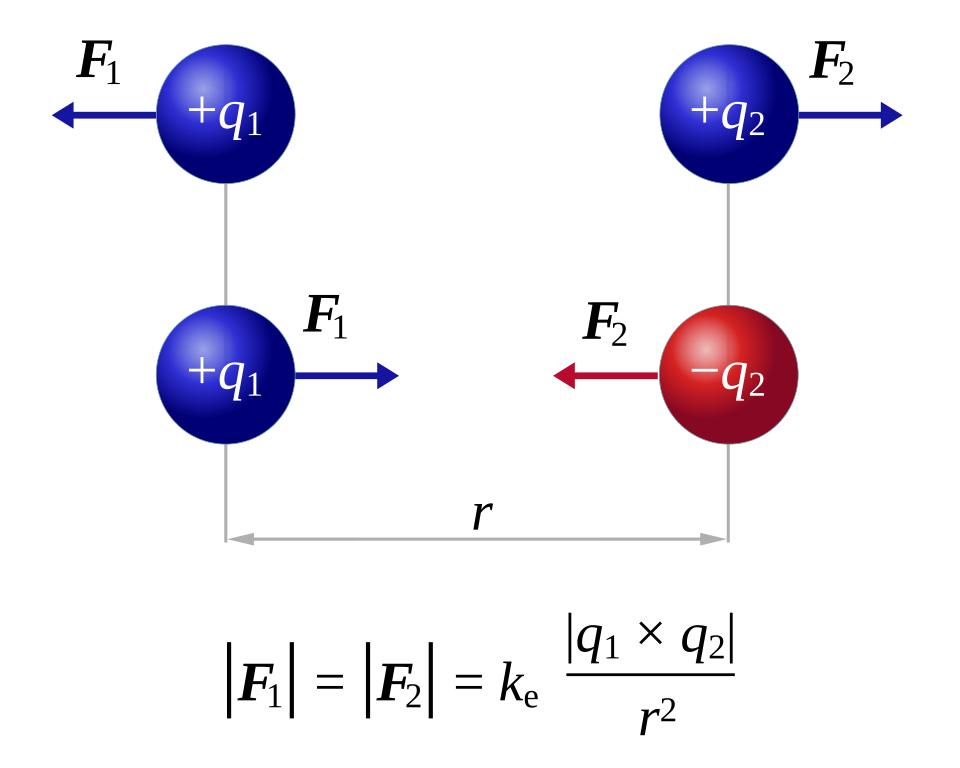
A clean schematic of Coulomb’s law showing how the electrostatic force depends on charge magnitude and separation distance . It provides a visual anchor for the proportionality that underpins ionic bond strength trends. Source
Why ionic bonding is strong
In ionic substances, the charges on ions are whole-number charges such as , , , or . These are much larger than the small partial charges found in many molecules, so the attraction can be very strong.
In a solid ionic compound, each ion is surrounded by ions of opposite charge in a regular arrangement.
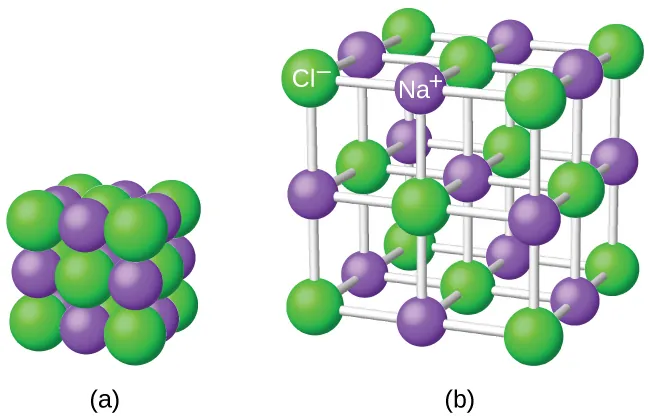
A labeled sodium chloride lattice showing the repeating 3D arrangement of alternating and ions. This helps you visualize why ionic bonding in a solid is the cumulative effect of many electrostatic attractions acting in all directions, rather than one isolated interaction. Source
The structure is therefore held together by many strong attractions acting in all directions, not by one isolated interaction.
Effect of ionic charge
Ionic charge has a major effect on bond strength. If the charges on the ions are larger, the electrostatic attraction between them is stronger.
A ion and a ion attract each other less strongly than a ion and a ion.
The greater the magnitude of the charges, the greater the force of attraction.
Stronger attraction means the ions are harder to separate.
For example, the attraction between and is stronger than the attraction between and . The ions in magnesium oxide have charges of and , while the ions in sodium chloride have charges of only and . Even before thinking about size, the greater charges in magnesium oxide lead to stronger ionic bonding.
When writing exam answers, it is better to say higher ionic charge or greater magnitude of charge rather than simply saying “more electrons” or “more protons.” The comparison must be linked directly to the charge on the ions.
Effect of ionic radius
Ionic radius is the size of an ion. Smaller ions allow the centers of positive and negative charge to be closer together, so the electrostatic attraction is stronger.
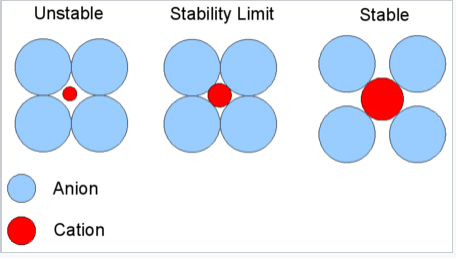
A sphere-packing diagram illustrating how relative cation and anion sizes affect how closely oppositely charged ions can fit together in a crystal. This links ionic radius to interionic distance, helping explain why smaller ions typically produce stronger electrostatic attraction in ionic solids. Source
If the ions are larger:
the distance between the nuclei and the opposite charge increases
the attraction becomes weaker
the ionic bonding is weaker
If the ions are smaller:
the ions can approach more closely
the distance between charges decreases
the attraction becomes stronger
A good comparison is between compounds containing small ions and compounds containing large ions. For instance, and are much smaller than and . Because the ions in lithium fluoride are smaller, the positive and negative charges are closer together, so the ionic bonding is stronger than in cesium iodide.
You may also see this explained in terms of the charge being concentrated into a smaller space. A small ion has a high concentration of charge near its surface, which increases attraction to an oppositely charged ion.
Considering charge and radius together
Questions often require both factors to be used together. A correct explanation should not mention only charge or only size unless the comparison is specifically about one factor.
To compare the strength of ionic bonding:
identify the charges on the ions
compare the ionic radii
decide which substance has ions with the greatest charges and the smallest radii
link both points to stronger electrostatic attraction
Sometimes one factor changes more than the other. In many common comparisons, a higher charge has a very large effect, especially when the ions are also small. This is why compounds containing small, multiply charged ions often have very strong ionic bonding.
Be careful with wording. Do not say that ionic bonding is strong because electrons are “shared strongly.” Electron sharing describes covalent bonding, not ionic bonding. In ionic bonding, the key idea is always attraction between opposite charges.
Writing high-quality exam statements
Strong answers are short and precise. Useful sentence patterns include:
“The ions have greater charges, so the electrostatic attraction is stronger.”
“The ions have smaller ionic radii, so the charges are closer together.”
“Because the ions are more highly charged and/or smaller, the ionic bonding is stronger.”
A weak answer might only state that one substance has a higher melting point or is “more stable.” A better answer explains why, using charge and radius. Exam answers should link each comparison to electrostatic attraction: greater ionic charge and/or smaller ionic radius lead to stronger ionic bonding.
Practice Questions
Define ionic bonding. [2]
strong electrostatic attraction (1)
between oppositely charged ions / between cations and anions (1)
Magnesium oxide, , has stronger ionic bonding than sodium chloride, .
Explain this difference in terms of ionic charge and ionic radius. [5]
and have charges of and , while and have charges of and (1)
larger ionic charges give stronger electrostatic attraction (1)
ions in are smaller overall / is smaller than and is smaller than (1)
smaller ionic radii mean the opposite charges are closer together / shorter distance between ion centers (1)
therefore the ionic bonding in is stronger / more energy is needed to separate the ions (1)
FAQ
Center-to-center distance gives a consistent way to compare ions in different crystals.
It is useful because:
crystal structures are measured using distances between nuclei
ionic radius values are based on those distances
smaller ions reduce that center-to-center distance, which strengthens attraction
This makes ionic radius a practical way to discuss bond strength, even though ions are not perfect hard spheres.
Ions do not have sharp outer edges. Their electron clouds fade out gradually, so a radius is inferred from measurements rather than measured like a solid ball.
Different data sources may use slightly different experimental methods or crystal data. That is why quoted ionic radii can vary a little, even for the same ion.
The apparent size of an ion depends partly on its surroundings in a crystal.
Factors include:
how many neighboring ions surround it
how closely those ions pack
the method used to divide the distance between neighboring nuclei
So an ionic radius is a useful model value, not an absolutely fixed size in every situation.
Melting point depends on the whole crystal, not just one pair of ions.
It is influenced by:
the three-dimensional arrangement of ions
how many nearest neighbors each ion has
how the lattice breaks apart during melting
So charge and radius are excellent for predicting trends, but the numerical values do not have to rise in simple proportion.
A very small, highly charged cation can distort the electron cloud of a nearby anion. This effect is called polarization.
If polarization is strong, the bonding is no longer perfectly ionic. For A-Level comparisons, the main rule is still that higher charge and smaller radius increase ionic attraction, but real substances can show slight departures from the ideal model.

