

CIE Syllabus focus:
'Understand how the physical properties of ionic compounds and the migration of ions provide evidence for the existence of ions.'
Ions cannot usually be seen directly, so chemists identify them from observable behavior. The characteristic properties of ionic compounds and the movement of charged particles in an electric field both reveal ionic particles.
Using observable behavior as evidence
Chemists often rely on indirect evidence. For ionic compounds, the evidence comes from a repeated pattern of physical properties and electrical behavior that is best explained by the presence of charged particles.
The idea becomes clearer once the term ion is defined.
Ion: An atom or group of atoms with a positive or negative charge caused by the loss or gain of electrons.
Ions are not just symbols in formulas such as sodium chloride or magnesium oxide. Their charge affects how substances melt, conduct electricity, and behave in an electric field.
Physical properties of ionic compounds
High melting and boiling temperatures
Ionic compounds are usually solids at room temperature and often have high melting and boiling temperatures.
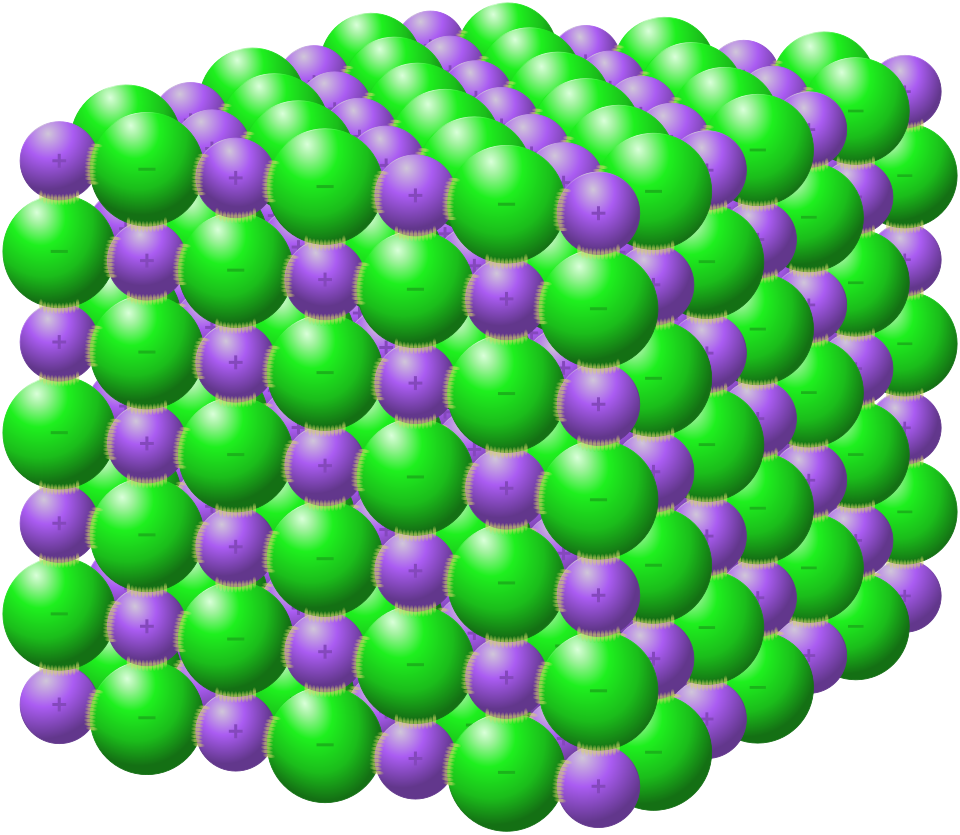
This diagram shows the sodium chloride crystal structure as a repeating 3D lattice of alternating and ions. The regular arrangement emphasizes that each ion is strongly attracted to many oppositely charged neighbors, helping explain why large amounts of energy are required to melt ionic solids. Source
This suggests that the particles are held together by very strong attractions throughout the substance.
If a substance were made of neutral particles with only weak forces between them, much less energy would be needed to separate those particles. The large amount of energy needed to melt or boil an ionic compound supports the idea that the particles are strongly attracted because they carry opposite charges.
This is evidence for ions because:
opposite charges attract strongly
the attraction acts throughout the solid
a large amount of energy is needed to separate the particles
A high melting temperature does not prove on its own that a substance is ionic, but it strongly fits the model of a solid made from positive and negative ions.
Electrical conductivity in different states
One of the clearest pieces of evidence is the way ionic compounds conduct electricity. A solid ionic compound does not conduct electricity, but when molten or dissolved in water, it usually does conduct.
This pattern is very important:
in a solid, the ions are fixed in place, so charge cannot move
in a molten compound, the ions are free to move
in aqueous solution, the ions can move through the liquid
The key idea is that electrical conduction requires mobile charged particles. Since conduction begins only when the particles are able to move, this provides strong evidence that the substance contains ions.
The term electrolyte is useful here.
Electrolyte: A substance that conducts electricity when molten or dissolved because it contains mobile ions.
A substance that behaves as an electrolyte is showing evidence of ions in motion. This is especially convincing because the same substance changes from non-conducting to conducting when the ions become mobile.
Brittle behavior
Many ionic solids are brittle. Instead of bending, they tend to shatter when enough force is applied. This also supports the idea of a regular arrangement of charged particles.
If layers in the solid are forced to shift, ions with the same charge may be brought close together. Strong repulsion then causes the structure to break apart. This behavior is consistent with a solid built from alternating positive and negative ions.
Brittleness is useful supporting evidence because it matches what would be expected from a structure containing charged particles in fixed positions.
Migration of ions
Movement in an electric field
Even stronger evidence comes from the migration of ions during electrolysis or any experiment in which an ionic liquid or solution is placed in an electric field.
If the particles in the liquid are truly charged:
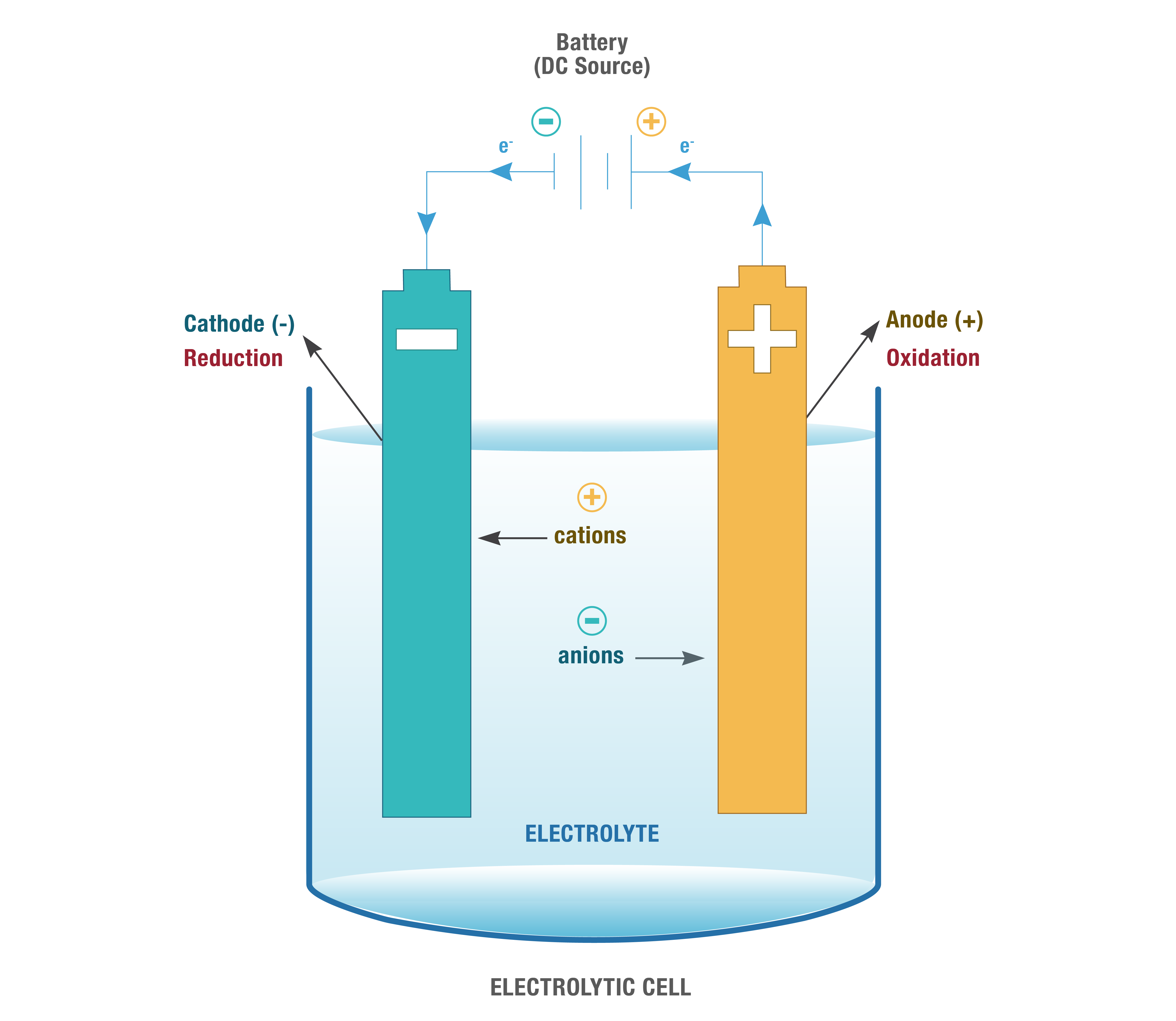
This labeled electrolytic-cell diagram shows ion migration in an electric field: cations move toward the cathode (negative electrode) and anions move toward the anode (positive electrode). It visually links the observed direction of movement to the sign of charge, which is strong evidence that the charge carriers in the liquid are ions rather than neutral particles. Source
cations move toward the negative electrode
anions move toward the positive electrode
That is exactly what is observed. The direction of movement depends on the sign of the charge, which is strong evidence that the moving particles are real charged species.
When the ions are colored, their movement can sometimes be seen directly. This makes the evidence especially convincing, because the charged particles do not stay randomly mixed; they separate and move in opposite directions under the influence of the electric field.
Why migration is such strong evidence
Migration shows more than simple electrical conduction. It shows what kind of particles are carrying the charge.
If a liquid conducts because two different types of particles move to opposite electrodes, then:
the particles must be charged
some must be positive
some must be negative
This explains why different products are formed at different electrodes during electrolysis. Positive ions move one way and negative ions move the other way before being discharged. The observed separation of products supports the ionic model very strongly.
Using the evidence together
No single observation is as powerful as the full pattern. The strongest case for ions comes when a substance:
has a high melting temperature
is a brittle crystalline solid
does not conduct when solid
does conduct when molten or in solution
shows movement of positive and negative particles to opposite electrodes
Together, these observations are difficult to explain unless the substance contains ions. The physical properties show strong attractions between charged particles, and ion migration shows that those charged particles can move and carry electrical charge.
Practice Questions
Solid sodium chloride does not conduct electricity, but molten sodium chloride does.
Explain why.
(2 marks)
In solid sodium chloride, ions are fixed in position / not free to move. (1)
In molten sodium chloride, ions are mobile / free to move and carry charge. (1)
A student investigates substance X and makes the following observations:
X is a brittle solid at room temperature.
X has a high melting temperature.
Solid X does not conduct electricity.
Molten X conducts electricity.
During electrolysis of molten X, particles move to opposite electrodes.
Explain how these observations provide evidence that X contains ions.
(5 marks)
High melting temperature shows strong attractions between particles. (1)
These strong attractions are consistent with electrostatic attraction between oppositely charged particles / ions. (1)
Solid X does not conduct because the ions are fixed in place / not mobile. (1)
Molten X conducts because ions are free to move and carry charge. (1)
Movement to opposite electrodes shows that both positive ions and negative ions are present. (1)
FAQ
A common method uses damp filter paper or agar with a dissolved ionic compound and two electrodes connected to a low-voltage supply.
If the ions are colored:
the colored cation moves toward the negative electrode
the colored anion moves toward the positive electrode
This gives visible evidence that different charged particles move in different directions.
Some molecular substances dissolve as neutral molecules, not as ions. Sugar is a good example.
To decide whether ions are present, chemists also check whether the solution conducts electricity:
a solution of mobile ions conducts
a solution of neutral molecules usually does not conduct well
So dissolving alone is not enough; conductivity matters too.
Weak conductivity does not always mean “not ionic.” It can happen if only a small amount dissolves.
Possible reasons include:
low solubility, so few ions are present
a very dilute solution
slow dissolving, so the ion concentration stays low during the test
The more mobile ions present in solution, the greater the conductivity is likely to be.
In ionic substances, charge is carried by moving ions. In metals, charge is carried by electrons.
Important differences:
ionic conduction requires ions to be mobile, so it happens in melts or solutions
metallic conduction happens in the solid state
ionic conduction is often accompanied by chemical change at electrodes
So electrical conduction does not always mean the same type of particle is moving.
Most ions are invisible in solution, so their motion cannot be followed by eye. Colored ions make the process easier to observe.
They are useful because:
their movement can sometimes be seen directly
the direction of movement helps identify whether they are positive or negative
they make the idea of ion migration much more concrete
This is why colored ionic solutions are often chosen for demonstration experiments.

