

CIE Syllabus focus:
'Understand the reasons for trends in ionic radii down a group and across a set of isoelectronic ions, such as N³⁻ to Al³⁺.'
Ionic size changes in regular ways because electron shells, shielding, and nuclear charge all affect how strongly the nucleus pulls on the outer electrons in an ion.
What ionic radius means
The ionic radius describes the size of an ion.
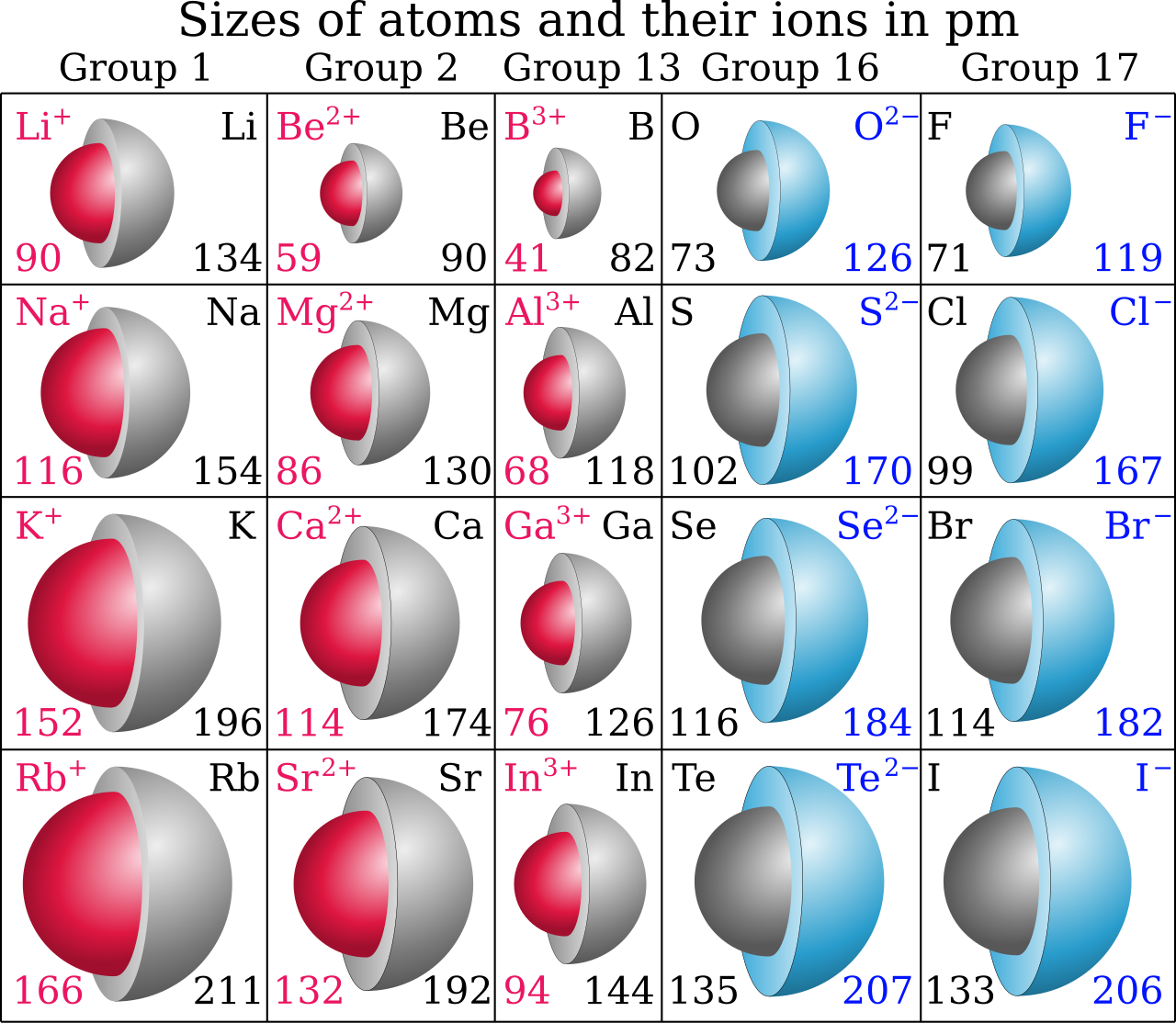
Reference chart comparing neutral-atom radii with cation (red) and anion (blue) radii, with values labeled in picometers. It helps students visualize the systematic size decrease when forming cations (greater effective attraction per electron) and size increase when forming anions (greater electron–electron repulsion and reduced effective pull). Source
It is useful when comparing ions in a group or within a set of ions that all contain the same number of electrons. Although ions do not have perfectly sharp edges, chemists can still compare their relative sizes very effectively.
Ionic radius: The size of an ion, usually treated as the distance from the nucleus to the outer region of its electron cloud.
The size of an ion depends mainly on three ideas:
the number of occupied electron shells
the amount of shielding from inner electrons
the nuclear charge, which is the attraction from the protons in the nucleus
A larger number of shells usually means a larger ion, because the outer electrons are farther from the nucleus. Greater shielding reduces the pull of the nucleus on outer electrons. A greater nuclear charge increases the attraction and pulls electrons closer, making the ion smaller.
Trend in ionic radius down a group
When comparing ions down a group, ionic radius increases.
For example, in Group 1 the order is:
This happens because each ion lower down the group has:
an extra occupied shell
outer electrons farther from the nucleus
more shielding from additional inner shells
Why the radius increases
Even though the nuclear charge also increases down a group, the extra shell has a bigger effect than the increased proton number. The outer electrons are in a higher energy level and experience less effective attraction to the nucleus.
A strong exam explanation should include these points:
the ion lower in the group has more electron shells
this places the outer electrons at a greater distance
increased inner-shell electrons cause more shielding
so the nuclear attraction on the outer electrons is weaker, giving a larger ionic radius
This trend is seen clearly when comparing ions with the same charge. For example, is larger than because has one more occupied shell. The same logic applies to negative ions down a group as well.
Trend across an isoelectronic series
A particularly important comparison is across a set of isoelectronic ions.
Isoelectronic ions: Ions that have the same number of electrons.
When ions are isoelectronic, they all have the same electron arrangement, so the main difference between them is the number of protons in the nucleus. This makes it easier to see the effect of nuclear charge on ionic radius.
Across a set of isoelectronic ions, ionic radius decreases as nuclear charge increases.
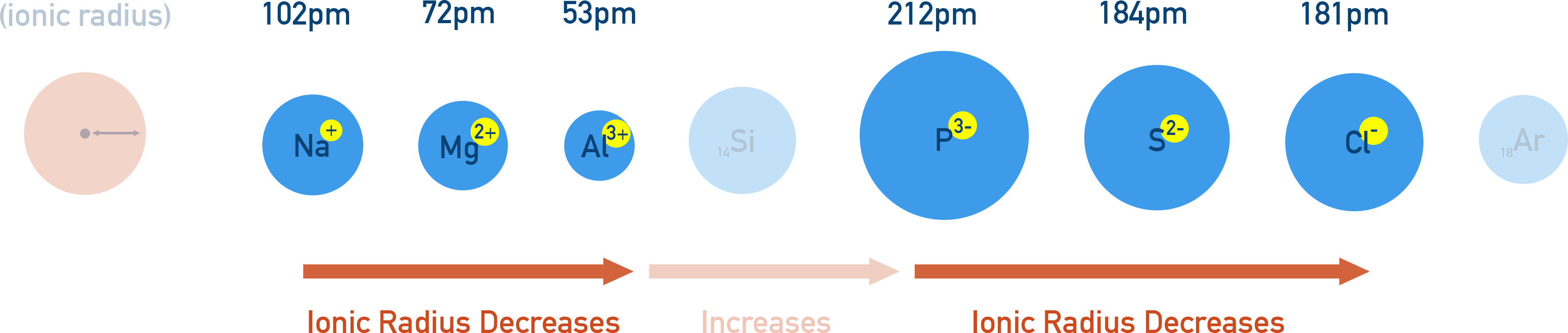
Diagram of Period 3 ionic radii showing decreasing in size, followed by a jump to larger anions (e.g., , , ). The shrinking cation trend illustrates how increasing nuclear charge with the same electron configuration pulls electrons closer and reduces ionic radius. Source
The ions all have the same number of shells and similar shielding, but the nucleus contains more protons from one ion to the next. That stronger attraction pulls the same electron cloud closer to the nucleus.
Example: to
The ions
are all isoelectronic because each has 10 electrons.
Their ionic radii decrease in this order:
The reason is that the number of protons increases from 7 in nitrogen to 13 in aluminum. Since the electron number stays the same, the increasing positive charge in the nucleus pulls those electrons inward more strongly.
So:
ions with fewer protons in the series are larger
ions with more protons in the series are smaller
This is why is the largest ion in the set and is the smallest.
You can also think about this in terms of overall charge. In an isoelectronic series, ions that are more negative tend to be larger, while ions that are more positive tend to be smaller. However, the best explanation is still based on increasing nuclear charge with the same number of electrons.
How to explain these trends in exams
When explaining ionic radius trends, be precise with your wording.
For ions down a group, say:
more occupied shells
greater distance from the nucleus
more shielding
therefore larger ionic radius
For isoelectronic ions across a series, say:
same number of electrons
same number of shells
similar shielding
increasing nuclear charge
therefore electrons are pulled closer and the ionic radius decreases
Common mistakes to avoid:
saying the radius decreases across an isoelectronic series because of more shielding
forgetting to mention that the ions have the same number of electrons
describing the trend down a group only in terms of proton number, without mentioning extra shells
Practice Questions
Explain why has a larger ionic radius than .
(2 marks)
has one more occupied electron shell than / electrons are farther from the nucleus. (1)
There is greater shielding in , so the outer electrons are held less strongly / the ionic radius is larger. (1)
The ions , , , , , and are isoelectronic.
(a) State what is meant by the term isoelectronic.
(1 mark)
(b) Write these ions in order of decreasing ionic radius.
(1 mark)
(c) Explain the trend in ionic radius across this set of ions.
(3 marks)
(a)
Same number of electrons. (1)
(b)
(1)
(c)
All ions have the same number of electrons / same electron arrangement. (1)
Nuclear charge increases across the series / proton number increases from to . (1)
Greater attraction between nucleus and electrons pulls the electron cloud closer / ionic radius decreases. (1)
FAQ
Ionic radius is not measured as a simple fixed edge, because an ion’s electron cloud fades out gradually rather than ending sharply.
Values can vary because:
different methods are used to estimate the radius
the ion may be in different crystal environments
some data sets assume different coordination numbers
So the exact value may change slightly, but the overall trends are still reliable.
The quoted radius of an ion often depends on how many oppositely charged ions surround it in a crystal.
If an ion is surrounded by more neighbors, the arrangement can slightly change the average distance between nuclei. That leads to a slightly different calculated ionic radius.
This is why radius values should be compared carefully, using data obtained under similar conditions.
$Al^{3+}$ is small because it has:
only two occupied shells
a relatively high proton number
a $3+$ charge
That means its electrons are pulled in very strongly, giving it a high charge density.
High charge density helps explain why $Al^{3+}$ often behaves differently from larger, lower-charge metal ions.
Isoelectronic ions remove one major variable: electron number.
Because each ion has the same number of electrons, differences in size can be linked much more directly to differences in proton number and nuclear attraction.
This makes isoelectronic series a very clear way to see how increasing nuclear charge causes ionic radius to shrink.
Yes. Similar ionic radii can occur when different factors balance each other.
For example:
one ion may have more protons
but it may also have electrons in a higher shell
or the ions may come from different parts of the periodic table
That is why chemists do not judge ionic size from charge alone. Electron arrangement and nuclear charge both matter.

