

CIE Syllabus focus:
'Understand hydrogen bonding in substances such as water, liquid ammonia and liquid hydrogen fluoride, and predict its presence in analogous molecules.'
Hydrogen bonding is a particularly important intermolecular force in a small group of molecules. Recognizing when it occurs helps explain why some simple substances behave differently from other molecules of similar size.
Nature of hydrogen bonding
In the substances named in this topic, hydrogen bonding acts between molecules. It arises when a very polar bond places a strong partial positive charge on hydrogen, which is then attracted to a lone pair on a nearby molecule.
Hydrogen bonding: A strong intermolecular attraction between a hydrogen atom covalently bonded to nitrogen, oxygen, or fluorine and a lone pair of electrons on a nitrogen, oxygen, or fluorine atom in a neighboring molecule.
Hydrogen bonding is stronger than ordinary permanent dipole-dipole attraction, but weaker than a covalent bond.
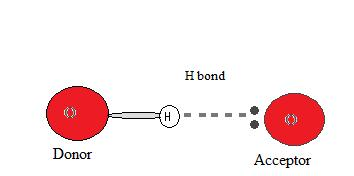
Generic hydrogen-bond schematic showing a hydrogen-bond donor (X–H) interacting with a lone pair on an acceptor atom. This emphasizes the key structural requirement: a polarized H attached to an electronegative atom and a neighboring lone pair that acts as the acceptor site. Source
This means it can have a major effect on physical properties without changing the covalent bonds inside each molecule.
Why nitrogen, oxygen, and fluorine are required
Hydrogen bonding is seen when hydrogen is bonded to N, O, or F because these atoms are:
highly electronegative, so the bonding electrons are drawn strongly toward them
small, so the positive hydrogen can approach a lone pair on a neighboring molecule closely
atoms that possess lone pairs, allowing the intermolecular attraction to form
A hydrogen atom attached to a less electronegative atom usually does not form hydrogen bonds strong enough to be considered significant at this level. For example, does not show hydrogen bonding in the same way as .
Hydrogen bonding in the named substances
Water
In water, each molecule contains two O-H bonds and two lone pairs on oxygen. The hydrogen atoms are strongly , and the oxygen atom is . A hydrogen atom from one water molecule is attracted to a lone pair on the oxygen of another water molecule.
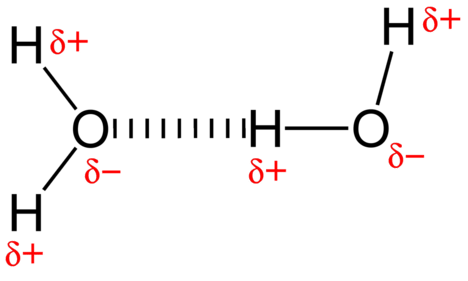
Diagram of hydrogen bonding between two water molecules: the hydrogen on one molecule is attracted to a lone pair on the oxygen of a neighboring molecule. The dotted line represents the hydrogen bond (an intermolecular attraction), not a covalent bond. Source
Because each water molecule has:
two hydrogen atoms that can take part in hydrogen bonding
two lone pairs that can accept hydrogen bonds
a large network of hydrogen bonds can form in liquid water. This extensive intermolecular bonding helps explain why water molecules are held together much more strongly than would be expected from their small size alone.
Liquid ammonia
In liquid ammonia, hydrogen bonding also occurs because ammonia molecules contain N-H bonds and a lone pair on nitrogen. The hydrogen bonded to nitrogen is sufficiently positive to attract a lone pair on a neighboring ammonia molecule.
Hydrogen bonding in ammonia is usually described as less extensive than in water because:
nitrogen is less electronegative than oxygen
each ammonia molecule has only one lone pair
the overall pattern of intermolecular bonding is less complete
Even so, hydrogen bonding is still important in explaining why liquid ammonia has stronger intermolecular attractions than similar molecules that cannot hydrogen bond.
Liquid hydrogen fluoride
In liquid hydrogen fluoride, the H-F bond is very polar because fluorine is extremely electronegative. This gives a strong attraction between the hydrogen of one molecule and a lone pair on fluorine in another molecule.
Hydrogen bonding in is especially significant because fluorine is both very electronegative and very small. As a result, molecules are strongly associated with one another in the liquid state.
Predicting hydrogen bonding in analogous molecules
A simple test
To predict whether a substance shows hydrogen bonding, check for both of these features:
a hydrogen directly bonded to N, O, or F
a lone pair on N, O, or F in a neighboring molecule
If both conditions are met, hydrogen bonding is likely.
This is why molecules such as alcohols with O-H bonds and amines with N-H bonds can form hydrogen bonds. The same logic used for water, ammonia, and hydrogen fluoride can be applied to these analogous molecules.
Common mistakes in identification
Students often overpredict hydrogen bonding. A molecule does not form hydrogen bonds just because it contains hydrogen and a very electronegative atom somewhere in the formula. The hydrogen must be directly attached to nitrogen, oxygen, or fluorine.
Keep these points clear:
does not hydrogen bond because hydrogen is bonded to carbon, not to N, O, or F.
does not show significant hydrogen bonding because chlorine is larger and less effective than fluorine at producing this strong attraction.
Molecules with O-H, N-H, or F-H bonds are the key cases to recognize quickly.
In diagrams, a hydrogen bond is often shown as a dotted line from the hydrogen atom to the atom carrying the lone pair.
Practice Questions
Explain why hydrogen fluoride molecules can form hydrogen bonds with each other. (2 marks)
Hydrogen is directly bonded to fluorine / an atom of high electronegativity. (1)
A lone pair on fluorine of one molecule is attracted to the hydrogen of another molecule. (1)
Compare hydrogen bonding in liquid water and liquid ammonia, and explain why methane does not show hydrogen bonding. (6 marks)
Water contains O-H bonds. (1)
Oxygen has lone pairs, so a hydrogen in one water molecule is attracted to a lone pair on oxygen in another molecule. (1)
Ammonia contains N-H bonds and a lone pair on nitrogen, so hydrogen bonding also occurs in liquid ammonia. (1)
Oxygen is more electronegative than nitrogen, so the hydrogen bonding in water is stronger. (1)
Water forms a more extensive hydrogen-bonded network because each molecule has two O-H bonds and two lone pairs. (1)
Methane does not hydrogen bond because its hydrogen atoms are bonded to carbon, not to nitrogen, oxygen, or fluorine. (1)
FAQ
Yes, but only as a hydrogen bond acceptor, not as a donor.
A molecule with a lone pair on nitrogen, oxygen, or fluorine can attract a hydrogen bond from another molecule. For example, a ketone or ether oxygen can accept hydrogen bonds from water.
In a pure sample, though, molecules without O-H, N-H, or F-H bonds usually cannot hydrogen bond to each other.
Chlorine is less electronegative than fluorine and much larger.
That means:
the H-Cl bond is less strongly polarized
the partial positive charge on hydrogen is smaller
the distance between the hydrogen and a neighboring lone pair is greater
The attraction is therefore much weaker than the hydrogen bonding seen with N, O, and F, so it is not usually treated as significant hydrogen bonding at this level.
Yes. This is called intramolecular hydrogen bonding.
It happens when a molecule contains both:
a suitable hydrogen bond donor, such as O-H
a suitable lone pair acceptor positioned nearby
This can change the molecule’s shape and sometimes reduce how strongly it hydrogen bonds to other molecules. However, for the simple substances in this topic, the main focus is intermolecular hydrogen bonding between separate molecules.
Hydrogen bonds are strongest when the atoms involved are arranged close to a straight line.
A nearly linear arrangement allows the $\delta^+$ hydrogen to approach the lone pair in the most favorable way. This gives a stronger attraction than a bent or badly aligned arrangement.
In simple diagrams, this detail is often simplified, but the directional nature of hydrogen bonding helps explain why it can influence molecular arrangement so effectively.
Usually much less, because gas molecules are far apart and spend less time close enough to attract strongly.
In liquids, molecules are close together, so many hydrogen bonds can form at once. In gases, any hydrogen-bonded association is more temporary and far less extensive.
Under some conditions, small groups of molecules can still associate in the gas phase, but hydrogen bonding is generally most important when molecules are packed closely, especially in liquids.
