

CIE Syllabus focus:
'Explain how hydrogen bonding causes water's relatively high melting and boiling temperatures and makes ice less dense than liquid water.'
Water shows two unusual physical properties for such a small molecule: it melts and boils at unexpectedly high temperatures, and its solid form floats on its liquid form. Both effects come from hydrogen bonding.
Why water behaves unusually
Water is a small, simple molecular substance, so if its intermolecular forces were only weak London forces, its melting and boiling temperatures would be much lower. Instead, water is liquid at room temperature and changes state only after a comparatively large energy input. This makes water anomalous, meaning unusual compared with similar small molecules.
Hydrogen bond: A strong intermolecular attraction between a hydrogen atom bonded to a very electronegative atom and a lone pair on a neighboring electronegative atom.
In water, oxygen is very electronegative, so each O–H bond is strongly polar. The oxygen atom also has two lone pairs. As a result, one water molecule can attract nearby water molecules through hydrogen bonds. In the liquid, these attractions are constantly breaking and reforming, creating an extended network throughout the sample.
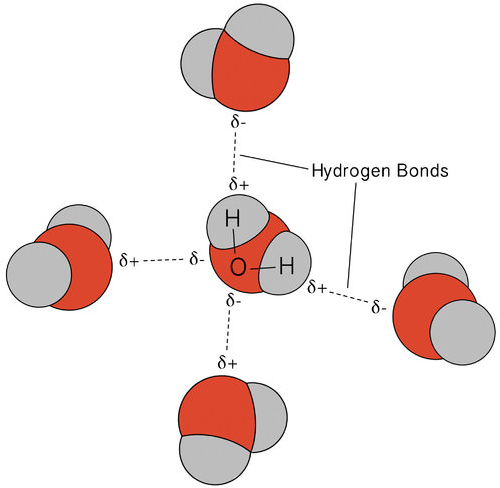
Multiple water molecules are drawn with partial charges (δ− on oxygen and δ+ on hydrogen) and dashed lines representing hydrogen bonds between molecules. The diagram emphasizes that each H2O can participate in several hydrogen bonds simultaneously, producing a connected network across the liquid. Source
A single water molecule can form several hydrogen bonds with surrounding molecules. This means the intermolecular attractions in water are much stronger overall than would be expected from its small size alone. These strong attractions are the key reason for both of the unusual properties named in the specification.
Hydrogen bonding and water’s high melting and boiling temperatures
Why extra energy is needed
When water melts or boils, the covalent bonds inside each H₂O molecule are not broken. Instead, energy is used to overcome the intermolecular forces between molecules.
In water, those intermolecular forces are hydrogen bonds.
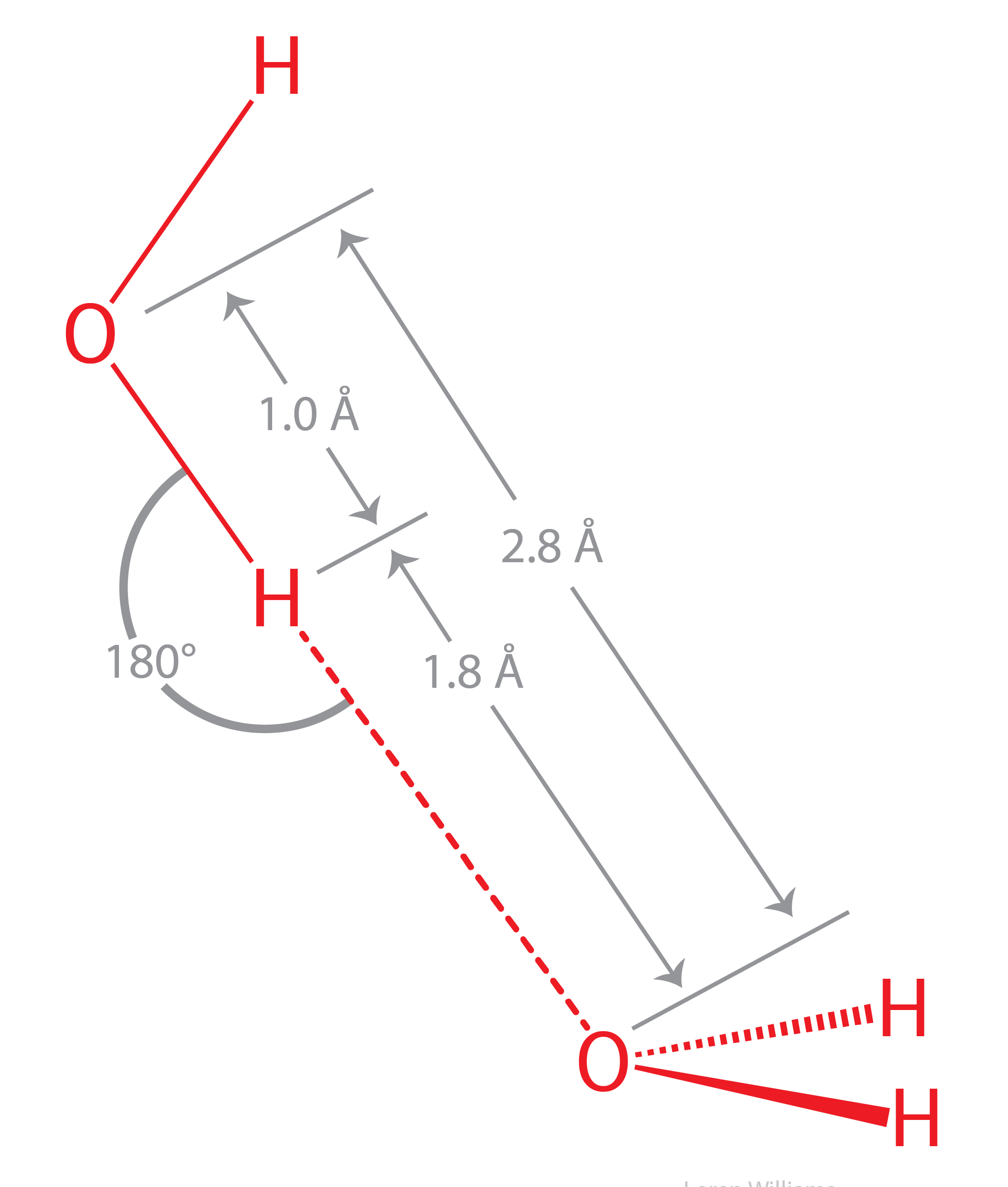
Two water molecules are shown with an O–H covalent bond and an O···H hydrogen bond drawn as a dashed line, highlighting that hydrogen bonding is an intermolecular attraction. The annotated distances (e.g., O···O separation) and near-linearity illustrate why hydrogen bonds are directional and relatively strong compared with ordinary dipole–dipole/London attractions. Source
Because hydrogen bonds are relatively strong, more energy must be supplied to separate the molecules than in many other simple molecular substances. This is why water has a relatively high melting temperature and boiling temperature.
For melting, some hydrogen bonds in the solid structure must be overcome so that the molecules are no longer fixed in place and can move past one another. For boiling, enough energy must be supplied for molecules to separate much more completely and enter the gas phase. Since this requires overcoming hydrogen bonding throughout the liquid, the boiling temperature is especially high for such a small molecule.
Why this is considered unusual
Most small molecules have low melting and boiling temperatures because only weak intermolecular attractions act between them. Water is different because hydrogen bonding is much stronger than ordinary London forces.
This means that:
water stays liquid over a much wider temperature range than might be expected from its molecular mass
much more energy is needed to change its state
its melting and boiling temperatures are relatively high compared with similar small molecules that cannot form such extensive hydrogen bonding
The important exam point is that strong intermolecular hydrogen bonds raise both temperatures by making the molecules harder to separate.
Why ice is less dense than liquid water
The structure of ice
In solid water, or ice, hydrogen bonds hold water molecules in a regular arrangement. Each water molecule is hydrogen-bonded to surrounding molecules in a way that produces an open lattice structure.
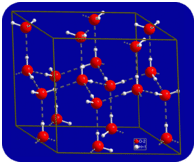
A repeating ice lattice is shown with water molecules arranged in a regular hydrogen-bonded network, illustrating the crystalline (ordered) structure of ice. The geometry makes visible the presence of gaps/voids in the solid lattice, helping explain why the same mass occupies a larger volume in ice than in liquid water. Source
This arrangement is important. The hydrogen bonds position the molecules so that there are spaces within the structure. As a result, the water molecules are held farther apart in ice than they are in liquid water.
Because the molecules are farther apart, the same mass of water occupies a larger volume when frozen. A larger volume for the same mass means a lower density. Therefore, ice is less dense than liquid water.
The structure of liquid water
In liquid water, hydrogen bonds are still present, but they are not arranged in a permanent regular lattice. They are continuously breaking and reforming as the molecules move.
Because the structure is less fixed, some water molecules can move into the spaces that would exist in the open ice lattice. This allows the molecules to pack more closely together than in ice.
Closer packing means that the same mass occupies a smaller volume, so liquid water has a higher density than ice. This is why ice floats on water.
Why water is unusual on freezing
For many substances, particles become more closely packed when the liquid freezes, so the solid is denser than the liquid. Water is unusual because hydrogen bonding creates a solid structure that is more open than the liquid structure.
So, when water freezes:
hydrogen bonds lock molecules into an open arrangement
the volume increases
the density decreases
That is the opposite of what happens in many other substances, which is why this property is described as anomalous.
Linking hydrogen bonding to both properties
The same type of intermolecular force explains both effects:
High melting and boiling temperatures: hydrogen bonds are strong, so a lot of energy is needed to overcome them.
Ice less dense than liquid water: hydrogen bonds in ice create an open lattice that keeps molecules farther apart.
Liquid water denser than ice: in the liquid, hydrogen bonds break and reform, allowing closer packing.
When answering exam questions, make the link clear between hydrogen bonding, molecular arrangement, and the resulting physical property.
Practice Questions
Explain why water has a relatively high boiling temperature. (2 marks)
Water molecules form hydrogen bonds. (1)
More energy is needed to overcome these strong intermolecular forces before the molecules can separate into the gas phase. (1)
Explain why ice is less dense than liquid water. Your answer should refer to hydrogen bonding and structure. (6 marks)
Ice contains hydrogen bonds between water molecules. (1)
In ice, water molecules are arranged in a regular lattice / open structure. (1)
Hydrogen bonding holds the molecules farther apart. (1)
There are spaces in the ice structure / the structure is less closely packed. (1)
In liquid water, hydrogen bonds break and reform / the structure is less fixed. (1)
Molecules can move closer together in the liquid, so liquid water has a greater density. (1)
FAQ
Down Group 16, boiling temperatures usually increase as molecules get larger because London forces get stronger.
Water is unusual because its boiling temperature is much higher than expected for such a small molecule. That happens because H₂O forms strong hydrogen bonds, while H₂S, H₂Se, and H₂Te do not form hydrogen bonding to the same extent.
As water cools from higher temperatures, the molecules move less and can pack more closely, so density increases.
Below about 4 °C, more local hydrogen-bonded ordering begins to develop. This starts to create extra open space, so the density decreases again as water approaches freezing.
No. In liquid water, hydrogen bonds are temporary.
They constantly:
break
reform
switch between neighboring molecules
This makes liquid water dynamic rather than rigid. Even though individual hydrogen bonds are short-lived, the overall network is strong enough to affect physical properties.
When water freezes, it forms the open ice structure, which takes up more volume than the liquid.
If water is trapped in a small space, this expansion creates pressure on the surroundings. Over time, that pressure can:
widen cracks in rocks
split containers
burst water pipes in cold weather
The common everyday form of ice, called ice Ih, is less dense than liquid water because of its open hydrogen-bonded structure.
However, at very high pressures, water can form other crystalline types of ice. Some of these high-pressure forms are denser than liquid water because their structures are packed more tightly.
